What's inside
As an Amazon Associate I earn from qualifying purchases. This post may contain affiliate links at no extra cost to you.
For laying out a long rip cut, a chalk line is usually the better tool. It can mark a straight line across an 8-foot sheet of plywood in seconds, costs little, and works without a long straightedge. A marking gauge is more precise in its proper role, but that role is marking a parallel line from an edge—not snapping a long line across a wide panel.
As an Amazon Associate we earn from qualifying purchases at no extra cost to you.


Our Top Picks
 IRWIN Tools STRAIT-LINE Chalk Line1 Count (Pack of 1)6.5 x 2.2 x 6.7 inches0.8 PoundsCheck on Amazon
 Milwaukee ELEC Tool 48-22-3986 Bold Line Chalk Reel2 Piece Set8.23 x 6.54 x 2.09 inches0.71 poundsCheck on Amazon


What Each Tool Is Designed to Do
A chalk line is a tensioned string coated with chalk. You pull it between two points, snap it against the work, and leave a visible reference. For a rip cut, those points are normally measurements taken from the same edge at both ends of the board or sheet.
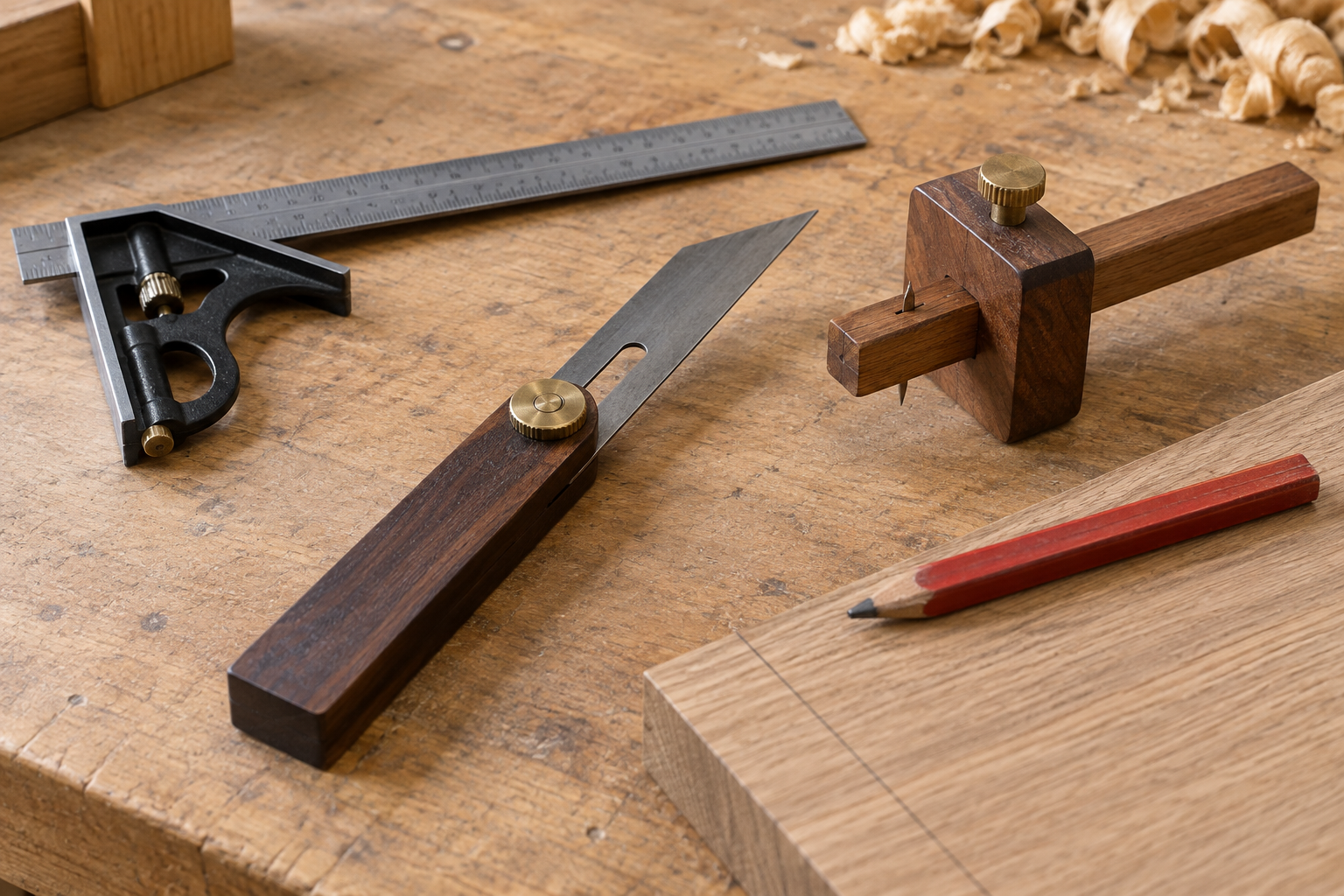
A marking gauge has a fence that rides against an edge and a cutter or pin that scribes the material at a fixed distance. Set it to 3 inches, for example, and it will mark a line exactly 3 inches from a board edge. That makes it valuable for joinery, trimming parts to a consistent width, and transferring dimensions around an edge.
The distinction matters: a chalk line references two measured points, while a marking gauge references one physical edge continuously. Neither is universally more accurate. They solve different layout problems.
Head-to-Head Comparison
| Category | Chalk line | Marking gauge |
|---|---|---|
| Best use | Long, straight layout lines | Short and medium lines parallel to an edge |
| Typical reach | 25 to 100 feet of line | Usually 4 to 8 inches of practical setup range |
| Speed on sheet goods | Very fast | Slow or impractical |
| Accuracy depends on | Measurement, string tension, and snapping technique | Fence accuracy and a consistent reference edge |
| Surface impact | Leaves a removable or semi-permanent powder line | Leaves a cut or scratch |
| Best material | Plywood, lumber, drywall, roofing and framing stock | Solid wood and joinery parts |
Accuracy on Long Rip Cuts
A chalk line is accurate enough for most circular-saw rip cuts when the line is laid out carefully. On an 8-foot sheet, a 1/16-inch error at one end can become a visibly tapered cut, but the chalk line itself is rarely the main cause. Bad reference measurements, a rounded factory edge, or allowing the string to sag are more common problems.
Measure from the same edge at both ends. Mark each measurement with a sharp pencil, then pull the line tightly through those marks. A 10-foot line should not have noticeable sag. Press the string down at the center and snap it once. Repeated snapping can make the line wider and less distinct, especially on dusty plywood.
For a finished cut, place the chalk line on the waste side and account for the saw blade. A typical circular saw blade removes about 1/8 inch, but the exact kerf varies. If the good side must finish at 24 inches, mark the layout line at 24 inches and keep the blade teeth on the waste side of that line. Do not center the blade on the mark unless the dimension calls for it.
Chalk is not a substitute for a guide rail. If the cut must be straight enough for a cabinet side, glue joint, or visible finished edge, use the chalk line to establish the layout, then clamp a circular saw straight-edge guide to the correct offset. A saw can wander several millimeters over a long freehand cut even when the chalk line is perfectly placed.
Where a Marking Gauge Wins
A marking gauge is better when the cut or scribe must remain a precise distance from an edge throughout its length. It does not depend on two end measurements, and it cannot gradually drift away from the edge unless the fence loses contact.
That makes it excellent for marking a shoulder, laying out a tenon, trimming a narrow board to a consistent width, or scribing a line before planing to it. The knife-style cutter on a quality gauge severs wood fibers cleanly and is easier to follow with a chisel than a fuzzy pencil line.
Its limitation is reach. Many gauges can be set farther than 8 inches, but their fences become awkward to control at larger settings. On a 24-inch-wide panel, you would need a long extension, a steady edge, and a way to keep the gauge square. At that point, a chalk line or straightedge is faster and usually more reliable.
A gauge also leaves a permanent scratch. That is useful when the line must survive handling, but risky on a finished surface. A slip can gouge the face, and a blunt cutter can crush fibers instead of making a clean reference. If you want to add this tool for joinery and smaller layout work, a woodworking marking gauge is the appropriate category—not a drywall or framing layout tool.
Chalk Selection and Failure Modes
Use blue or white chalk when the line must brush away easily. Red chalk is more visible and more resistant to weather, but it can stain porous wood and may show through paint or light finishes. Permanent chalk is a poor choice for interior cabinet parts unless the line will be removed by the cut.
Cheap chalk lines commonly fail because the string is too thin, the reel does not lock securely, or the line is overloaded with powder. Fill the reel only as directed; excess chalk can produce a line wide enough to hide the true blade position. Before a critical cut, test the reel on scrap and confirm that the hook is not bent.
Wind is another problem outdoors. A gust can move the string while you are trying to mark, particularly on a large sheet. Set the panel flat, secure the hook, and have a second person hold the far end if necessary. On a short, high-precision line, a 48-inch aluminum straightedge may be a better choice than either tool.
Which One Should You Buy?
Buy a chalk line first if your work includes plywood, construction lumber, flooring, drywall, decking, or any rip cut longer than roughly 4 feet. It is the inexpensive answer to long layout lines, and the cheaper option is entirely adequate for general construction. A basic carpenter’s chalk line is enough; spend more only for a tougher reel, a larger hook, or improved line visibility.
Choose a marking gauge if your work is mostly solid-wood joinery, furniture parts, and repeated edge-referenced dimensions. It costs more than a basic chalk reel and requires a sharp cutter, but it earns that cost when clean, repeatable scribe lines matter.
For most long rip-cut layouts, the practical setup is a chalk line for locating the cut and a saw guide for controlling it. A marking gauge is a specialist tool that becomes the better choice only when the edge—not two distant points—is the dimension you must preserve.