What's inside
As an Amazon Associate I earn from qualifying purchases. This post may contain affiliate links at no extra cost to you.
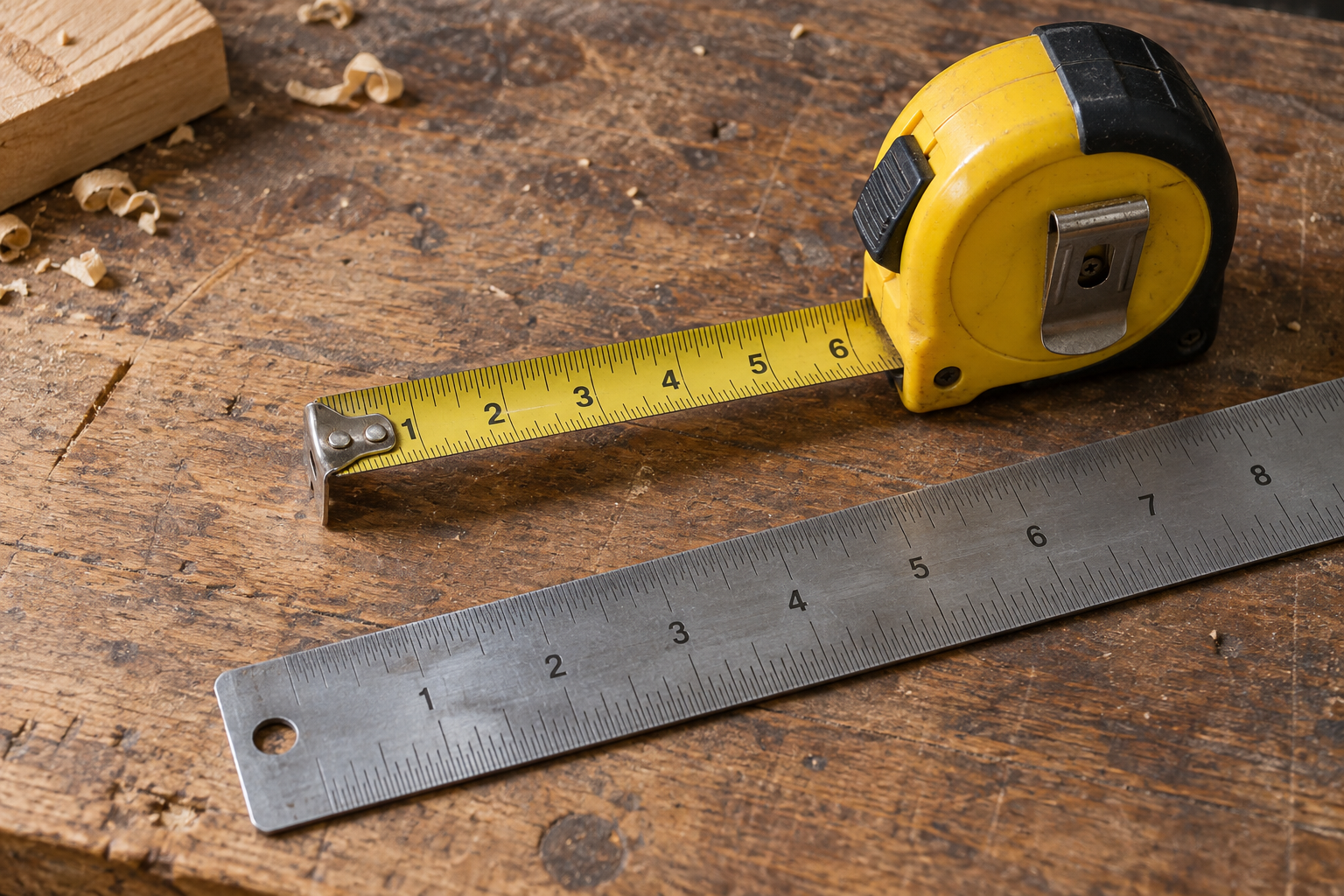
Cabinet scribe work is less about measuring long distances and more about transferring a wall, floor, or adjacent cabinet’s shape onto a workpiece. For that job, a folding rule is usually more accurate than a tape measure—but only when the measurement is short and the rule is kept square. A tape measure remains the better all-purpose tool and is often faster for rough layout, cabinet openings, and longer runs.
As an Amazon Associate we earn from qualifying purchases at no extra cost to you.



Our Top Picks


The short answer
Choose a folding rule for final scribe measurements on cabinet fillers, end panels, toe-kick pieces, and narrow trim. Its rigid sections do not bow, twist, or develop the loose hook movement common in tapes. Choose a tape measure for checking cabinet widths, measuring wall-to-wall distances, and transferring dimensions longer than about 6 feet.
Neither tool automatically makes a scribe accurate. The largest errors usually come from measuring from the wrong reference point, holding the tool at an angle, or cutting directly on a marked line without accounting for the blade’s thickness.
Tape measure vs folding rule for scribing
| Factor | Tape measure | Folding rule |
|---|---|---|
| Best working range | 1 to 25 feet or more | 1 to 6 feet, depending on length |
| Short-distance repeatability | Good, but affected by hook play and blade flex | Excellent when the joints are tight and the rule is held square |
| Working against an uneven wall | Awkward; the blade bows or lifts | Better; rigid sections can bridge small gaps |
| Reading inside corners | Convenient with the hook, but easy to misread | Requires careful placement and a clear reference edge |
| Speed | Fast for long measurements | Fast for short, repeated offsets |
| Common failure | Hook movement, blade bow, parallax, incorrect inside measurement | Loose hinges, worn ends, cumulative error at several folds |
Why folding rules often win on cabinet scribes
A folding rule gives you a rigid reference. If you need to mark a 3/8-inch scribe allowance along the edge of a filler, the rule can sit flat against the cabinet or wall while you transfer the distance with a pencil or marking knife. A tape blade tends to curve away from the surface, especially when the measurement is less than 12 inches.
That rigidity matters when the gap is irregular. Suppose a wall varies from 1/8 inch to 5/8 inch across a 30-inch filler. You can set the filler in place, open the folding rule to the largest gap, and mark each end or several intermediate points. A straightedge or compass can then connect those marks. A tape measure can provide the same numbers, but it is harder to keep the hook and blade in the same plane as the panel.
Folding rules also avoid one common tape problem: hook movement. The sliding hook on a tape is supposed to move by roughly its own thickness so inside and outside measurements share the same zero point. If the hook is bent, loose, or packed with dust, a nominal 1/16-inch error is easy to create. That is enough to leave a visible gap beside a cabinet.
For this work, a wooden folding rule for cabinetmaking with clear 1/16-inch markings is a sensible choice. Wood is comfortable against finished surfaces and does not conduct heat or cold like steel, though it must be kept dry.
When a tape measure is the better tool
A tape is the right choice for dimensions that exceed the folding rule’s reach. Use it to measure the cabinet run before cutting a filler, check the width of an appliance opening, or compare the left and right sides of an alcove. For a 92-inch wall, folding a rule through multiple positions introduces more opportunities for a hinge to open slightly or for the rule to shift.
A tape is also better when you need to record dimensions quickly. A quality 25-foot tape measure with 1/16-inch markings is enough for most cabinet installations. Look for a blade that stands out at least 8 feet, a hook that moves smoothly without excessive side play, and markings that remain readable in low light.
Do not treat the printed precision as real cutting accuracy. A tape marked in 1/16-inch increments does not mean you can reliably measure a crooked wall to the nearest 1/16 inch. The wall, cabinet, pencil line, and cutting process usually create more error than the graduations do.
A reliable scribing method
First, install or dry-fit the panel in its final position. Clamp it if possible. Do not measure the gap with the panel sitting on a workbench unless the bench represents the actual floor and wall conditions.
Next, find the largest gap. If the wall is 1/8 inch away at the top and 1/2 inch away at the bottom, set the scribe for 1/2 inch. Transfer that distance with a folding rule, scribing tool, or compass. Make several small reference marks rather than relying on one measurement at each end.
For a wall scribe, hold the panel plumb and run the scribing tool down the wall. Keep the tool’s point against the wall and its pencil or knife against the panel. A cabinet scribe tool with an adjustable offset is useful when the gap changes gradually. Cut just outside the line, then sneak up on it with a block plane, file, or sanding block.
After cutting, test-fit the panel again. A 1/32-inch gap may disappear after the panel is pushed tight, while a 1/16-inch gap can remain obvious on a painted cabinet. For visible end panels, aim for a tight fit but leave enough clearance that seasonal movement or a slightly out-of-plumb wall does not force the panel out of position.
Mistakes that make either tool inaccurate
Measuring diagonally across a gap is a frequent problem. The tool must be perpendicular to the edge or the reading will be too large. This is especially easy with a tape because the blade naturally swings into the corner.
Another mistake is measuring from the tape hook instead of the actual cabinet reference edge. Confirm the hook is seated fully, and measure twice from the same point. With a folding rule, inspect the hinges. If a joint has visible play, the rule may show 1/16 inch more or less every time it is opened.
Finally, distinguish between marking for removal and marking for the finished edge. If you mark the line that represents the wall and then cut on that line, the blade removes material from the good side. On a circular saw, place the cut line on the waste side and allow for the blade kerf; on a plane or sander, leave material to remove gradually.
Which one should you buy?
If you already own a decent tape measure, keep it for layout and add a folding rule when cabinet scribing becomes regular work. The folding rule is the cheaper specialty purchase and can improve short, controlled measurements more than upgrading to a larger or more heavily advertised tape.
If you only do one cabinet project, the cheaper option is fine: use your existing tape, measure from consistent reference points, and confirm the fit with a test piece. For repeated installations or furniture-quality panels, use both tools. The tape establishes the overall dimension; the folding rule handles the final offset where a small error is visible.
For the most demanding work, a precision folding rule with fine markings is the better measuring companion, but technique still matters more than the price tag. In cabinet scribe work, rigidity and repeatable contact beat theoretical measurement resolution.