What's inside
As an Amazon Associate I earn from qualifying purchases. This post may contain affiliate links at no extra cost to you.
For cabinet and trim work, the folding rule and tape measure solve different problems. A tape is quicker for long runs and awkward spans. A folding rule is steadier for short, repeated measurements and can stand out from a surface to measure depth. If you do both kinds of work, owning both is useful; if you want just one, choose based on the measurements you make most often.
As an Amazon Associate we earn from qualifying purchases at no extra cost to you.


Our Top Picks
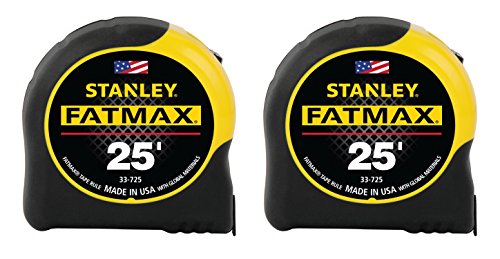 Stanley FMHT74038A FatMax 25 Foot Tape Measure 2PK7.6 m5.13 x 3.38 x 3.63 Inches1.2 PoundsCheck on Amazon


Quick comparison
| Task or feature | Folding rule | Tape measure |
|---|---|---|
| Long wall or cabinet runs | Awkward; usually needs a second person | Fast and convenient |
| Cabinet depth and inside openings | Rigid sections are easy to position | Blade can flex or buckle |
| Repeated short measurements | Easy to set and compare directly | Quick, but the blade can shift |
| One-person measuring | Limited reach | Usually easier, especially with a strong standout |
| Portability | Rigid and bulky in a pocket | Compact case clips to a belt or fits in a pouch |
Cabinet measurements: reach versus control
A tape measure is the practical choice for checking a cabinet run, measuring between walls, or laying out a long countertop. A 16- or 25-foot tape covers common kitchen dimensions without needing to reposition a rule every few inches. Its blade can also reach across an opening while you hold the case at one end.
The trade-off is that a tape blade bends. It can buckle when extended too far without support, and it may sag across a span. A tape’s advertised standout is a best-case figure, not a guarantee of accurate measuring in every position. For a long cabinet run, hook the end securely, keep the blade straight, and have another person read or hold it when possible. When measuring alone, take the reading with the blade supported rather than trusting a drooping extension.
A folding rule is better controlled for short cabinet dimensions: carcass depth, shelf spacing, toe-kick height, or the width of a narrow opening. Its stiff sections stay straight against a panel, so you can place it inside a cabinet without the blade curling away from the surface. Many rules have a sliding end piece for inside measurements. Check how that end is read, though: some designs require adding the length of the end piece, and a small reading error matters when fitting a panel to a tight opening.
Trim work: repeatability matters
For baseboard, casing, and small returns, either tool can give an accurate reading. The folding rule’s advantage is that it behaves like a rigid reference. You can mark several short lengths from the same edge, check a reveal, or compare a piece against an opening without holding a flexible blade under tension.
A tape is faster when you need to measure stock or a long wall before cutting. For repeated trim cuts, use the same measuring method each time. Hooking the tape over an edge, pushing it against the edge, and measuring from the case can produce slightly different readings. A worn or loose hook also shifts as it changes direction. The hook is designed to move by roughly its own thickness, but dirt, damage, or a loose rivet can make readings inconsistent. Check it against a known ruler before relying on it for close-fitting work.
Neither tool replaces a test fit. Walls and corners are rarely perfectly square, and trim ends may need scribing or adjustment. Measure the actual opening or piece you’re fitting, not just the nominal dimension on a plan.
Accuracy, durability, and common mistakes
For most cabinet and trim work, careful technique matters more than the tool’s printed accuracy. Read the scale straight on to avoid parallax, keep the rule or blade flush to the surface, and mark with a sharp pencil or knife. On an inside measurement, note whether the tool’s design accounts for the case or end piece. Confirm critical dimensions in a second way before cutting expensive material.
A folding rule has fewer delicate moving parts, but its hinges can loosen or collect dust, and a damaged section may no longer sit straight. Avoid forcing the joints past their stops. A tape is easier to carry and replace, but its blade can kink, the hook can loosen, and a bent blade may no longer retract cleanly. Don’t let the blade snap back uncontrolled; that can damage the hook or cut your fingers.
What to buy
If you mainly install cabinets, measure rooms, or work alone, start with a 25-foot tape measure. It gives useful reach for room layouts and cabinet runs. A 16-foot tape is lighter and often enough for small built-ins and trim jobs. Choose a case you can hold comfortably and a blade that stays extended far enough for your typical one-person measurements; don’t buy on standout claims alone.
If your work is mostly short, controlled measurements on cabinet parts and trim, a folding rule with an inside-measure end can be a useful primary tool. Check that its graduations are clear and that the joints open smoothly without wobble. It is not a good substitute for a tape when you regularly measure across several feet or need to work quickly by yourself.
For a small shop or a homeowner doing both cabinet and trim work, the sensible pairing is a tape for long dimensions and a folding rule for short, rigid checks. If you need to choose only one, buy the tape for versatility. The cheaper option is fine when its limitations match the job: a basic tape will handle occasional shelf or casing measurements, while a folding rule is a good buy if you rarely need long reach and value stable, direct placement.