What's inside
As an Amazon Associate I earn from qualifying purchases. This post may contain affiliate links at no extra cost to you.
The best universal socket set for everyday repairs is a compact pin-style set with a 7–19 mm metric working range, a 1/4-inch hex adapter, and a 3/8-inch square-drive adapter—but a conventional six-point socket set remains the better choice for high-torque, delicate, or badly damaged fasteners.
As an Amazon Associate we earn from qualifying purchases at no extra cost to you.



Our Top Picks



Best universal socket sets by situation
| Situation | Best choice | Useful specification | Why |
|---|---|---|---|
| Occasional household repairs | Single pin-style universal socket | 7–19 mm or 1/4–3/4 inch coverage; 3/8-inch adapter | Replaces several loose sockets in a drawer and handles common nuts, bolts, hooks, and eyelets. |
| Mixed metric and imperial hardware | Universal socket kit with both drive adapters | 6–32 mm claimed range; 1/4-inch hex and 3/8-inch square adapters | Useful when the fastener standard is unknown, especially on older equipment. |
| Frequent workshop use | Conventional six-point socket set plus one universal socket | Metric 8–19 mm, 3/8-inch drive; chrome-vanadium sockets | Normal sockets provide better torque transfer and last longer under repeated use. |
| Very limited storage | Compact universal socket with bit adapter | Approximately 50–70 mm long; under 250 g with adapters | One tool covers many sizes, although its length can restrict access in recessed holes. |
| Corroded or rounded fasteners | Dedicated six-point impact or bolt-extractor sockets | Correct individual size; impact-rated steel where applicable | Universal pins can slip, mark the fastener, or make a damaged head worse. |
What makes a universal socket different?
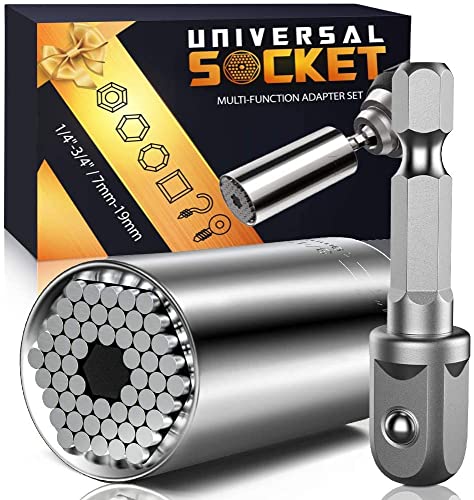
A universal socket uses spring-loaded hardened pins or small sliding elements. When placed over a nut, bolt head, hook, or irregular fitting, the pins retract around the outside shape and transmit turning force through the remaining contact points. That is why one socket can cover many metric and imperial sizes.
This flexibility is valuable for repairs where the size is unknown or where a fastener is non-standard. It is not the same as having every size in a conventional socket set. A six-point socket contacts the flats of a correctly sized hex fastener over a large area. A universal socket contacts fewer points and concentrates force through its pins, so it has less margin when torque is high.
Key buying criteria
1. Size coverage and actual access
Ignore the largest number printed on the package until you check how the range is achieved. A universal socket advertised as covering 6–32 mm may include several socket bodies, while a single compact model commonly covers approximately 7–19 mm or 1/4–3/4 inch. For household tasks, the smaller range usually covers furniture hardware, plumbing fittings, bicycle components, appliance fasteners, and automotive trim.
Check both the minimum and maximum usable size, not just the nominal range. Also measure the socket’s outside diameter and length. A universal socket can be wider than a normal socket because of its pin mechanism, preventing it from entering a narrow recess. Its longer body may also interfere with nearby panels or walls.
2. Grip on varied fasteners
Universal sockets are at their best on intact hex nuts and bolts, square fasteners, eyelets, hooks, and irregular external shapes. They can also turn some partially rounded fasteners, but this is a recovery function rather than a reason to apply unlimited force.
They are poor choices for low-profile fasteners, thin sheet-metal nuts, security fasteners, and anything with a delicate plated finish. The pins need enough surrounding material to retract and support one another. A protruding stud, washer, or nearby obstruction can stop the socket from seating fully.
3. Materials and drive strength
Look for chrome-vanadium steel for the socket body and hardened steel pins. A chrome finish helps resist corrosion and makes the tool easier to clean, but it does not make a universal socket suitable for impact work. Unless the manufacturer specifically marks the socket and adapter as impact-rated, use a hand ratchet only.
Adapters are often the weakest part of a low-cost kit. A useful package may include a 1/4-inch hex-shank adapter for a drill or bit driver and a 3/8-inch square-drive adapter for a ratchet. Some kits also include a 1/2-inch adapter. More adapters increase versatility, but they also add length and another joint that can twist or loosen.
4. Retention and maintenance
The pins should move smoothly, return evenly, and remain captive when the socket is turned upside down. A gritty or uneven mechanism is a warning sign. Avoid forcing a universal socket onto a fastener that is too large; doing so can jam individual pins and permanently reduce the working range.
After use, brush away metal filings and wipe the socket dry. A small amount of light machine oil on the pin mechanism can help prevent corrosion, but excess oil attracts grit. Do not hammer a non-impact universal socket onto a fastener.
Head-to-head: universal socket versus conventional socket set
| Characteristic | Universal pin socket | Conventional six-point socket |
|---|---|---|
| Typical size coverage | About 7–19 mm per compact socket; wider kits may claim 6–32 mm | One socket per size, commonly 8–19 mm in a household metric set |
| Fastener shapes | Hex, square, some hooks, eyelets, and irregular external shapes | Correctly matched hex fasteners; best contact on standard hardware |
| Torque handling | Moderate hand-tool torque only unless specifically rated otherwise | Higher and more predictable torque transfer |
| Risk to hardware | Can mark finishes or slip on damaged edges | Low when correctly sized; six-point designs reduce corner rounding |
| Storage efficiency | Excellent: one or two bodies replace many sizes | Requires a rail, case, or drawer for the full range |
| Best use | Unknown sizes, occasional repairs, awkward shapes | Repeated assembly, rusted hardware, machinery, and high-torque work |
Recommended set types
Best compact option: one 3/8-inch-drive pin socket
Choose this type when the main goal is saving space. A 7–19 mm socket with a 3/8-inch adapter covers many everyday repairs, and a 1/4-inch hex adapter allows use with a cordless drill at low torque. It is a practical addition to a home toolbox, but it should not replace a ratchet and correctly sized sockets for furniture assembly or vehicle repairs where fasteners need controlled tightening.
Best mixed-hardware option: a multi-piece universal kit
A kit with two socket bodies, usually a smaller body for approximately 7–19 mm and a larger body for approximately 11–32 mm, is more flexible when working on farm equipment, older machinery, or imported and domestic hardware. Prefer a kit that includes clearly marked adapters and a case that prevents the pins from contacting loose metal debris.
Best workshop option: conventional set with one universal backup
For regular woodworking, maintenance, or mechanical work, buy a conventional metric set first. A 3/8-inch-drive, six-point set covering 8–19 mm is a useful baseline. Add a universal socket for unknown or unusual fittings. This combination costs more than a single universal tool but avoids using the flexible socket where precision and torque matter.
How to use one without damaging hardware
- Clean the fastener. Remove sawdust, paint flakes, and loose rust so the socket can seat fully.
- Choose the smallest suitable socket. A smaller body gives the pins more support and usually provides better control.
- Press straight down. Do not begin turning while the socket is tilted. Rock it gently until the pins conform to the fastener.
- Start with hand pressure. Use a short ratchet or screwdriver handle first. If the socket slips, stop and change tools.
- Switch to a dedicated socket for final tightening. Especially on structural joints, bicycle components, machinery, or fasteners with a specified torque.
- Inspect the pins afterward. Bent, stuck, or uneven pins mean the socket should be cleaned or replaced.
Durability and ownership costs
The first parts to wear are usually the small pins, their springs, and the adapter’s square-drive detent. Repeated use on sharp-edged fasteners can flatten pin ends. Dirt inside the mechanism can prevent full retraction, while excessive leverage can distort the socket body or adapter.
For occasional use, a universal socket costing roughly $10–$25 may be economical. Suppose it handles 20 household repairs over five years: at $15, the tool costs about $0.75 per repair. A $30–$60 multi-piece kit becomes easier to justify when it prevents several separate purchases or is used across dozens of unknown-size fasteners. For frequent work, however, the lower cost per use comes from conventional sockets because they tolerate repeated torque better and are less likely to damage expensive hardware.
Bottom line
Choose the best universal socket set by matching its coverage to your real fasteners, not by choosing the kit with the biggest advertised range. A compact 7–19 mm pin socket is the most useful everyday supplement; a two-socket 6–32 mm-style kit suits mixed and irregular hardware; and a conventional six-point set remains the dependable primary choice for repeated or high-torque work. Universal sockets solve uncertainty and storage problems well, but they are not a substitute for correct sizing on damaged, delicate, or safety-critical fasteners.