What's inside
- The best complete socket set depends on the fasteners you work with: choose one that covers metric and SAE, shallow and deep sockets, more than one drive size, and stores each piece where you can find it.
- Compare coverage before comparing piece counts
- Choose by the jobs your toolbox actually needs to cover
- A practical coverage check before purchase
- Fit, drive size, and tool limits
- Where durability shows up after purchase
- Bottom line
- Related Guides
As an Amazon Associate I earn from qualifying purchases. This post may contain affiliate links at no extra cost to you.
Our Top Picks
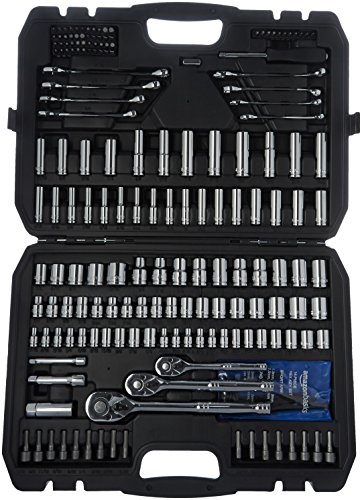 Amazon Basics 201-Piece Mechanic's Socket Tool Set With201 Piece17.7 x 13 x 3.53 inches16.49 poundsCheck on Amazon


The best complete socket set depends on the fasteners you work with: choose one that covers metric and SAE, shallow and deep sockets, more than one drive size, and stores each piece where you can find it.
For a general home, garage, or woodworking toolbox, the best complete socket set is usually a well-organized set with 1/4-inch and 3/8-inch drive, both measurement systems, shallow and deep sockets, extensions, and a useful selection of bits. A large piece count alone is a poor measure of coverage: duplicate sizes, oversized accessories, or missing deep sockets can leave practical gaps.
Use the comparison below as a checklist rather than a ranking. Exact contents vary by set and by revision, so check the manufacturer’s current inventory before buying; the ranges shown are useful coverage targets, not claims that every set in a category contains every size.
As an Amazon Associate we earn from qualifying purchases at no extra cost to you.



Compare coverage before comparing piece counts
| Set type | Useful drive coverage | Socket coverage to look for | Best fit | Main trade-off |
|---|---|---|---|---|
| Compact starter set | 1/4 in. and 3/8 in. | About 5–14 mm and 3/16–9/16 in.; shallow sockets, selected deep sockets, extensions, bits | Small toolbox, occasional household repairs | May omit larger fasteners and some deep sizes |
| General-purpose mechanics set | 1/4 in., 3/8 in., and often 1/2 in. | About 4–19 mm and 5/32–3/4 in.; shallow and deep coverage across common sizes | Mixed household, vehicle, and workshop jobs | More space and weight; verify which sizes are duplicated or missing |
| Large mixed set | 1/4 in., 3/8 in., and 1/2 in. | Often extends to 22–24 mm and 7/8–1 in.; multiple socket depths, bits, and adapters | Frequent repairs and a shared workshop | High piece count can conceal thin coverage in a particular drive or system |
| Dedicated 1/2-inch set | 1/2 in. | Commonly larger metric and SAE sockets, often with deep options | Large nuts and bolts where extra leverage is useful | Not a substitute for small sockets or delicate, low-torque work |
Choose by the jobs your toolbox actually needs to cover
For home repairs and woodworking machinery
Choose a compact 1/4-inch and 3/8-inch set if you mainly assemble equipment, adjust jigs, service clamps, or handle small household fasteners. Prioritize a complete run of common metric sizes, a useful SAE range if you own older equipment, and extensions that reach recessed nuts. For woodworking machines, avoid assuming every adjustment uses a socket: some need hex keys, screwdrivers, or specialty wrenches.
For one set to share across a household and garage
A three-drive set is the more versatile choice. The small drive handles lighter work, 3/8-inch covers many everyday fasteners, and 1/2-inch accommodates larger sockets. Look for shallow and deep sockets in both metric and SAE, but inspect the size list by drive: a set can advertise all three drive sizes while supplying only a few 1/2-inch sockets.
For an established toolbox with known gaps
Buy a focused socket set instead of another oversized collection. If your existing 3/8-inch set already covers common sizes, a 1/2-inch set may add more value than a duplicate assortment. Likewise, buy a separate deep-socket rail if the main set is strong on shallow sockets but weak on access over long studs.
For limited storage or occasional use
Favor a compact case with clearly marked, dedicated positions over a high piece count. A set is only useful if sockets stay with their labels and the lid or latch survives being carried. If space is tight, prioritize 1/4-inch and 3/8-inch drives and add larger sockets only when a real job calls for them.
A practical coverage check before purchase
- List both systems separately. Confirm the actual metric and SAE socket sizes; a dual-system label does not guarantee a complete range in both.
- Check shallow and deep coverage. Deep sockets reach nuts on protruding studs, while shallow sockets fit better where clearance is limited. Check which sizes are available in each depth.
- Inspect the drive-size breakdown. Confirm the included ratchets, sockets, extensions, and adapters—not just the number of drive sizes mentioned in the title.
- Look for useful accessories. A short and a longer extension, a universal joint, and a bit adapter often help more than many duplicate bits. Bits should match the fasteners you expect to encounter.
- Check the socket profile and markings. Six-point sockets generally provide more contact on a hex fastener; clear size markings make selection easier. If you need to work on damaged or rounded fasteners, consider a dedicated extraction set.
- Inspect the case layout. Each piece should have a labeled home, with enough retention to prevent sockets from scattering during transport. A bulky case that is difficult to store can undermine an otherwise good set.
Fit, drive size, and tool limits
Metric and SAE sizes are not interchangeable just because some are close. For example, 10 mm is approximately 0.394 inch, while 3/8 inch is 0.375 inch—a difference of about 0.48 mm. That may seem small, but a loose fit can round a fastener, particularly when it is tight or corroded. Use the correctly fitting socket rather than forcing a near-match.
Drive size is also a strength and access choice, not simply a socket-size label. A 1/4-inch drive is compact and suited to lighter work; 3/8-inch is a useful middle ground; 1/2-inch is intended for larger sockets and higher loads. Do not use a ratchet extension as a substitute for a torque wrench when a specified tightening torque matters, and avoid using ordinary chrome sockets with an impact wrench. Impact-rated sockets are designed for that work.
Where durability shows up after purchase
In ordinary use, ratchet mechanisms and case latches often become the first annoyances: a ratchet may develop a rough feel or stop reversing reliably, while a weak latch can let tools spill in transit. Bits are another likely wear item, especially if used in a powered driver or on stubborn fasteners. Keep replacement bits and specialty adapters separate if the set’s case does not secure them well.
Wipe sockets dry after use, particularly after contact with moisture or shop chemicals, and return them to their labeled positions. This limits rust and makes missing sizes obvious. Do not use a ratchet handle as a breaker bar or add a pipe for leverage; that can damage the mechanism. For a seized fastener, use an appropriate breaker bar and the correct socket instead.
Bottom line
For broad, everyday coverage, choose a 1/4-inch, 3/8-inch, and 1/2-inch set only if its inventory actually includes useful metric and SAE ranges, shallow and deep options, extensions, and secure storage. For a smaller toolbox, a well-chosen 1/4-inch and 3/8-inch set is often the better buy. Match the size list to your fasteners and the case to the way you work; those details matter more than the headline piece count.