What's inside
- Best Socket Organizers for Tool Boxes: Choose by Drawer, Drive Size, and How You Work
- Rails vs. trays vs. locking cases
- Choose by your tool-box situation
- What to look for in each type
- Check drawer fit before ordering
- Drive size and socket capacity: avoid buying the wrong layout
- Durability and ownership details
- Bottom line
- Related Guides
As an Amazon Associate I earn from qualifying purchases. This post may contain affiliate links at no extra cost to you.
Our Top Picks
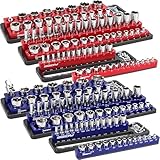
 Magnetic Socket Holder Organizer Set: 9-Piece Detachable 1/41/2,1/4,3/816.5 x 1.18 x 7.68 inches5.3 poundsCheck on Amazon


Best Socket Organizers for Tool Boxes: Choose by Drawer, Drive Size, and How You Work
The best socket organizer for tool box use depends on whether you value compact storage, quick access, or keeping sockets in place while carrying the box: choose rails for a shallow, flexible setup, trays for the clearest drawer layout, and a locking case for secure transport.
Before buying, check three measurements: the drawer’s usable height with the lid closed, its interior width and depth, and the overall length of your largest sockets. Then decide whether you need separate organizers for 1/4-, 3/8-, and 1/2-inch drive, or one system that covers all three.
As an Amazon Associate we earn from qualifying purchases at no extra cost to you.



Rails vs. trays vs. locking cases
| Organizer type | Typical capacity | Common size and fit | Hold when moved | Best for |
|---|---|---|---|---|
| Socket rail | 10–16 sockets per rail | About 8–18 in. long; low profile, but sockets stand upright | Fair to good; depends on clip tension and socket weight | Compact drawers, adding or rearranging sockets |
| Socket tray | 20–60 sockets per tray | Often about 10–18 in. long and 6–12 in. wide; needs a flat drawer area | Fair; sockets can lift or tip if the tray is turned or carried | At-a-glance organization and frequent bench use |
| Locking case | About 20–100 sockets, depending on case | Usually bulkier and taller than a rail; check closed height against drawer clearance | Very good when latches and socket retainers are engaged | Mobile tool kits and sockets that travel between jobs |
These are practical size ranges, not guarantees for every product. Capacity varies with drive size, whether the organizer is for shallow or deep sockets, and whether it holds metric, SAE, or both. A tray advertised for a large number of sockets may use multiple rows or separate sides, so compare its actual footprint with your drawer—not just the socket count.
Choose by your tool-box situation
| Your situation | Best fit | Why |
|---|---|---|
| Shallow drawer or tight budget | Rails | Low-profile rails are easy to split between drawers and usually cost less than a full tray system. |
| Mostly stationary workshop; want sizes visible | Trays | Rows make gaps and missing sockets easy to spot, and the whole set can be lifted to a workbench. |
| Tool box regularly rides in a vehicle | Locking case | A closed case limits spills if the box tips or is carried over uneven ground. |
| Mixed brands, sizes, or growing socket collection | Rails or modular trays | They are easier to expand or rearrange than a fixed molded case with sockets assigned to specific recesses. |
| Deep sockets and several drive sizes | Separate drive-specific rails or a tall case | Separate groups reduce crowding; confirm deep-socket clearance and closed-case height before buying. |
What to look for in each type
Rails: compact and adaptable
A rail usually has a metal or plastic spine with rotating clips sized for a particular drive. The clips let you turn a socket for easier removal, and some rails can be cut or joined to fit a drawer. Check that the clips match your drive size: a 3/8-inch rail is not a universal holder for 1/4- and 1/2-inch sockets.
Retention varies. A snug clip keeps a socket from sliding during normal drawer use, but a rail is not automatically spill-proof when carried upside down. Heavy impact sockets can also overwhelm a loose or worn clip. If portability matters, test the fit with your heaviest sockets before loading the full set.
Trays: fastest visual inventory
Trays organize sockets into labeled or numbered rows, often divided by drive size and measurement system. They are a good match for a wide drawer because you can see what is missing without lifting each organizer. Some have molded wells that hold sockets securely; others mainly keep them separated and rely on gravity.
Measure the full footprint, including handles or raised edges. A tray that fits an open drawer can still prevent it from closing if it catches on the drawer lip or sits too high. For a crowded toolbox, two narrow trays may fit better than one wide one and be easier to lift out.
Locking cases: best for transport
A case adds latches and usually a dedicated recess for each socket. That combination is the most dependable choice for a mobile kit, especially when sockets share space with other tools. The tradeoff is bulk: the case takes up room even when partly empty, and fixed layouts can be awkward when your socket collection changes.
Inspect how the sockets are retained, not just whether the case has a latch. A latch keeps the lid shut; it does not stop a loose socket from falling out of its holder inside. Check that the lid closes over your tallest deep sockets and that the case’s drive-size layout matches what you own.
Check drawer fit before ordering
Use the drawer’s interior measurements rather than the toolbox’s advertised dimensions. Measure between the sides, from the back to the inner face of the front, and from the drawer floor to the lowest obstruction when closed. Leave roughly 1/2 inch of width and depth clearance where possible so an organizer does not bind against a slightly uneven drawer or catch when pulled out.
For height, measure the tallest socket while it is mounted on the organizer. A low-profile rail can still be too tall once a deep socket is attached. If the drawer has a liner, include its thickness in the usable height measurement.
Example: If a drawer measures 20 inches wide by 16 inches deep, and you reserve 1/2 inch around the organizer, aim for a combined layout no larger than about 19 by 15 inches. Two 9-inch rails placed side by side may work better than a single 18-inch tray if the drawer has a divider or handle intrusion. Check the layout in the drawer before loading every socket.
Drive size and socket capacity: avoid buying the wrong layout
Organizers are commonly sold for 1/4-, 3/8-, and 1/2-inch drives. These are the square-drive sizes, not the socket’s hex size. A useful setup groups sockets by drive, then separates metric from SAE if you use both. This prevents a crowded row of similar-looking sockets from becoming slower to search than a loose drawer.
Count the sockets you actually want to store, including shallow and deep versions. For example, 12 metric and 12 SAE sockets in one drive size already require 24 positions if you keep each set together. Add deep sockets and you may need a second rail or a larger tray. Buy for the complete working set, not the headline capacity: empty positions are helpful for expansion, but a holder that forces sockets into the wrong clips is not.
Durability and ownership details
- Rails: clips are usually the first part to loosen, crack, or lose grip. Avoid forcing oversized sockets onto a clip, and replace a rail when sockets no longer stay put.
- Trays: molded labels and edges can wear or crack, especially if the tray is dropped while loaded. Keep oily grit out of recesses so sockets seat fully.
- Cases: latches and hinges take the most abuse. Close both latches before carrying, and check for cracked retainers if a socket has started coming free.
For any style, wipe sockets before returning them. Dirt and oil can make labels hard to read and can collect in molded wells; a quick wipe also makes it easier to see missing or misplaced pieces. Don’t overload a tray or rail just because every position is filled—the socket’s size and weight still need to match the holder.
Bottom line
For the best balance of cost, flexibility, and shallow-drawer fit, start with drive-specific rails. Choose trays when your toolbox stays put and you want a clear inventory at a glance. If the box travels and a spilled drawer would cost time, prioritize a locking case with individual socket retainers. In every case, measure closed-drawer clearance and confirm drive size, socket count, and deep-socket fit before committing.