What's inside
As an Amazon Associate I earn from qualifying purchases. This post may contain affiliate links at no extra cost to you.
Our Top Picks
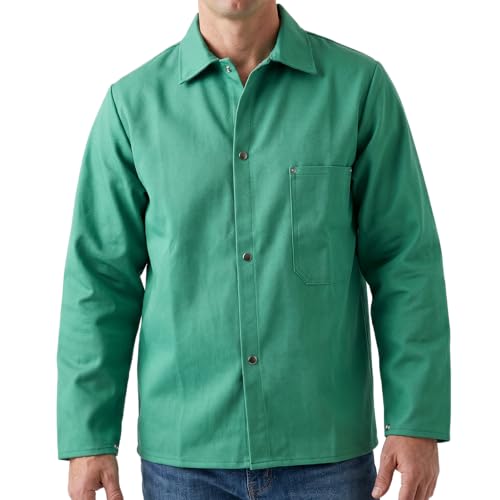 MAGID SparkGuard Flame Resistant Green Welding JacketLarge12.5 x 10 x 10 Inches1.2 poundsCheck on Amazon


The Best Flame-Resistant Welding Jackets for Different Jobs
The best flame resistant welding jacket depends on where sparks land: choose a heavy leather jacket for frequent overhead work and close-range spatter, or a lighter FR-cotton jacket for hot-weather work with mostly light, directional sparks. For mixed jobs, a leather-front, FR-fabric-back jacket can balance coverage and ventilation.
Seven picks by work situation
1. Tillman 5030: leather for overhead welding
The Tillman 5030 is a split cowhide welding jacket with a cotton lining and a snap-front closure. Its leather shell offers more resistance to hot spatter than ordinary FR cotton, making it a sensible choice for overhead or out-of-position work. The trade-off is weight and heat retention: it can feel cumbersome during long shifts in warm shops.
As an Amazon Associate we earn from qualifying purchases at no extra cost to you.


2. Lincoln Electric K2989: leather for regular shop use
Lincoln Electric’s K2989 leather welding jacket is another option for welders who want broad leather coverage rather than a fabric shell. Consider it for frequent welding where sparks can reach the torso and sleeves. Check the current size chart and sleeve measurements before ordering; a jacket that pulls open when you reach overhead leaves gaps where coverage matters most.
3. Revco Industries Black Stallion FN9-30C: FR cotton for hot conditions
The Black Stallion FN9-30C is a 9-ounce FR-cotton jacket with a snap-front design. It is a lighter-feeling alternative to leather for MIG or stick work with limited spatter, particularly in warm conditions. FR cotton is not a substitute for leather where heavy, sustained sparks or molten material are likely to hit.
4. Black Stallion FN9-30: FR cotton with a shorter cut
This 9-ounce FR-cotton model is a practical pick when a shorter body length is more comfortable for frequent bending or sitting. It still needs to overlap the waistband in working positions. Raise both arms and bend forward while checking fit: a jacket that rides up can expose the lower back.
5. Tillman 9215: leather sleeves for mixed heat and spatter
The Tillman 9215 combines a cotton body with leather sleeves. That arrangement can suit work where the arms take more spatter than the torso, while avoiding a full leather shell. It is not as cool as a lightweight cotton jacket, and the body remains less spark-resistant than leather. Use it only when that coverage matches the actual process and position.
6. Lincoln Electric K2987: leather sleeves for targeted protection
Lincoln Electric’s K2987 is a leather-sleeve jacket intended to put tougher material where arm exposure is common. It may be more comfortable than full leather for intermittent welding, but the fabric body is still a compromise around direct sparks. For overhead passes or heavy spatter across the chest, step up to a full leather jacket.
7. A split cowhide jacket with FR-cotton panels: the mixed-work choice
Several welding-apparel makers offer jackets combining leather on the front and sleeves with FR-cotton panels elsewhere. Choose this construction by inspecting the panel layout, seams, closures, and coverage—not by assuming every hybrid jacket is equivalent. It can be a useful middle ground for a shop that alternates between hotter work and warm-weather tasks, provided the fabric panels are not in the main spatter path.
Leather versus FR cotton: what the trade-off means
| Jacket type | Typical shell weight | Relative weight and airflow | Best fit for | Main limitation |
|---|---|---|---|---|
| FR cotton | About 9 oz/yd² for the Black Stallion FN9-30C | Lighter and generally more breathable | Warm shops, light spatter, shorter tasks | Less robust against concentrated hot spatter than leather |
| Split cowhide | Varies by hide and construction; check the maker’s specification | Heavier and less breathable | Overhead work, frequent spatter, longer exposure | Heat buildup, stiffness, and greater fatigue in summer |
| Leather-and-cotton hybrid | Varies by panel and material | Between full leather and cotton, depending on coverage | Mixed tasks where spark paths are predictable | Fabric panels remain vulnerable to direct spatter |
The 9-ounce figure is fabric weight per square yard, not the finished jacket’s total weight. Leather thickness and finished-jacket weights vary, so compare manufacturer specifications when available rather than treating all leather jackets as identical. Also, “FR” describes a fabric’s flame-resistant performance; it does not mean the garment cannot burn or that it protects against every welding hazard.
Choose by exposure, not just by season
- Overhead welding or heavy spatter: Favor a full leather jacket, secure cuffs, and a fit that stays closed when reaching. Wear the rest of the required protective gear; a jacket alone does not protect the head, neck, hands, or legs.
- Hot-weather welding with light spatter: FR cotton can reduce bulk and feel cooler. If your process changes or sparks start landing heavily, reassess rather than relying on comfort as a sign of adequate protection.
- Mixed-position work: A hybrid or leather-sleeve design may work when exposure is concentrated on certain areas. Match the leather panels to the actual direction of sparks.
- Frequent welding: Favor durable seams, reliable closures, and replaceable or repairable parts where available. A cheaper, lighter jacket is poor value if it wears through quickly in the areas that see spatter.
Get the fit right for reaching and bending
Measure over the clothes you expect to wear underneath. Compare chest, sleeve, and body-length measurements with the specific maker’s chart: sizes are not reliably interchangeable between brands. If you are between sizes, allow room for movement, but avoid sleeves or cuffs so loose they can catch on equipment.
Try the jacket in welding positions before relying on it. Reach overhead, extend both arms forward, twist, and bend. Check that the front stays overlapped, the cuffs cover the wrist, and the hem does not uncover the waistband. For overhead work, a little extra sleeve length can help preserve coverage when the arms are raised—but excess fabric at the wrist can also interfere with gloves.
Care and replacement: the parts that fail first
Spatter commonly damages sleeves, cuffs, and the front closure first. Inspect these areas, along with seams and lining, before each use. Retire a jacket if holes, torn seams, severe scorching, or damaged fasteners create gaps in protection. Do not cover damage with ordinary fabric or adhesive; repairs should maintain the garment’s protective properties.
Follow the label’s cleaning instructions. FR-cotton garments can lose protection or become contaminated if washed with unsuitable products; avoid fabric softeners or bleach unless the manufacturer explicitly permits them. Leather needs care appropriate to its construction, and oil or grease contamination is a reason to remove a jacket from service until its condition is assessed. Keep garments dry and away from sparks when stored.
For a fire resistant welding jacket, the practical rule is simple: buy for the worst routine spark exposure, then check that the fit still works in the positions you actually weld. Leather earns its extra weight in demanding spatter conditions; FR cotton earns its place when airflow and mobility matter and exposure is lighter.