
What's inside
- What matters most in a commuter cruiser
- Best cruiser boards for commuting by situation
- Wheel diameter and durometer: the practical head-to-head
- Deck length, wheelbase, and carry weight
- A simple decision matrix
- Worked route calculation: when the larger wheel is worth it
- Setup details that prevent common commuting problems
- Durability and ownership costs
- Final recommendation
As an Amazon Associate I earn from qualifying purchases. This post may contain affiliate links at no extra cost to you.
The best cruiser boards for commuting are usually 28–32 inches long, fitted with 60–65 mm wheels in a soft 78A–85A durometer range, and light enough to carry when the pavement ends or a train arrives.
As an Amazon Associate we earn from qualifying purchases at no extra cost to you.

Our Top Picks
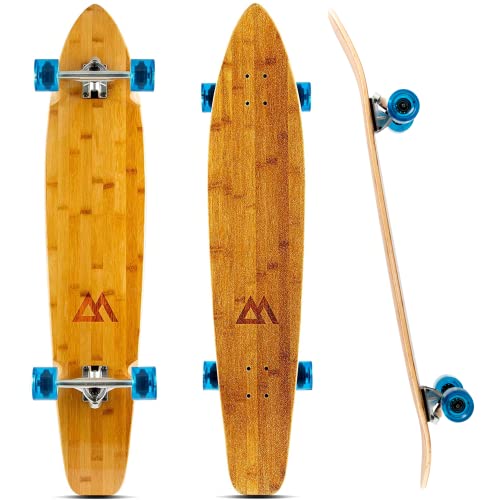
What matters most in a commuter cruiser
A city board has to do two different jobs: roll smoothly over imperfect pavement and remain manageable when you are walking, boarding transit, or storing it under a desk. Large, soft wheels help with the first job; a compact, reasonably light deck helps with the second. The ideal compromise depends on your route rather than on a single “best” specification.
- Wheel diameter: 60–65 mm is a useful commuting range. Wheels below about 58 mm feel nimble but transmit more vibration and are more likely to catch on cracks. Wheels around 66–70 mm roll more comfortably over rough surfaces, but add weight and may require risers to prevent wheel bite.
- Wheel durometer: 78A–82A is comfortable on asphalt and concrete. Around 83A–85A feels faster and more responsive on smooth streets while still offering useful grip. Harder wheels above roughly 90A are better suited to skateparks and polished surfaces than general commuting.
- Deck length: 28–30 inches is easiest to carry and turn in crowded areas. A 31–34-inch deck gives more foot room and stability, especially for beginners, but takes more space on transit.
- Carry weight: About 6–8 pounds is practical for regular walking and train transfers. A board near 9 pounds or more can still ride well, but its weight becomes noticeable during a long commute.
- Truck width and shape: Wider trucks and a broader deck feel stable. A shorter wheelbase and narrower setup turns more quickly, which is useful on sidewalks but less relaxed at speed.
Best cruiser boards for commuting by situation
Best compact choice: Landyachtz Dinghy
The Landyachtz Dinghy is a strong choice for a rider who prioritizes storage, quick turning, and a relatively easy carry. Its compact deck is commonly sold in lengths around 28–29 inches, with a short wheelbase and soft cruiser wheels. That combination makes it convenient for weaving around pedestrians and fitting beside a seat.
The trade-off is foot space. Larger riders or anyone who prefers a relaxed stance may find a compact cruiser less comfortable over a long distance. The small deck also gives less room to reposition your feet when the pavement becomes rough. Choose a Dinghy-style board when your route involves frequent stops, elevators, buses, and crowded platforms.
Best stable short board: Arbor Pilsner
The Arbor Pilsner is a compact cruiser with a more substantial feel than many mini-cruisers. Its approximately 28-inch length keeps it transit-friendly, while its shaped deck and cruiser-oriented wheels provide a stable platform for city riding. It suits riders who want a short board but do not want an extremely twitchy setup.
Look for the specific wheel and truck configuration before buying, because Arbor offers variations across its range and production years. A soft wheel in the low-80A range is preferable for cracked sidewalks; a harder wheel will feel quicker on smooth bike paths but less forgiving on rough concrete.
Best longer commuter option: Globe Blazer
The Globe Blazer is available in several compact and mid-length configurations, making it useful for riders who want more deck room without moving to a full longboard. A version around 31–32 inches generally offers a calmer ride than a mini-cruiser while remaining easier to store than a 36-inch board.
This type of deck is a good match for beginners, taller riders, and routes with longer uninterrupted stretches. The additional length usually adds some carry bulk, but the extra stability can reduce the need for constant foot adjustments. Check the exact model’s wheel diameter and deck construction, since the Blazer name covers different specifications.
Best for a larger standing platform: Loaded Omakase
The Loaded Omakase is a wider, short longboard-style cruiser rather than a tiny sidewalk board. Its broad platform and approximately 33.5-inch length provide generous foot room, while large soft wheels are suited to rough urban pavement. It is particularly appealing to experienced riders who want carving comfort and a planted feel.
The drawbacks are clear for transit users: a wider deck occupies more space, and the board is less discreet to carry through narrow aisles. It is better for a commute dominated by riding than one involving several transfers and long walks.
Wheel diameter and durometer: the practical head-to-head
| Wheel setup | Typical size | Surface behavior | Best use | Main compromise |
|---|---|---|---|---|
| Small and firm | 55–59 mm, 83A–90A | Quick acceleration and sharp turning; more vibration | Smooth pavement, short trips, compact storage | Cracks and pebbles feel harsh |
| Balanced cruiser | 60–65 mm, 78A–85A | Smooth over ordinary cracks with predictable grip | Most city commutes | May need risers depending on trucks and deck |
| Rough-surface cruiser | 66–70 mm, 78A–81A | Rolls over damaged asphalt and small obstacles more easily | Longer routes and poor pavement | Heavier, slower to turn, greater wheel-bite risk |
Diameter determines how easily a wheel maintains momentum over imperfections. Durometer affects grip and vibration: a lower number is softer, generally quieter, and more comfortable, while a higher number slides and accelerates more readily on smooth surfaces. Wheel formula also matters, so durometer should not be treated as a perfect cross-brand comparison.
Deck length, wheelbase, and carry weight
Deck length alone does not determine stability. Wheelbase—the distance between the trucks—has a major effect on steering. A 29-inch board with a short wheelbase can turn more sharply than a 31-inch board with a longer wheelbase. For commuting, a wheelbase around 15–17 inches is a useful middle ground: responsive enough for city movement without feeling excessively nervous.
| Commuter profile | Recommended deck | Wheel target | Approximate carry target |
|---|---|---|---|
| Frequent transit transfers | 27–29 inches, narrow to medium width | 58–62 mm, 80A–85A | 6–7.5 lb |
| Mixed riding and transit | 29–32 inches, medium width | 60–65 mm, 78A–84A | 6.5–8.5 lb |
| Mostly riding, occasional carrying | 31–34 inches, wider platform | 65–70 mm, 78A–82A | 7.5–10 lb |
These are practical targets rather than strict limits. A lighter board is not automatically better if it uses very small wheels that make the route uncomfortable. Conversely, the smoothest large-wheel setup is a poor choice if you must carry it up four flights of stairs twice a day.
A simple decision matrix
| Your priority | Choose this type | Avoid this type |
|---|---|---|
| Lowest general cost | Standard maple cruiser with 60–63 mm soft wheels | Specialized carbon or unusually wide longboard constructions |
| First board and maximum confidence | 30–33-inch deck with a medium-long wheelbase | Very short mini-cruiser with loose trucks |
| Small apartment or office storage | 27–29-inch compact cruiser under about 7.5 lb | Wide 34-inch deck with large wheels |
| Daily rough-pavement use | 63–70 mm wheels at 78A–82A, with adequate clearance | 55–58 mm hard wheels |
| Several miles plus train travel | 29–32-inch board, 60–65 mm wheels, moderate weight | Either an ultra-small board or a heavy downhill-style setup |
Worked route calculation: when the larger wheel is worth it
Suppose a 3-mile commute includes 2 miles of riding and 1 mile of walking or carrying. A 6.8-pound compact board may be preferable to an 8.8-pound rough-surface board because it is carried for one-third of the journey. The larger board saves effort only during the 2 riding miles, while the extra 2 pounds affects every carried section.
Now reverse the route: 2.8 miles of damaged pavement and only 0.2 miles of carrying. In that case, 65–70 mm soft wheels can be the better choice. The calculation is not about a precise energy formula; it is about weighting the board’s two jobs. Estimate riding distance, walking distance, stairs, and transit time before choosing the lightest possible deck.
Setup details that prevent common commuting problems
- Check wheel clearance. Turn the trucks fully left and right while pressing the deck down. If the wheel can touch the deck, install suitable risers or use smaller wheels. Wheel bite can stop a board abruptly.
- Set truck tightness gradually. Beginners often benefit from trucks that are secure but not rigid. Adjust in small increments and keep both sides similar. Excessively loose trucks can feel unstable; excessively tight trucks make a cruiser difficult to turn.
- Inspect axle nuts and mounting hardware. Before regular use, confirm that nuts are snug and that the trucks do not shift against the deck. Do not overtighten hardware into a wooden deck.
- Practice stopping before commuting. Learn foot braking and controlled turning in an empty area. A board that feels easy to push can still carry enough speed to require deliberate stopping.
Durability and ownership costs
Bearings usually suffer first when a board is ridden through rain, grit, or puddles. Avoid standing water, dry the board after damp conditions, and clean bearings only with a compatible method; replacing contaminated bearings is often more practical than trying to restore them. Do not spray general-purpose oil onto dirty bearings, because it can attract more grit.
Wheel edges gradually round off, and softer wheels may develop flat spots if you brake by dragging the same foot or repeatedly skid. Rotate wheels only when the manufacturer’s shape and mounting pattern make that sensible. Check the deck for cracks around truck bolts, especially after impacts. Maple decks can last for years when kept dry, while prolonged moisture can loosen layers and soften the mounting area.
For a typical daily commuter, budget for occasional bearing replacement, periodic hardware checks, and eventual wheels. Spending slightly more on appropriate wheels is often more valuable than choosing decorative deck features, because wheel comfort affects every block of the journey.
Final recommendation
For most riders, start with a 29–32-inch cruiser, 60–65 mm wheels, and a durometer around 80A–84A. Choose a compact Landyachtz Dinghy- or Arbor Pilsner-style board when carrying and storage dominate; choose a Globe Blazer-style mid-length board for extra stability; and move to a wider Loaded Omakase-style setup when rough pavement and riding comfort matter more than transit convenience. The best cruiser boards for commuting are the ones whose wheel comfort matches your pavement without making the non-riding parts of the trip unnecessarily difficult.