What's inside
- Top 3 Picks
- Quick Comparison
- How We Chose
- 1. Ovation Vega Quantum Zip Paddock – Best for Everyday Schooling and Stable Work
- 2. TuffRider Ladies Black Synthetic Leather Field Riding Boots – Best Budget Tall Field Boot
- 3. Equinavia Karina Tall Field Boots – Best Mid-Range Show-Ready Tall Boot
- 4. TuffRider Ladies Starter Back Zip Field Boots – Best First Tall Boot for Beginners
- 5. Ovation Highlander Tall Winter Riding Boot – Best for Cold-Weather Riding
- 6. Ovation Kids’ Quantum Zip Paddock Boots – Best for Young Riders
- 7. Sam Edelman Penny Classic Equestrian Boot – Best for Off-Horse Style
- 8. HORZE Rover Tall Field Riding Boots – Best Overall All-Around Tall Boot
- How to Choose
As an Amazon Associate I earn from qualifying purchases. This post may contain affiliate links at no extra cost to you.
The best riding boot for most equestrians in this roundup is the HORZE Rover Tall Field Riding Boots. It sits in the mid-range price tier, delivers the tall-boot silhouette that English riders need for schooling and low-level showing, and avoids the two most common compromises in the category — the flimsy ankle flex of cheap synthetic uppers and the eye-watering price of full-grain competition leather. It suits adult riders logging three to five sessions a week who want one pair of boots to do nearly everything. If money is the binding constraint, the TuffRider Ladies Black Synthetic Leather Field Riding Boots give you a genuine tall field boot for the least outlay. If you ride through a real winter, the Ovation Highlander is the cold-weather pick. And if you want an equestrian-styled leather boot for off-horse wear rather than for the stirrup, the Sam Edelman Penny is the premium option. Everything below is organized around four things that actually determine whether you will still like your boots in year three: upper material, sole grip, ankle support, and how they handle water.
Our Top Picks




Top 3 Picks
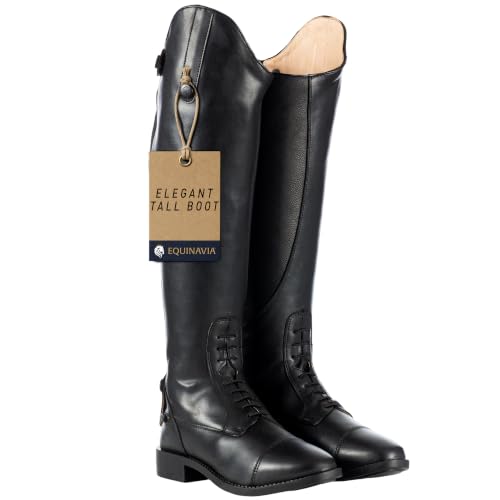
Best overall: HORZE Rover Tall Field Riding Boots
The Rover is the closest thing here to a do-everything English boot. It is a tall field boot for women at a mid-range price, which means you get shaft coverage for your lower leg, a proper riding heel, and a silhouette that reads as correct in a lesson, a clinic, or an entry-level show ring. It is the pick for the rider who is past the beginner stage but not yet ready to spend premium money on a boot they will only wear on show days.
Best budget: TuffRider Ladies Black Synthetic Leather Field Riding Boots
This is a full-height field boot in a synthetic leather upper at a budget price, offered in regular calf widths and in women’s sizes including half sizes. It is the honest answer for a rider who needs the tall-boot look and the leg coverage that comes with it but cannot justify mid-range money — a first pair, a spare pair, or a pair for a rider who is still growing. Synthetic uppers trade breathability and long-term repairability for cost and easy cleaning.
Best for cold weather: Ovation Highlander Tall Winter Riding Boot
The Highlander is the winter-specific pick, built as a tall riding boot with a faux fur lining. If your barn has no indoor arena and your toes go numb somewhere around the second lap of the warm-up, an insulated tall boot changes the experience of winter riding more than any other single piece of gear. The trade-off is that lined boots fit differently, and you need to size with your winter sock in mind.
Quick Comparison
Every product covered in this roundup, in the order the full reviews appear below. Price tiers are broad market bands, not per-product figures, because listed prices move constantly.
| Product | Best for | Key specs | Price tier |
|---|---|---|---|
| Ovation Vega Quantum Zip Paddock | Everyday schooling, stable work, hot weather | Ankle-height paddock boot; synthetic upper; front zip; rubber outsole with defined tread; low block heel | Budget |
| TuffRider Ladies Black Synthetic Leather Field Riding Boots | Lowest-cost tall boot with full leg coverage | Tall field boot; synthetic leather upper; regular calf width class; women’s sizing incl. half sizes | Budget |
| Equinavia Karina Tall Field Boots | Polished look for low-level showing and clinics | Women’s tall field boot; full-length shaft; zip closure with elastic panel; narrow-to-regular calf options | Mid-range |
| TuffRider Ladies Starter Back Zip Field Boots | First tall boot for new adult and teen riders | Tall field boot; synthetic leather upper; back zip; beginner-oriented construction; wide size run | Mid-range |
| Ovation Highlander Tall Winter Riding Boot | Cold-weather riding and unheated barns | Tall riding boot; faux fur lining; insulated shaft; rubber outsole; size up for winter socks | Mid-range |
| Ovation Kids’ Quantum Zip Paddock Boots | Young riders in lessons, camps, and pony club | Ankle-height kids’ paddock boot; front zip; lightweight; classic styling; easy-clean upper | Budget |
| Sam Edelman Penny Classic Equestrian Boot | Off-horse wear with equestrian styling | Black leather upper; medium width; women’s whole and half sizes; low stacked fashion heel; not built for stirrups | Premium |
| HORZE Rover Tall Field Riding Boots | All-around English riding, schooling to low-level showing | Women’s tall field boot; full shaft; zip closure; riding-appropriate heel and sole; mid-range construction | Mid-range |
How We Chose
This roundup was assembled from published manufacturer and retailer specifications, brand documentation, and the established construction standards of the riding-boot category — not from testing. We do not own these boots, and we have not ridden in them. What we did was compare each listed product against the four variables that decide whether a riding boot works: upper material (leather versus synthetic, and what that means for break-in, breathability, and repair), outsole and tread design (grip on a stirrup, grip in mud, and how the sole behaves when wet), ankle support (how much of the lower leg the boot actually stabilizes, and whether a laced field boot or a zip boot is the better fit for the rider), and water management (resistance versus true waterproofing, plus how seams and linings behave over time).
We also weighted category fit heavily. A paddock boot and a tall field boot are not interchangeable, and a fashion boot is not a riding boot no matter how equestrian it looks. Each pick is described in terms of the rider it actually serves: discipline, experience level, climate, budget band, and growth stage. Where a listing does not state a specification, we describe the product by spec class — the range of shaft heights, calf widths, or sole constructions typical for that style of boot — rather than inventing a figure. Where a product is aimed at a niche rather than the mainstream, we say so plainly rather than pretending it is a universal recommendation.
1. Ovation Vega Quantum Zip Paddock – Best for Everyday Schooling and Stable Work
As an Amazon Associate we earn from qualifying purchases at no extra cost to you.

This is an ankle-height paddock boot from Ovation, a brand that has been a fixture in English tack rooms for decades. The listing describes it as lightweight and stylish, built with a synthetic upper the brand calls Vega leather, and closed with a front zip. That combination — synthetic upper plus front zip plus ankle height — puts it squarely in the everyday-schooling category rather than the competition category. It is the boot you put on for a Tuesday afternoon flat school, a hack, mucking out, and a quick lunge, and it is the boot you can hose off afterward instead of treating with conditioner.
Key specs
- Style: ankle-height paddock boot, English discipline pattern
- Upper: synthetic leather (listed as “Vega leather”) — wipe-clean, no conditioning required
- Closure: front zip, which runs from the instep up the front of the ankle
- Sole: rubber outsole with a defined tread pattern — the class of sole that grips a wet stirrup tread better than a smooth leather dress sole
- Heel: low block heel in the roughly 1-inch class typical of paddock boots, which is what keeps the foot from sliding through the stirrup
- Leg coverage: none above the ankle — this is designed to be worn with half chaps
- Sizing: women’s sizing; check the listing for the specific size run and whether wide widths are offered
Where it shines
The front zip is the feature that sells this boot to most riders. Back-zip and pull-on boots require you to commit to a boot jack or a wrestling match; a front zip goes on standing up, in a barn aisle, with one hand while you are holding a lead rope in the other. That sounds trivial until you have done it a few hundred times. The synthetic upper also means you are not carrying a leather-care kit to the barn. Mud, arena dust, and water all come off with a damp cloth, and you never have to think about conditioning, polishing, or whether a wet leather boot is drying in the wrong shape.
Weight is the other real advantage. Ankle-height boots are the lightest option in the riding-boot category — typically around a pound to a pound and a half per boot in this construction class, versus two pounds and up for a lined leather tall boot. For riders who do a lot of walking between the barn, the paddock, and the arena, or who have a long walk from the parking area, that difference shows up by the end of the day.
Paired with half chaps, this boot produces a tall-boot look at roughly half the cost and with considerably more flexibility. It is a legitimate strategy, not a compromise — many adult amateurs school exclusively in paddock boots and chaps and keep a tall boot for shows only.
Pros
- Front zip makes it the fastest boot in this roundup to get on and off
- Lightweight — among the lightest construction classes in riding footwear
- Synthetic upper needs no conditioning and wipes clean in seconds
- Budget tier, so it works as a first boot, a second boot, or a barn-only boot
- Ankle-height means it packs flat and travels well in a gear bag
- Rubber tread gives useful grip on wet stirrup treads and gravel
Cons
- Zero lower-leg support — all ankle and shin stabilization has to come from half chaps or a tall boot
- Not show-legal in disciplines that require a tall boot
- Synthetic uppers do not mold to the foot the way leather does, so fit stays as-delivered
- Front zips collect arena sand and manure grit, and the zipper is usually the first thing to fail
- No insulation, so it is a three-season boot in most climates
- Synthetic materials generally do not breathe as well as leather in summer heat
How it compares with the nearest alternative
The closest alternative in this list is the TuffRider Ladies Starter Back Zip Field Boots. The TuffRider gives you a full shaft, so it covers the lower leg and removes the need for half chaps entirely. The Ovation Vega gives you speed, weight savings, and a lower entry price. If your riding is mostly short schooling sessions and barn chores and you already own chaps, the paddock boot wins. If you are starting lessons and want one purchase to cover everything, the tall boot is the more efficient first buy.
2. TuffRider Ladies Black Synthetic Leather Field Riding Boots – Best Budget Tall Field Boot

TuffRider has built its reputation on making the entry point to English riding affordable, and this boot is a direct expression of that. It is a tall field boot in a synthetic leather upper, offered in a regular calf width class and in women’s sizes including half sizes. In the listing, the “regular” designation matters more than most buyers realize: tall boots are sized on two axes — foot size and calf width — and buying the right foot size in the wrong calf width is the single most common tall-boot mistake.
Key specs
- Style: tall field boot, which in equestrian terminology means front lacing over the instep area
- Upper: synthetic leather — wipe-clean, no conditioning, limited ability to stretch
- Calf width: listed as regular; expect a narrow/regular/wide family across the size run
- Shaft height: full-height tall boot, in the range typical of women’s tall boots — the top should land just below the crease at the back of the knee when seated in the saddle
- Sole: rubber outsole with tread, appropriate for a stirrup tread
- Heel: riding-appropriate low block heel, not a fashion heel
- Care: damp cloth; no polish, no conditioner, no leather food
Where it shines
The value proposition here is straightforward: full lower-leg coverage at a budget price. A tall boot does something a paddock boot physically cannot — it distributes pressure from the stirrup and the saddle flap across the calf and shin rather than concentrating it at the ankle bone. For riders who are riding several days a week, that alone is worth the upgrade, and it is the reason so many instructors push beginners toward tall boots or paddock-boot-and-chaps combinations rather than bare paddock boots.
The synthetic upper has practical advantages at this price point. It does not require the break-in period that stiff leather does, so it is comfortable in week one rather than week six. It does not water-stain the way unfinished leather does. And it does not need to be dried on a boot tree to hold its shape. For a rider who is going to outgrow the boot, or who is going to move up to a nicer boot within a couple of seasons anyway, that is exactly the right set of trade-offs.
Front lacing, which is what makes a field boot a field boot, also gives you a small amount of fit adjustment across the instep. That is genuinely useful if your foot is between sizes or if you have a high instep, and it is the reason field boots have remained the standard English schooling boot for over a century despite the existence of simpler zip-only designs.
Pros
- Tall-boot leg coverage at a budget price tier
- Synthetic leather needs no break-in and no conditioning
- Front lacing provides adjustable fit across the instep
- Half sizes available, which reduces the guesswork on foot length
- Wipe-clean surface handles mud, arena dust, and rain without staining
- An efficient first tall boot for a teen or a returning adult rider
Cons
- Synthetic uppers do not stretch, so a calf that is slightly too wide stays slightly too wide
- Less breathable than leather in hot weather
- Synthetic material can crease permanently at the ankle flex point with heavy use
- Typically not resolable or rebuildable, so the boot’s life is the boot’s life
- Front laces need to be checked and re-tied, and laces are a wear item
- Regular calf width only in the listing shown — wide-calf riders need to check the full size run
How it compares with the nearest alternative
Against the TuffRider Ladies Starter Back Zip Field Boots, the choice comes down to closure and intent. The Starter uses a back zip, which is faster to put on and has no laces to manage, and it is positioned as a beginner’s boot within the same brand family. This synthetic field boot leans more on the traditional field-boot pattern with front lacing. If you want the simplest possible routine, take the back zip. If you want the classic field-boot fit adjustment across the instep, take this one. Both land in the same general construction class; the difference is the closure system you will live with twice a day.
3. Equinavia Karina Tall Field Boots – Best Mid-Range Show-Ready Tall Boot

The Karina is a women’s tall field boot from Equinavia, positioned in the mid-range tier. This is the boot for the rider who has decided that schooling boots and show boots can be the same pair. It is the step up from the budget synthetic boots above: a more refined shaft, a slimmer overall profile, and the kind of finish that looks deliberate in a show ring rather than merely functional in a schooling arena.
Key specs
- Style: women’s tall field boot, full-height shaft
- Closure: full-length zip with an elastic panel — the standard configuration that lets a tall boot go on over the instep and then close snug around the calf
- Upper: described in the listing as a tall field boot; confirm the upper material in the spec panel, since equestrian brands at this price point offer both leather and high-grade synthetic constructions
- Calf fit: typically offered across a range of calf widths; the elastic panel provides some tolerance but does not replace correct sizing
- Sole: rubber outsole with tread, riding-appropriate heel
- Finish: polished, show-appropriate styling
- Care: depends on upper material — leather needs conditioning and a boot tree; synthetic needs a damp cloth
Where it shines
The reason to move up to this tier is not durability, it is presentation and fit refinement. Budget tall boots tend to have a slightly bulky shaft and a boxier toe. Mid-range boots are cut slimmer through the ankle and calf, and that changes how the boot reads under a pair of breeches — the leg looks longer and cleaner, which is precisely what a judge is evaluating in an equitation or hunter class even when nobody is scoring the boot itself.
The full-length zip with elastic panel is the other meaningful upgrade. It is the configuration that makes a tall boot practical: the zip does the work of getting the boot past your heel and instep, and the elastic panel takes up the difference between your calf measurement and the boot’s stated calf width. Without that panel, a tall boot has to be almost exactly your calf circumference, which is why so many riders end up with boots that are either impossible to zip or loose enough to twist.
This is also the tier where the boot starts to hold its shape. A mid-range shaft does not collapse around the ankle after a season of riding the way a very light synthetic can, and the boot’s top edge stays level rather than sagging to one side.
Pros
- Show-appropriate finish without a premium-tier price
- Slimmer shaft profile than budget tall boots
- Full-length zip plus elastic panel makes on/off realistic for daily use
- Holds its shape better than the lightest synthetics over multiple seasons
- Works as a single pair for schooling, lessons, clinics, and low-level showing
- Wide range of calf and height combinations available across the line
Cons
- Mid-range price for a boot that will still eventually need replacing if the upper is synthetic
- If the upper is leather, it requires actual maintenance — conditioner, boot trees, and drying discipline
- Slimmer shafts fit fewer calves off the shelf; correct measurement is essential
- Elastic panels are a wear point and can lose tension over years
- Not an insulated or winter boot
- Overkill if you only ride once a week in a lesson program
How it compares with the nearest alternative
The nearest alternative in this list is the HORZE Rover Tall Field Riding Boots. Both are mid-range women’s tall field boots, and both are aimed at the same rider. The distinction is emphasis: the Karina leans toward polish and show presentation, while the Rover is positioned as an all-around schooling boot that happens to be presentable. If your calendar includes a show season, the Karina’s finish earns its keep. If your calendar is mostly lessons, hacks, and the occasional clinic, the Rover is the more sensible allocation of the same money.
4. TuffRider Ladies Starter Back Zip Field Boots – Best First Tall Boot for Beginners

The Starter is exactly what its name says: a tall field boot designed as an entry point, in a synthetic leather upper, closed with a back zip. TuffRider’s whole brand identity is built around lowering the cost of getting into English riding, and the Starter line is the clearest example of that. It is the boot you buy when you have been taking lessons for three months, your instructor has started talking about your leg position, and you have realized that paddock boots alone are not going to get you there.
Key specs
- Style: women’s tall field boot, full-height shaft
- Upper: synthetic leather — wipe-clean, no break-in period, no conditioning
- Closure: back zip, which runs up the rear of the calf
- Sole: rubber outsole with tread; riding-appropriate low heel
- Calf: regular width class; check the size run for narrow and wide options
- Care: damp cloth only
- Intended rider: beginners and casual riders, not competitors
Where it shines
The back zip is the defining feature, and it is the right choice for a beginner. Back-zip boots have no laces to tie, no front zipper to line up over the instep, and no tongue to fold the wrong way. You sit down, you pull, you zip. For a rider who is still developing the habit of arriving early enough to tack up without rushing, that simplicity removes one more friction point from the routine.
The synthetic upper is also well matched to the beginner stage. New riders are hard on boots in ways that have nothing to do with riding: they stand in mud, they walk through deep bedding, they leave boots in the car overnight, and they do not yet own a boot tree or a tin of conditioner. A synthetic boot tolerates all of that without permanent damage. If you forget it in a damp tack room for a week, it will be fine. A comparable leather boot would not be.
There is also a real argument that beginners should not buy expensive boots at all. Your leg position changes dramatically over the first year or two of riding, and so does your understanding of what you want from a boot. The Starter is priced so that moving on from it in two seasons does not feel like a waste.
Pros
- Back zip is the simplest closure system for a new rider to manage
- Synthetic upper tolerates mud, damp storage, and neglect
- No break-in period — comfortable from the first ride
- Full lower-leg coverage, which is the whole point of a tall boot
- Broad size availability, including half sizes
- Low financial commitment for a rider whose goals are still changing
Cons
- Synthetic uppers do not stretch to accommodate a calf that is between widths
- Back zips can be harder to close over a high instep than front zips
- Less breathable than leather in summer
- Not a show boot — the finish is functional, not polished
- Not resolable or rebuildable
- Riders who progress quickly will outgrow its capabilities within a few seasons
How it compares with the nearest alternative
The nearest alternative is the TuffRider Ladies Black Synthetic Leather Field Riding Boots, and they come from the same brand. The Starter uses a back zip; the field boot uses front lacing. For a genuine beginner, the back zip is easier to live with and I would steer you there. For a rider who has already been riding a year or more and wants the classic field-boot fit adjustment, the laced version is the better match. Both are synthetic, both are in the same general construction class, and both are meant to be replaced rather than repaired.
5. Ovation Highlander Tall Winter Riding Boot – Best for Cold-Weather Riding
The Highlander is Ovation’s winter entry: a tall riding boot with a faux fur lining, built for riders who keep going through the cold months. This is a genuinely different product category from everything else in this roundup. An unlined tall boot in January is a punishment; an insulated tall boot turns winter riding from an ordeal into an ordinary barn day. If you ride outdoors in a climate with real winters, this is the boot that changes the most about your experience.
Key specs
- Style: women’s tall riding boot, full-height shaft
- Lining: faux fur, running the length of the shaft and around the foot
- Upper: durable synthetic construction intended for winter conditions
- Sole: rubber outsole with a deeper tread pattern than a summer boot, for cold-weather grip
- Insulation: built into the lining rather than added as a separate layer
- Sizing note: insulated boots run snug — plan for the sock thickness you actually ride in
- Care: wipe the exterior; air-dry the lining thoroughly between rides
Where it shines
The faux fur lining is doing two jobs, and most riders only think about one of them. The obvious job is warmth. The less obvious one is that the lining fills the space between your calf and the boot shaft, which means an insulated boot often fits a rider with a narrower calf better than an unlined boot of the same stated calf width. If you have struggled with tall boots that gap and twist because your calf is at the low end of the regular width, a lined boot is worth trying.
The deeper tread is the second real advantage. Winter riding means frozen ground, muddy gateways, slush, and ice in the barn aisle. A summer boot’s shallow tread pattern packs with mud and then behaves like a smooth sole. A winter boot’s deeper lugs shed that material and keep grip on surfaces where a slip means a fall while leading a horse — which is a genuinely higher-stakes situation than slipping on your own two feet.
The full shaft also matters more in winter than in summer. Cold air against the lower leg is a real comfort problem, and a tall insulated boot covers the calf and shin that a paddock boot leaves exposed.
One practical caution: if you regularly experience numbness, tingling, or color changes in your feet in cold weather, that is a question for a clinician rather than a boot-spec question, and no amount of insulation is a substitute for getting it looked at.
Pros
- Insulated lining makes winter riding dramatically more comfortable
- Faux fur fills calf gaps, which can improve fit for narrower calves
- Deeper tread pattern provides better grip on mud, slush, and frozen ground
- Full shaft coverage protects the lower leg from cold air
- Mid-range price for a specialized seasonal boot
- Extends your riding season rather than forcing an indoor-only winter
Cons
- Too warm for three-season use — this is a dedicated winter boot
- Lined boots fit snug; sizing needs to account for winter socks
- The lining mats down with use and loses some loft over several seasons
- Lining traps moisture and needs thorough air-drying to avoid odor
- Bulky profile compared with an unlined schooling boot
- Faux fur is a comfort feature, not a waterproofing feature — wet and cold are separate problems
How it compares with the nearest alternative
The nearest alternative is the HORZE Rover Tall Field Riding Boots, and the comparison is really about season rather than quality. The Rover is an unlined, all-around tall boot that will serve you eight or nine months a year in a temperate climate. The Highlander is a specialist that serves you the other three or four. If you ride year-round in a cold climate, owning both is not extravagance — it is the correct answer. If you can only own one and your winters are mild, the Rover is the more versatile purchase.
6. Ovation Kids’ Quantum Zip Paddock Boots – Best for Young Riders

These are the kids’ version of the Quantum Zip paddock boot: ankle height, front zip, lightweight, and styled in the classic pattern that has been standard in lesson programs for generations. The listing describes them as classic, lightweight, and easy to get on. For a young rider in a weekly lesson program, a pony club, or a summer camp, this is the practical starting point.
Key specs
- Style: kids’ ankle-height paddock boot, English pattern
- Closure: front zip — the closure system children can manage independently
- Upper: synthetic, wipe-clean
- Sole: rubber outsole with tread
- Heel: low block heel in the paddock-boot class
- Leg coverage: none above the ankle; pairs with kids’ half chaps
- Care: damp cloth; no conditioning
Where it shines
The front zip is the whole argument for this boot over a pull-on design. Getting a child into riding gear is a logistical exercise, and anything that a seven-year-old can do without adult help is worth more than it looks on a spec sheet. A child who can put on their own boots is a child who is ready five minutes earlier, and in a lesson program those five minutes are the difference between a calm warm-up and a rushed one.
The synthetic upper is also the correct choice for this age group, for the same reasons it makes sense for adult beginners but more so. Kids stand in puddles. Kids walk through mud in their riding boots and then get in the car. Kids leave boots in a heap in the corner of the tack room. A synthetic paddock boot survives all of this without the kind of damage that would ruin a leather boot, and it can be rinsed off in a utility sink in under a minute.
There is a fit consideration that matters more with children than adults: growth. A child’s foot can change a full size within a single season, and sometimes faster. That argues for buying boots that fit well now rather than boots with an inch of growing room, because a boot that is too long slides on the foot and a boot that is too wide lets the heel lift. Check that the heel stays seated when the child walks, and check toe room with the child standing rather than sitting.
Half chaps are worth adding here. Kids’ half chaps are inexpensive, they protect the lower leg from stirrup leather rub, and they turn a paddock boot into something that looks and functions much more like a tall boot. It is the same strategy adult riders use, scaled down.
Pros
- Front zip that children can operate independently
- Synthetic upper survives mud, water, and rough handling
- Lightweight, which matters for smaller riders
- Budget tier, appropriate for a foot that will outgrow the boot within a year or two
- Classic styling that looks correct in any lesson program
- Easy to clean — a genuine factor for parents
Cons
- No ankle or lower-leg support on its own; half chaps are needed for anything beyond beginner work
- Children outgrow these quickly, so the cost-per-season is higher than it first appears
- Front zips take abuse from kids and can fail before the boot wears out
- Not appropriate for showing in disciplines requiring tall boots
- Synthetic upper is warm in summer
- Limited adjustability compared with a laced design
How it compares with the nearest alternative
The obvious comparison is with the adult Ovation Vega Quantum Zip Paddock, which is the same design philosophy in a grown-up size run. They are the same category of boot. The practical decision for a family is usually whether a child is close enough to adult sizing to buy a small adult boot, which lasts longer and costs proportionally less per season, or whether they are still in the kids’ size range where growth makes an inexpensive pair the smarter call. Below roughly age ten or eleven, the kids’ boot wins on economics. Above that, price out the smallest adult size before committing.
7. Sam Edelman Penny Classic Equestrian Boot – Best for Off-Horse Style

The Penny is a black leather equestrian-styled boot from Sam Edelman, a fashion footwear brand, offered in women’s whole and half sizes and in medium width. It is listed as a classic equestrian boot, and it is worth being direct about what that means: this is a fashion boot with equestrian styling, not a technical riding boot. It is designed for the barn-adjacent look — worn with jeans, leggings, or a skirt, in town, at work, or at the barn when you are not riding.
Key specs
- Style: leather equestrian-inspired boot, low stacked heel
- Upper: leather — which is why it sits in the premium price tier
- Width: medium; sizing runs in women’s whole and half sizes
- Heel: low stacked heel in the fashion range, not a riding heel
- Sole: fashion sole, not a deep-lug riding outsole
- Intended use: off-horse wear; not designed for stirrups, mounting, or riding
- Care: leather conditioner, protection spray, and storage away from damp
Where it shines
Leather is the reason this boot costs what it costs, and leather is genuinely the best material in footwear for the specific thing this boot is for. It molds to the foot over time. It develops a patina that synthetic materials cannot replicate. It can be conditioned, polished, and in some cases resoled, which extends its life well beyond a comparable synthetic boot. For a boot worn on pavement and in offices rather than in an arena, those are the properties that matter.
The equestrian silhouette is a durable style choice. The tall shaft, the clean lines, and the low heel have been in and out of fashion for decades without ever fully leaving, and a black leather version is about as safe a wardrobe decision as footwear gets. It reads as deliberate rather than trendy, which is why it works across a wide range of outfits.
It is also worth naming the honest limitation, because it is the thing buyers most often get wrong. A fashion equestrian boot generally does not have a riding-appropriate sole, a stirrup-safe heel geometry, or the structural support a rider’s ankle needs when a horse spooks. Riding in a fashion boot is a real safety risk, not a stylistic quibble. If you want an equestrian-styled leather boot that you can also ride in, look at the functional tall boots in this roundup instead.
Pros
- Genuine leather upper, which is the premium material for off-horse footwear
- Molds to the foot and improves with wear
- Timeless equestrian silhouette that works across seasons
- Can be conditioned and, in some cases, repaired rather than replaced
- Available in whole and half sizes in medium width
- Transitions easily between barn-adjacent, casual, and workplace settings
Cons
- Not a riding boot — the sole, heel, and support are all fashion-grade
- Premium tier pricing for a boot that will not serve you in the saddle
- Leather requires real maintenance: conditioning, drying, and storage discipline
- Medium width only, so fit is limited for wide or narrow feet
- No ankle support or lateral stability for riding
- Water exposure without protection will mark and stiffen the leather
How it compares with the nearest alternative
The nearest functional comparison is the Equinavia Karina Tall Field Boots, which occupies a similar visual space — a tall, polished, equestrian-styled boot — at a lower price tier. The difference is purpose. The Karina is built to be ridden in; the Penny is built to be worn. If you need one tall boot that does both, the Karina is the answer, and it costs less. If you already own riding boots and want a leather tall boot for the rest of your life, the Penny is the better-made object of the two, and leather is why.
8. HORZE Rover Tall Field Riding Boots – Best Overall All-Around Tall Boot
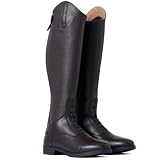
The Rover is a women’s tall field riding boot from HORZE, an equestrian brand that has been supplying riders across Europe and North America for decades. It sits in the mid-range tier, and it is the boot in this roundup that best balances capability against cost. It is not the cheapest tall boot here and it is not the most refined, but it is the one that will handle the widest range of what an ordinary rider actually does — schooling, lessons, hacks, clinics, and the occasional low-level show — without either falling apart or embarrassing you.
Key specs
- Style: women’s tall field boot, full-height shaft
- Closure: zip closure with the elastic panel configuration standard for tall boots
- Construction tier: mid-range, above the entry synthetics and below competition leather
- Shaft height: full tall-boot height — the top should sit just below the back-of-knee crease when you are seated in the saddle
- Sole: riding-appropriate rubber outsole with tread
- Heel: low block riding heel
- Calf fit: check the size run for the calf widths offered; tall boots are sized on both foot length and calf circumference
- Care: depends on the upper material confirmed in the listing — leather needs conditioning, synthetic needs wiping
Where it shines
The Rover’s case rests on versatility. A tall field boot is the most useful single piece of English riding footwear because it does the job of a paddock boot and half chaps at once, and it does it without the fuss of two pieces to manage. You put it on, and your lower leg is covered, supported, and protected from stirrup leather rub. That is the whole benefit, and it is a large one.
The mid-range position is what makes it the overall pick rather than a specialty choice. Budget synthetic tall boots work, but they tend to feel disposable and their finish does not hold up to showing. Premium leather boots are better objects, but they demand maintenance and they cost enough that many riders hesitate to wear them for everyday schooling — which means they sit in a bag and get used four times a year. The Rover occupies the useful middle: good enough to wear anywhere, inexpensive enough to wear every day.
It is also a reasonable match for riders whose bodies or goals are still changing. Mid-range boots have enough structure to support a developing leg position without the rigidity of a competition boot, which can actually make it harder to feel the horse while you are learning. A slightly more forgiving shaft is a feature during the years when you are still building independent seat and leg.
One note on discipline: this is an English-pattern tall field boot. Western riders use a different boot geometry entirely — a higher heel, a pointed toe, and a thick leather sole with no lugs, designed so the foot can slide free of a stirrup rather than catch in it. None of the boots in this roundup is a Western boot, and English tall boots are not a substitute. Western riders should look for a traditional Western riding boot or a roper, sized with a heel in the 1.5-to-2-inch class and a smooth sole.
Pros
- Best balance of capability and cost in this roundup
- Full lower-leg coverage and support in a single piece of footwear
- Mid-range construction holds shape better than entry-level tall boots
- Presentable enough for low-level showing and clinics
- Comfortable enough to wear as a daily schooling boot
- Broad size and calf-width availability across the line
Cons
- Not a dedicated show boot — a competition rider will eventually want a finer pair
- Not insulated, so it is not a winter boot in a cold climate
- Tall boots require correct two-axis sizing, which takes measurement effort
- Break-in period is longer than a paddock boot or a synthetic
- Elastic panels and zips are wear points that eventually need replacing
- English pattern only — no Western option
How it compares with the nearest alternative
Against the Equinavia Karina Tall Field Boots, the Rover is the more practical everyday choice and the Karina is the more polished one. Against the TuffRider Ladies Black Synthetic Leather Field Riding Boots, the Rover costs more and lasts longer and looks better doing it — the budget boot is the right call if money is genuinely tight, but the Rover is the better long-run purchase for a rider who has settled into regular riding. If you want one boot to cover schooling through entry-level competition, this is it.
How to Choose
The riding-boot market is confusing for a reason: the same word means different things to different riders, and the specifications that actually determine whether a boot