What's inside
As an Amazon Associate I earn from qualifying purchases. This post may contain affiliate links at no extra cost to you.
Our Top Picks
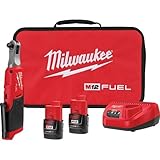
 Milwaukee 2457-20 M12 Cordless 3/8" Sub-Compact 35 ft-Lbs3/8"9.47 x 2.94 x 1.76 inches1 PoundsCheck on Amazon
Milwaukee 3/8-Inch Cordless Ratchets: Models Compared
For most repairs, choose the Milwaukee M12 FUEL 3/8-Inch High Speed Ratchet (2567-20) if speed matters, or the M12 FUEL 3/8-Inch Ratchet (2557-20) for a more compact, general-purpose balance; pick the M12 3/8-Inch Extended Reach Ratchet (2569-20) when fasteners sit deep behind components. These are powered ratchets for spinning already-loosened fasteners—not impact wrenches for breaking stubborn bolts free.
At a glance: the main 3/8-inch choices
The figures below are published tool specifications; bare-tool weight excludes the battery. Milwaukee’s product specifications can vary slightly by region and revision, so check the exact model number before buying. “Maximum torque” is a tool rating, not a promise that every fastener can safely be tightened to that value.
As an Amazon Associate we earn from qualifying purchases at no extra cost to you.


| Model | Head clearance | No-load speed | Maximum torque | Tool length | Battery platform |
|---|---|---|---|---|---|
| M12 FUEL 3/8-Inch Ratchet, 2557-20 | About 0.75 in (19 mm) head profile | 0–200 rpm | 55 ft-lb (75 N·m) | About 10.8 in (274 mm) | M12, 12 V |
| M12 FUEL 3/8-Inch High Speed Ratchet, 2567-20 | About 0.75 in (19 mm) head profile | 0–450 rpm | 35 ft-lb (47 N·m) | About 10.8 in (274 mm) | M12, 12 V |
| M12 3/8-Inch Extended Reach Ratchet, 2569-20 | About 0.75 in (19 mm) head profile | 0–175 rpm | 35 ft-lb (47 N·m) | About 14 in (356 mm) | M12, 12 V |
Published bare-tool weights are roughly 2.0–2.4 lb (0.9–1.1 kg), depending on model and specification source. A larger battery adds weight and can make a tool less comfortable in a cramped position. These models use Milwaukee’s M12 battery system; they are not compatible with M18 batteries. “Tool only” listings do not include a battery or charger.
Which ratchet fits your repair?
| Your situation | Best fit | Why—and the trade-off |
|---|---|---|
| Frequent under-hood work with room to reach the fastener | 2557-20 | Higher rated torque than the high-speed and extended-reach options; useful when you want one 3/8-inch ratchet for varied service work. It is not the fastest choice. |
| Long runs of accessible bolts, such as covers or brackets | 2567-20 | Up to 450 rpm helps spin fasteners out and back in quickly. Its lower torque rating makes hand breakaway especially important. |
| Fasteners recessed behind hoses, panels, or other components | 2569-20 | The longer neck reaches farther without stacking extensions. The extra length can be awkward where the tool needs to swing or fit beside an obstruction. |
| Only occasional home or vehicle repairs, and you already own M12 batteries | 2557-20 or 2567-20 | Choose by priority: torque rating and versatility, or speed. Buying a kit can make more sense if you need a battery and charger as well. |
| Tight access around a small fastener | Consider the M12 1/4-Inch Ratchet, such as 2457-20 | The smaller drive accepts 1/4-inch sockets and can suit lighter-duty, smaller hardware. It is not a substitute for 3/8-inch sockets or higher fastener capacity. |
Head clearance is only part of the fit
Milwaukee’s M12 ratchet heads are compact, but the head-profile figure alone cannot tell you whether the tool will fit. The socket, fastener position, battery, and direction of the handle all affect access. Before choosing, compare the space above the fastener with the socket height and the room needed to position the ratchet. A long extension can clear an obstruction, but it can also make the setup less stable.
The 2569-20’s extended neck helps when a fastener is deep, not necessarily when it is close to a wall or tucked into a narrow lateral gap. In that kind of space, a shorter tool or a hand ratchet may give better control. A flex-head hand ratchet is another useful companion when the powered tool cannot be positioned squarely.
Speed and torque: what the ratings mean on the job
The high-speed 2567-20 tops out at 450 rpm, more than twice the 2557-20’s 200 rpm rating. That difference matters most when spinning many loose fasteners; it does not mean the faster tool is better at loosening a seized bolt. The 2557-20’s higher 55 ft-lb rating gives it a higher stated torque ceiling, while the other two are rated at 35 ft-lb.
For stubborn or corroded hardware, break the fastener loose by hand first. Then use the ratchet to run it out. When installing a fastener, start the threads by hand and use the powered ratchet gently; finish with a calibrated torque wrench wherever the service procedure specifies a torque. Avoid using a cordless ratchet to apply final torque to wheel fasteners, engine fasteners, or other critical joints.
Battery compatibility, kits, and ownership costs
All three models listed here belong to Milwaukee’s M12 platform. If you already own M12 batteries and a charger, a bare tool can be the lower-cost route; if you do not, compare the cost of a kit against the combined cost of the tool, battery, and charger. Market prices vary with kit contents, sales, and region, so treat price as a range rather than a fixed specification.
Battery capacity affects working time and balance, but Milwaukee does not provide a universal runtime figure that applies to every repair. Fastener size, corrosion, load, speed setting, and battery condition all change consumption. For prolonged jobs, a spare charged battery can reduce interruptions. For work overhead or in tight engine bays, a smaller battery may be easier to manage even if it means swapping sooner.
Keep the tool useful—and avoid the common mistakes
- Do not use the ratchet as a breaker bar. Loosen a tight fastener manually before powering it; forcing the motor against a stuck bolt adds strain to the tool and risks damaging the fastener.
- Keep the socket square. Side-loading the square drive can wear or damage it, especially with a long extension. Use the correct socket size and support the tool rather than levering against the ratchet head.
- Keep the head clean. Wipe away oil, grit, and metal debris after use. Avoid flooding the mechanism with cleaner or lubricant unless the manual specifies a suitable product and method.
- Watch for early warning signs. A loose or damaged square drive, inconsistent direction control, unusual noise, or declining operation can indicate wear or damage. Stop and consult the product manual or Milwaukee service guidance rather than opening the tool without the right repair information.
Bottom line
The 2557-20 is the sensible all-round M12 FUEL 3/8-inch pick when you value its higher torque rating; the 2567-20 is the speed choice for repeated, accessible fasteners; and the 2569-20 earns its longer body when reach is the limiting factor. If your work is mostly small hardware in restricted spaces, a Milwaukee 1/4-inch cordless ratchet may fit better. Match the drive size and tool length to the fasteners you actually service, and keep a hand ratchet or torque wrench for breakaway and final tightening.