What's inside
- Quick Answer: Kreg Rip-Cut or Bora NGX?
- Which Bora NGX? Clamp Edge vs Twin Rail Rip Guide
- How They Work: Sled vs Clamp Edge
- Accuracy and Repeatability Where It Counts
- Setup Speed and Ease of Use
- Capacity and Compatibility
- Cut Quality, Tear-Out, and Depth of Cut
- Crosscuts, Angles, and Full-Sheet Breakdown
- Durability and Common Failure Modes
- Head-to-Head Scorecard
- Step-by-Step: Getting Matching Parts From Either Guide
- Expanding Each System: Accessories and Alternatives
- Kreg Rip-Cut vs Bora NGX: Two More Circular Saw Guides Worth Comparing
- Kreg Rip-Cut vs Bora NGX by Project
- Which Should You Buy?
- Frequently Asked Questions
As an Amazon Associate I earn from qualifying purchases. This post may contain affiliate links at no extra cost to you.
Updated October 2026 — In the Kreg Rip-Cut vs Bora NGX matchup, the Kreg Rip-Cut is more repeatable for same-width rips up to 24 inches, while the Bora NGX Clamp Edge is more versatile for crosscuts, wide rips and cuts to a line.
Check which “NGX” you mean: Bora sells two different NGX tools. The NGX Clamp Edge is a clamp-on straightedge (24″, 36″, 50″ and 100″ versions). The NGX Twin Rail Rip Guide is a saw-mounted rip guide with 24 inches of capacity, built to compete with the Rip-Cut directly. This guide compares the Rip-Cut with both.
Our Top Picks
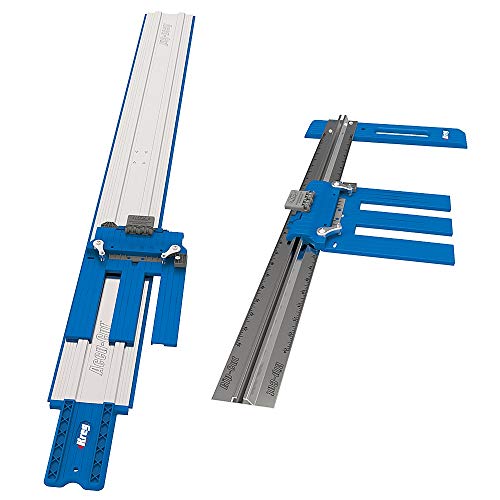 Kreg KMA2700 Accu-Cut 48-Inch Guide Track System With9.1 x 9.1 x 9.1 inches4.21 poundsCheck on Amazon


Quick Answer: Kreg Rip-Cut or Bora NGX?
If most of your cuts are parallel strips taken off the factory edge of a sheet, the Kreg Rip-Cut is the more repeatable tool: you set the width once on its scale and every rip after that matches until you change it. If you need crosscuts on a full 48-inch sheet, rips wider than 24 inches, cuts to a pencil line, or a guide that works with any saw or router, the Bora NGX Clamp Edge is the more versatile choice.
In short, the Rip-Cut wins on repeatability for same-width parts, and the NGX wins on capacity and flexibility. The sections below explain why, where each one loses accuracy, and how to set either up so your parts actually match in 2026.
Which Bora NGX? Clamp Edge vs Twin Rail Rip Guide
Most “Kreg Rip-Cut vs Bora NGX” questions mix up two Bora products. Knowing which one you are looking at changes the answer.
Bora NGX Clamp Edge is a long aluminum straightedge with a built-in clamp. Your saw runs against it like a fence, and nothing attaches to the saw. The 50-inch version (model 544050) clamps across a full 48-inch sheet, and a 50-inch extension joins to it for 100 inches of rip capacity. This is the tool most of this comparison refers to.

Bora NGX Twin Rail Rip Guide (model 546250) is Bora’s direct answer to the Kreg Rip-Cut. Like the Rip-Cut, your saw mounts to a sled that rides on rails, and a fence follows the sheet edge for repeat rips up to 24 inches. The differences are two aluminum rails instead of one, which resists racking, a micro-adjust knob for fine width changes, and tool-free saw mounting. It weighs roughly 4 to 5 lb against about 2.5 lb for the Rip-Cut, and owners report that the width adjustment can stick, so many remove the saw before changing settings. It won a 2023 Pro Tool Innovation Award.

If you want Rip-Cut-style repeatability, compare the Rip-Cut with the Twin Rail. If you want a straightedge for crosscuts and long rips, compare it with the Clamp Edge.
| Spec | Kreg Rip-Cut | Bora NGX Twin Rail Rip Guide | Bora NGX 50″ Clamp Edge |
|---|---|---|---|
| Guide type | Saw sled on one rail, edge-referenced | Saw sled on two rails, edge-referenced | Clamp-on straightedge fence |
| Max rip / cut length | 24″ from the sheet edge | 24″ from the sheet edge | 50″; 100″ with the 50″ extension |
| Needs a straight factory edge? | Yes | Yes | No |
| Full 48″ crosscut | No | No | Yes |
| Width setting | Scale and pointer, thumbscrew lock | Scale with micro-adjust knob | Measure or use a spacer block |
| Saw mounting | Clamps to universal sled | Tool-free mount | None; any flat-based tool |
| Weight | About 2.5 lb | About 4-5 lb | About 2.3 lb |
| Tools it can guide | Circular saws only (per Kreg) | Circular saws | Circular saw, jigsaw or router |
| Main weak point | Plastic sled and pointer | Plastic parts, sticky adjustment | Clamp flex on unsupported sheets |
How They Work: Sled vs Clamp Edge
The Kreg Rip-Cut and Bora NGX take completely different approaches to the same problem: getting straight, repeatable rip cuts without a table saw.
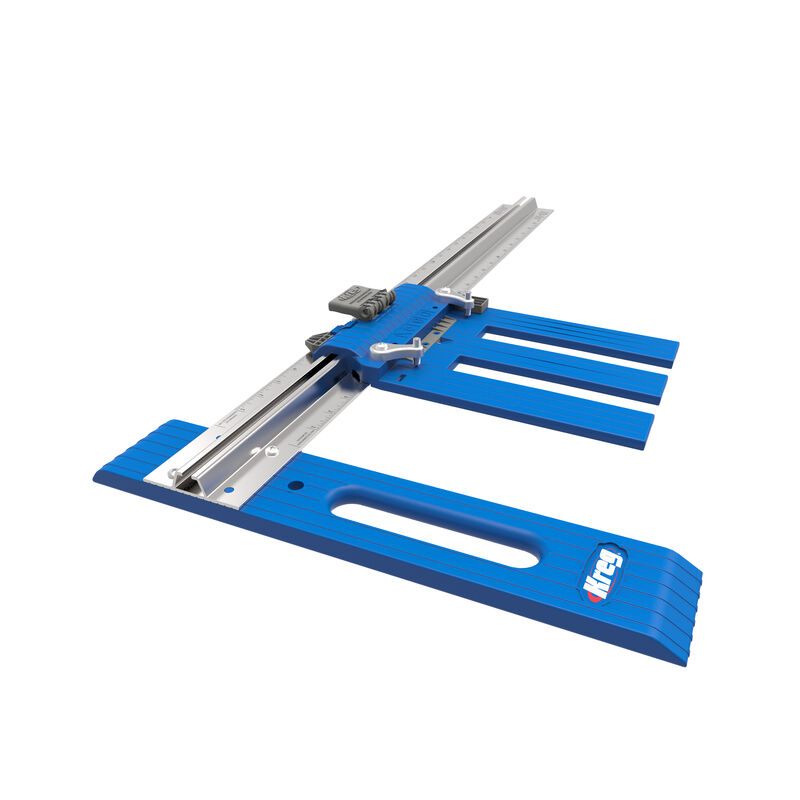
The Kreg Rip-Cut is a sled. Your circular saw mounts to a small carriage that rides on an aluminum rail. The rail has a built-in ruler and a wide edge guide that references off the edge of your sheet. You set your cut width on the sled’s scale, lock it, and push the whole assembly across the plywood. The saw and guide move as one unit. The first product card below carries a listing title that says “Cuts up to 48″ Wide”; read that as the sheet width the guide can split in half, because the rip capacity measured from the sheet edge is about 24 inches, so plan every cut around 24 inches.
As an Amazon Associate we earn from qualifying purchases at no extra cost to you.


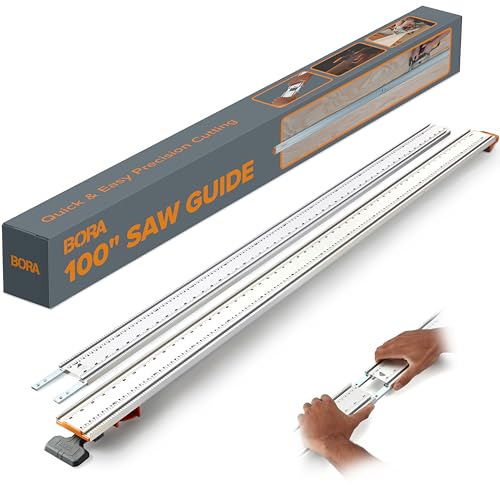
The Bora NGX is a clamp edge. It’s essentially a long, straight aluminum extrusion with a clamping mechanism on the underside. You measure, mark your cut line or set the distance from the edge, clamp the NGX to the sheet, and then run your circular saw’s baseplate against it like a fence. The saw is not attached to the guide.
That fundamental difference drives everything else about repeatability, speed, and where each system fails.
Accuracy and Repeatability Where It Counts
If you need to cut four identical 6-inch strips for a cabinet or a series of shelves, repeatability matters more than absolute accuracy. You can be off by 1/32″ from your target as long as all four parts match.
The Kreg Rip-Cut is better for repeatability once it’s set. You dial in 6″ on the integrated scale, tighten the thumbscrew, and every cut after that is the same until you move the setting. You are not measuring and marking each time. Repeatability depends on the sheet edge you are referencing from being straight and clean. The weakness is that initial setup. The built-in tape and pointer need to be calibrated. The scale may not read exactly right out of the box. You have to make a test cut, measure the actual piece, and adjust the pointer. If you skip that calibration, every cut will be consistently wrong.
The Bora NGX has no built-in measurement. Your repeatability depends entirely on how you set it. If you measure from the edge to the NGX at both ends with a tape and clamp, you introduce two measurement errors and a potential for the guide to shift while clamping. Measuring each time leaves room for small cut-to-cut variation. You can improve this by using a story stick or spacer block: cut one perfect spacer at your target width, then use it to position the NGX for every subsequent cut. That gets you close to the Kreg’s repeatability, but it requires an extra step and an extra jig.
For crosscuts or single cuts where you mark a line and align the guide to it, the NGX is actually more accurate. You can see the saw blade relative to the line and clamp exactly where you need to. The Kreg is awkward for single, non-referenced cuts because you have to do math to account for the offset.
Setup Speed and Ease of Use
The Kreg wins on quick, repeated rips. Once calibrated, the workflow is: set width, place on sheet, cut. No marking. No measuring. A 4×8 sheet breaks into six 8-inch rips quickly because nothing is marked or measured between cuts. Changing widths means loosening the thumbscrew and sliding to the new setting.
The learning curve is mounting your saw. The universal sled fits most left-blade and right-blade sidewinder saws, but you need to center the blade and make sure the sled is square. If the sled is racked even 0.5 degrees, your 24-inch wide cut will be out of square by nearly 1/4″ at the far end. Take five minutes to square it with a small square against the blade and the sled base before you tighten everything.
The Bora NGX is faster for one-off cuts. Clamp, cut, done. No saw mounting. No calibration. Anyone can use it in under a minute. For repeated rips, it is slower because you are measuring and re-clamping each time. The clamping itself is quick – the NGX levers lock with one hand and hold well on 1/2″ to 3/4″ material – but they are fussy on thin 1/4″ plywood or on material already cut narrower than the clamp span. If the sheet is not fully supported, the clamp pressure can bow the edge.
If you are looking for a fast way to break down sheet goods into same-width parts, a dedicated Kreg Rip-Cut circular saw guide saves a lot of marking time. If you mostly need a reliable straightedge for occasional cuts, the clamp-style guide is simpler.
Capacity and Compatibility
| Feature | Kreg Rip-Cut | Bora NGX Clamp Edge |
|---|---|---|
| How It Guides | Saw mounted to sled, sled rides on rail | Saw base runs against clamped straight edge |
| Rip Capacity | Up to 24″ wide (with included rail) | NGX 24″, 36″, and 50″ versions available; can join two for 100″ |
| Best For | Repeated rips referenced off sheet edge | Single rips, crosscuts, angled cuts, any cut to a marked line |
| Saw Compatibility | Universal sled for most circular saws, but you must mount and square the saw; Kreg says it is not intended for worm-drive saws | Works with any circular saw, jigsaw, or router; nothing to mount |
| Reference Edge | Must have straight factory edge to reference from | Clamps anywhere, does not need factory edge |
| Accuracy Limit | Scale calibration and sled squareness | Your tape measure and clamp placement |
The 24-inch limit is the Kreg’s biggest constraint. If you need 30-inch rips for a base cabinet side, you cannot do it. The Bora NGX 50-inch model handles that easily, and you can use it for crosscutting a full 48-inch sheet width, which the Kreg cannot do at all.
Compatibility also matters. The Kreg sled adds some height to your saw base and changes the balance. On compact 6-1/2″ saws, it feels fine. On heavy 7-1/4″ saws, especially right-blade saws where the motor hangs over the guide, it can feel tippy and the sled can flex if you push down hard. The Bora NGX Clamp Edge guide does not care what saw you use, but you need a flat, smooth saw base. Stamped steel bases with a rough edge will catch and leave marks on the aluminum guide.
Cut Quality, Tear-Out, and Depth of Cut
Repeatable dimensions are only half of a good rip. The other half is a clean edge you do not have to sand, plane, or hide with edge banding. Neither guide changes how your blade cuts, but each one changes how well you can control the saw through the cut.
Why the cut edge splinters
A circular saw blade spins upward through the material, so the top face of the sheet takes most of the tear-out. With either guide, put the good face down. On veneered plywood and melamine, a fine-tooth blade (a 40- to 60-tooth finishing blade on a 7-1/4″ saw) makes a much bigger difference to edge quality than the guide does. A strip of painter’s tape along the cut line on the show face also reduces chipping on brittle veneers.
How each guide affects edge quality
The Kreg Rip-Cut holds the saw at a fixed relationship to the sheet edge, which keeps the blade from wandering mid-cut. Wander is the most common cause of a scalloped or burned edge with a freehand saw. The catch is that the sled only references the sheet edge at one point near the saw, so any wave in that edge transfers straight into your cut. Rough or damaged edges produce rough parts.
The Bora NGX guides the saw base along a long, rigid edge, so the line is as straight as the extrusion. That makes it better for the first cut on a sheet with a bad factory edge. Edge quality depends on keeping the saw base tight against the fence for the whole pass. If you let the saw drift away from the extrusion even briefly, you get a small step in the cut.
Depth of cut and the NGX saw plate
Running the saw base directly against the NGX costs you no cutting depth. Bora also offers a saw plate accessory that rides in the extrusion like a mini track system. It removes the need to measure blade offset, but the plate sits under the saw base and reduces maximum cut depth by roughly the plate’s thickness. That still clears 3/4″ sheet goods with a 7-1/4″ saw, but it can get tight with a 6-1/2″ or smaller cordless saw on thicker stock. The Kreg sled also raises the saw slightly, as noted above, so check your remaining depth before ripping 1-1/2″ material with either setup.
Crosscuts, Angles, and Full-Sheet Breakdown
Most comparisons focus on rips, but a typical cabinet or shelving project starts by crosscutting a 4×8 sheet into manageable lengths. This is where the two tools separate most clearly.
Kreg Rip-Cut: It is built mainly for rips. Kreg also lists crosscuts, but only up to 24 inches wide, and the sled needs a straight, parallel reference edge. Crosscutting a full 48-inch sheet width is not what it is designed for, and angled cuts are not practical because the sled references squarely off the edge.
Bora NGX: The standard clamp locks the extrusion at 90 degrees to the edge you hook it on, which makes square crosscuts quick on a full sheet. For angled cuts, such as tapers or a sloped side panel, you mark both ends of the line and clamp the guide to it. Bora offers optional clamp accessories that hold the extrusion at other angles. Longer NGX lengths, or two sections joined, handle the 96-inch rip along a full sheet that the Rip-Cut cannot reach.
A practical workflow many small shops use: crosscut the sheet to rough length with a clamp edge, then switch to the sled for the repeated same-width rips. Each tool does the part of the job it is best at.
Durability and Common Failure Modes
Neither tool is a lifetime track saw, but both hold up if you understand how they fail.
Kreg Rip-Cut failures: The plastic sled and pointer are the weak points. Overtightening the thumbscrew cracks the pointer housing, and dropping the sled can knock the pointer out of calibration without visible damage. The aluminum rail is thin and will kink if stored leaning against a wall under weight. A kinked rail causes the sled to bind mid-cut, which usually results in a burn mark and a curved cut. Sawdust packed in the sled channel also causes binding – blow it out every few cuts.
Bora NGX failures: The clamp pads are rubber and lose grip when dusty. Wipe them before clamping MDF, which creates fine dust that coats everything. The bigger issue is clamp deflection. If you clamp a 50-inch NGX to a sheet supported only on two sawhorses, the middle of the guide can flex if you press your saw hard against it. Light, consistent pressure is critical. Push the saw forward, not sideways into the fence. Also, the NGX extrusion can dent if dropped on concrete, and any dent on the guiding edge will telegraph into your cut as a bump.
For long-term accuracy, store both flat or hung horizontally. Do not use either guide as a straightedge for marking with a utility knife – you will nick the edge and ruin it as a saw fence.
Head-to-Head Scorecard
This scorecard summarizes the practical differences covered above. “Edge” means the tool that generally has the advantage for that task, not a rating of overall quality.
| Task or factor | Kreg Rip-Cut | Bora NGX Clamp Edge | Edge |
|---|---|---|---|
| Repeated same-width rips | Set once on the scale, no re-measuring | Needs a spacer block or careful measuring each time | Kreg |
| Single cut to a marked line | Awkward; requires offset math | Align and clamp directly to the line | Bora |
| Rips wider than 24″ | Not possible with the standard rail | Handled by longer NGX lengths | Bora |
| Full-sheet crosscuts | Not designed for it | Quick square clamp-on crosscuts | Bora |
| Rough or damaged sheet edges | Copies the edge into the cut | Ignores the edge; follows the extrusion | Bora |
| Saw and tool compatibility | Saw must be mounted and squared | Any flat saw base, jigsaw, or router | Bora |
| Setup between different widths | A few seconds once calibrated | Re-measure and re-clamp | Kreg |
| Storage and portability | Compact; fits in a drawer or bin | Long extrusion needs wall or rack space | Kreg |
| Upgrade path | Track bundle and Kreg straight-edge guides | Extensions, saw plate, router and rip accessories | Bora |
Step-by-Step: Getting Matching Parts From Either Guide
Accuracy comes more from routine than from the tool itself. These steps apply to both systems and fix the most common sources of mismatched parts.
- Support the whole sheet. Cut on a sheet of rigid foam insulation or a grid of 2x4s on sawhorses so both the part and the offcut stay supported. A sagging offcut pinches the blade, which causes burning and can lead to kickback.
- Set blade depth about 1/4″ below the material. A shallow blade setting gives a cleaner cut and reduces the load on the saw and the guide.
- Make a test cut on scrap first. Measure the actual strip with a tape or calipers, not the scale or a mark. For the Kreg, adjust the pointer to match. For the NGX, use that strip as your spacer block for the remaining cuts.
- Check the reference edge. For the Kreg, run a straightedge along the factory edge before you start. If it is not straight, trim it first with the NGX or another straightedge, then rip off that clean edge.
- Feed steadily with forward pressure. Push the saw along the cut line, not sideways into the guide. Sideways pressure flexes a clamp edge and twists a sled.
- Cut all same-width parts in one session. Changing the setting and coming back to it later is where small differences creep in.
Expanding Each System: Accessories and Alternatives
Both guides belong to larger product families, and the upgrade path matters if you expect your projects to grow.
Kreg options
Kreg sells the Rip-Cut in a bundle with its 48-inch Accu-Cut guide track, which adds track-guided crosscuts and long straight cuts to the Rip-Cut’s repeat-rip setup. If you like the idea of a clamp-on straightedge but want to stay with one brand, the Kreg Straight Edge Guide XL is a 98-inch clamp-style guide that covers full-length rips on an 8-foot sheet. Together they cover most of what the Bora system does, at a higher combined cost than either tool alone.
Bora options
The NGX system is modular. Shorter and longer extrusions can be joined for long rips, and Bora offers a saw plate that removes blade-offset measuring, a router accessory for dadoes, and angle clamp accessories. Bora also makes the NGX Twin Rail Rip Guide, a saw-mounted rip guide that works like the Kreg Rip-Cut and pairs with the NGX system. If you want Rip-Cut-style repeatability inside the Bora family, that is the closest match.
Step up without a track saw: Kreg Accu-Cut or a 100-inch NGX
If you outgrow the Rip-Cut or a single 50-inch NGX but are not ready for a track saw, two mid-step options keep your existing circular saw.
Kreg Accu-Cut is a two-piece aluminum track (two 26.5-inch sections, about 50 inches of cutting capacity) with a universal sled that fits most 6-1/2″ and 7-1/4″ saws. Its dual guide strips have an anti-slip coating, so the track holds without clamps on most sheets, and an anti-chip edge that reduces splintering along the cut. The standard kit crosscuts a full 4×8 sheet; for full 8-foot rips you need the 50-inch expansion pack or the 100-inch Accu-Cut XL. The sled also accepts the Rip-Cut, so a Rip-Cut owner can add the track rather than start over. Check clearance beside the base plate before using it with a worm-drive saw, since the sled attaches at the side.

Bora NGX 100-inch Clamp Edge joins two 50-inch sections for full-length rips on an 8-foot sheet. It keeps the clamp-on workflow, so nothing mounts to the saw, and it accepts Bora’s saw plate, router dado jig and track clamps. Support the sheet along its length, because a 100-inch fence flexes more than a 50-inch one under sideways pressure.
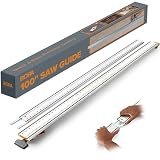
Choose the Accu-Cut if splinter-free edges on veneered plywood matter most. Choose the 100-inch NGX if you want one straightedge that also guides a router and jigsaw.
When to skip both
If you break down sheet goods every week or need splinter-free cuts in expensive veneered panels, a dedicated track saw with a splinter strip will outperform both guides in speed and edge quality. For occasional projects, either of these guides paired with a good fine-tooth blade gets you most of the way there for a fraction of the cost.
Kreg Rip-Cut vs Bora NGX: Two More Circular Saw Guides Worth Comparing
If neither guide fits your saw or budget, two other options sit close to these tools: a sled-style rip guide that Milescraft lists for worm-drive saws, and a Bora kit that adds a saw plate to the NGX Clamp Edge so you never measure blade offset.
Milescraft 1404 RipSawGuide – Best for Worm-Drive and Sidewinder Saws

The Milescraft 1404 is a direct alternative to the Kreg Rip-Cut: the saw rides on a plate, a guide bar sets the distance and an edge guide follows the sheet. It suits a DIYer who wants repeat rips up to 24 inches and owns a worm-drive saw.
- Fits sidewinder and worm-drive saws with a 5-1/2″ to 7-1/4″ blade, per Milescraft
- 24″ edge range, so it shares the Rip-Cut’s width limit
- Four clamping points on a rubberized aluminum saw plate
- Laser-etched scale in 1/16″ increments with a micro-adjust indicator for calibration
- Extruded aluminum guide bar with a reinforced plastic edge guide
Pros: Maker lists worm-drive compatibility; zero-and-calibrate setup is simple; the same cut-test routine used for the Rip-Cut works here.
Cons: Still limited to 24 inches; needs a straight factory edge; the 1/16″ scale means a scrap test cut is still required for tight fits.
Skip it if you need full-width crosscuts on a 48-inch sheet or want one guide for a router and jigsaw as well.
Bora NGX Saw Plate RT with 50-Inch NGX Clamp Edge – Best for Cuts Without Measuring Blade Offset

This kit turns the NGX Clamp Edge into a track-style setup: the saw snaps into a plate that rides the extrusion, so you line the cut mark up with the edge instead of calculating the offset from the blade. It suits someone who likes the NGX clamp workflow but makes many cuts to a pencil line.
- 50″ NGX Clamp Edge, expandable to 100″ with the 50″ extension
- Saw Plate RT with tool-free mounting for right- and left-handed saws
- Bora’s manual lists saw bases under 7-3/4″ wide and 9″ to 12-3/4″ long
- Blade must sit within 1-3/4″ of the base edge
- Track clamps included for cutting at an angle
Pros: No offset math; the straightedge still works alone with a router or jigsaw; angled cuts are practical with the clamps.
Cons: The plate sits under the saw and trims usable cut depth; compact cordless saws may fall outside the base-size range; costs more than the clamp edge alone.
Skip it if you only rip same-width strips, where the Kreg Rip-Cut or Twin Rail sleds are quicker.
Kreg Rip-Cut vs Bora NGX by Project
Match the guide to the job you do most often. These are the common sheet-goods projects and the tool that fits each one better.
- Bookshelves and closet shelving (many 10″ to 12″ strips): Kreg Rip-Cut. Set the width once and every shelf matches. The Bora NGX Twin Rail Rip Guide works the same way if you already own NGX gear.
- Base cabinet sides (about 23″ to 24″ deep): either sled works at its limit, but the Bora NGX Clamp Edge is safer at full width because the sled is fully extended and more likely to flex.
- Wider panels such as 30″ desk tops or wardrobe sides: Bora NGX Clamp Edge. Both sled-style guides stop at 24 inches.
- Breaking down a 4×8 sheet in a driveway: Bora NGX Clamp Edge for the first 48-inch crosscut, then a sled for repeated strips.
- Trimming a door or a tapered panel: Bora NGX Clamp Edge, because you align it to a pencil line at both ends.
- Shiplap, plywood flooring or wall paneling: Kreg Rip-Cut for fast, identical strips from a straight factory edge.
- Dadoes for shelf supports: Bora NGX Clamp Edge with a router; the Rip-Cut only works with a circular saw.
- Small apartment or shared workshop: Kreg Rip-Cut. It fits in a drawer, while the 50-inch NGX needs wall or rack space.
If two or more of your regular projects land on each side of this list, owning both is the practical answer, and together they still cost far less than an entry-level track saw.
Which Should You Buy?
Buy the Kreg Rip-Cut if your primary work is breaking down plywood into multiple parallel strips: shelving, cabinet carcasses, shiplap, or flooring underlayment. The set-once, cut-many workflow is genuinely faster and more repeatable than measuring each cut. Just calibrate it on scrap first and verify the sled is square. It is the cheaper option and it is completely fine for that specific job, even if it is not as robust as a full track system. Kreg now lists the original Rip-Cut as a legacy model, so check that your seller has it in stock.
Buy the Bora NGX if you need more versatility. It handles rips beyond 24″, crosscuts, mitered cuts, and works with any saw or router without setup. It is also the better choice if you often cut from a marked line rather than from the sheet edge, or if your sheet edges are rough or damaged. For repeatability with the NGX, make a spacer block at your target dimension and use it to set the guide instead of measuring with a tape each time.
Many small shops end up owning both. They are not expensive compared to a track saw, and they cover different tasks. If you can only buy one and you have to prioritize repeatable rips for built-ins or cabinets, the sled design is the more repeatable system out of the box. If you want one straightedge that does a little of everything, get the clamp edge.
If you are comparing full systems, looking at a dedicated circular saw track guide system is worth considering when your budget allows, but when you only need a sheet-goods guide on a modest budget, the choice between these two comes down to repeated rips versus general straight cuts.
Frequently Asked Questions
Can the Kreg Rip-Cut crosscut a full 4×8 sheet?
No. The Rip-Cut is designed for rips referenced off a straight edge, with a capacity of about 24 inches from that edge. To crosscut the full 48-inch width, use a clamp-style straightedge such as the Bora NGX or Kreg’s track and straight-edge guides, then switch back to the Rip-Cut for repeated strips.
Which is more accurate, the Kreg Rip-Cut or the Bora NGX?
It depends on the type of accuracy you need. For matching widths across several parts, the calibrated Kreg sled is more repeatable because you do not re-measure each cut. For hitting a single marked line exactly, the NGX is more accurate because you align the guide directly to the line.
Will the Kreg Rip-Cut fit my cordless circular saw?
The sled is designed to fit most left-blade and right-blade sidewinder circular saws, including many cordless 6-1/2″ and 7-1/4″ models. Compact saws generally feel more balanced on the sled than heavy corded saws, and Kreg says the sled is not intended for worm-drive saws or saws with a plastic upper blade guard. Check that your saw’s base plate is flat and can be clamped securely to the sled before buying.
Can I use the Bora NGX with a router or jigsaw?
Yes. Because the NGX is simply a straight fence clamped to the work, any tool with a flat base can run along it, including routers and jigsaws. Bora also sells a router accessory for cutting dadoes, which is useful for shelving and cabinet backs.
How do I stop plywood from splintering with either guide?
Use a fine-tooth finishing blade, place the good face down, set the blade just below the material, and support both sides of the cut. Painter’s tape over the cut line on the show face also helps with brittle veneers and melamine.
Is either guide as good as a track saw?
Not quite. A track saw has a splinter strip and a saw that locks into the track, so edge quality and straightness are more consistent. Both guides close much of that gap for occasional sheet-goods work at a much lower cost, and many owners use one of them for years before deciding whether a track saw is worth it.
Should I buy both?
If you regularly build cabinets, shelving, or built-ins, owning both is common and practical: the clamp edge handles crosscuts, wide rips, and first cuts on rough edges, and the sled handles batches of identical strips. If you can only buy one, choose based on whether repeated narrow rips or general-purpose straight cuts make up most of your work.
Is the Bora NGX Twin Rail Rip Guide better than the Kreg Rip-Cut?
Not clearly; both rip up to 24 inches from a straight edge, so the choice comes down to details. The Bora NGX Twin Rail Rip Guide resists racking better with two rails and adds micro-adjust and tool-free saw mounting, but it weighs about 2 lb more. The Kreg Rip-Cut is lighter, fits a wide range of saws and pairs with the Kreg Accu-Cut sled system.
Can the Kreg Rip-Cut be used with a jigsaw?
No. Kreg lists the Rip-Cut for circular saws only, and its sled is not intended for jigsaws. If you want a guide for a jigsaw or router, use a clamp-on straightedge such as the Bora NGX Clamp Edge instead.
What is the difference between the Kreg Rip-Cut and the Kreg Accu-Cut?
The Rip-Cut is a saw sled with an edge guide for rips up to 24 inches, while the Accu-Cut is a track that guides the saw across a full sheet, including crosscuts. The Accu-Cut sled also accepts the Rip-Cut, so you can add the track later.
Does the Bora NGX Twin Rail Rip Guide cut wider than the Kreg Rip-Cut?
No. Both reach about 24 inches from the sheet edge. The Twin Rail adds a second rail and micro-adjust, while rips wider than 24 inches need a clamp edge such as the 50-inch NGX.
Is the Bora NGX the same as the older Bora WTX?
No. The WTX is Bora’s earlier clamp edge and the NGX is the newer version. Bora lists its saw plate and track clamps as compatible with both, so accessories are often shared.