What's inside
As an Amazon Associate I earn from qualifying purchases. This post may contain affiliate links at no extra cost to you.
Heavy edge profiling puts more load on a router bit than ordinary roundovers or small chamfers. A large profile removes more material, stays engaged with the work longer, and creates greater leverage against the shank. Choosing the right shank diameter is therefore a matter of tool capacity, cut size, workpiece material, and how much risk you are willing to accept—not simply buying the largest bit that fits.
The basic choice: 1/4-inch or 1/2-inch shank
For serious edge work, a 1/2-inch shank is the preferred option whenever your router accepts it. The larger shank is stiffer and resists bending, which helps the bit track more predictably and reduces vibration. It also gives the cutter a larger bearing surface in the collet.
A 1/4-inch shank is not automatically unsafe or poor quality. It is usually adequate for small roundovers, flush-trim bits, rabbeting bits, and profiles with a modest cutting diameter. It is also useful with compact routers, trim routers, and jobs involving thin stock. The problem comes when a small shank is paired with a large, aggressive cutter.
As a general buying rule, use a 1/2-inch shank router bit for large roundovers, ogees, coves, and raised-panel-style edge profiles. Choose a 1/4-inch shank when the profile is small, the cut is light, or your router cannot safely accept the larger size.
Why shank diameter matters
A router bit’s shank does not perform the cutting, but it transfers the motor’s torque and the cutting force into the collet. A 1/2-inch shank has four times the cross-sectional area of a 1/4-inch shank. That does not mean it is four times stronger in every real-world situation, because steel grade, flute design, overhang, and manufacturing quality also matter. It does mean the larger shank has substantially more resistance to flexing.
Flex creates several failure modes. The bit can chatter, leave scalloped marks, or produce an inconsistent bearing line. In extreme cases, the bit can slip in the collet, bend, or break. A large bit on a 1/4-inch shank also concentrates stress at the transition between the cutter body and shank. That is a poor combination for deep passes in hardwood.
Shank size does not eliminate kickback. A heavy 1/2-inch bit can still grab the work if you feed in the wrong direction, take too much material, or allow the stock to move. It simply gives the cutting assembly more rigidity when used within its rated limits.
Match the bit to the router
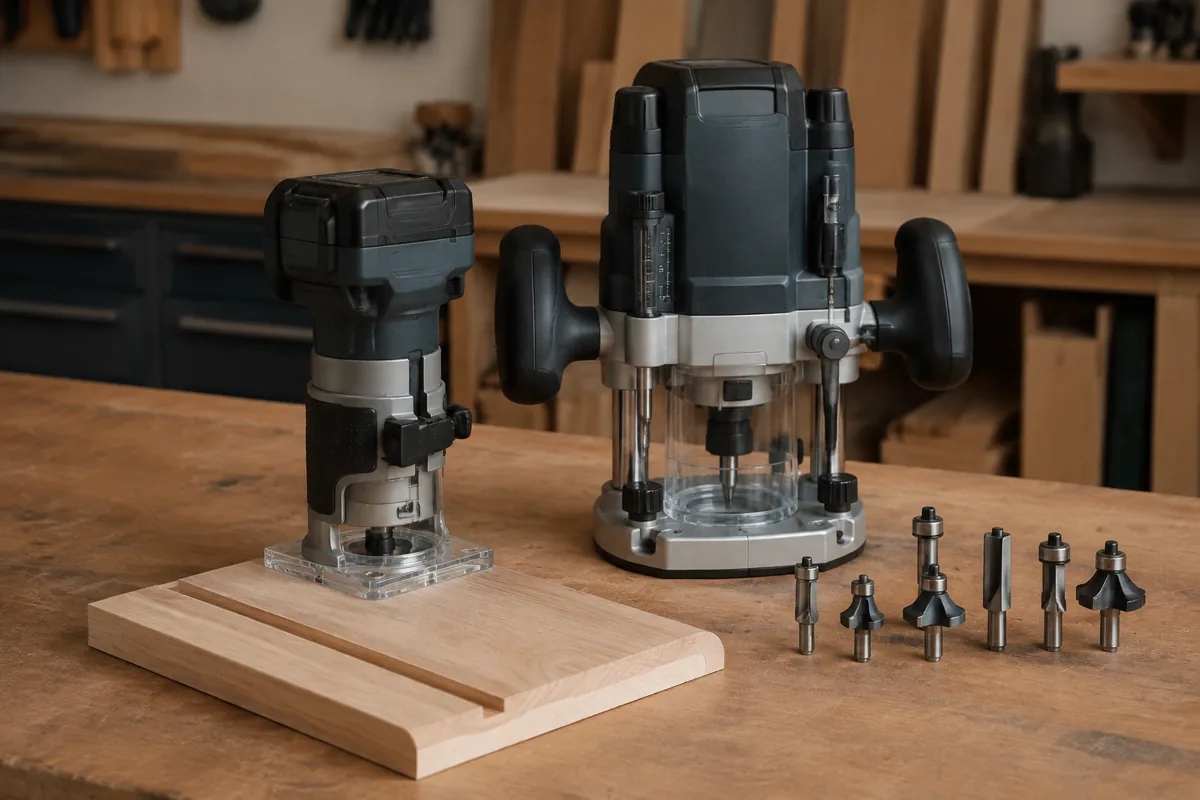
Check the router’s collet before shopping. A 1/2-inch-capable router may include both 1/2-inch and 1/4-inch collets, but a trim router generally accepts only 1/4-inch shanks. Never use a reducing sleeve, improvised adapter, or a 1/2-inch bit in a nominally smaller collet.
| Shank diameter | Best use | Main advantage | Main limitation |
|---|---|---|---|
| 1/4 inch | Small profiles, trim routers, light work | Lower cost and broad compatibility | More flex with large cutters and deep cuts |
| 3/8 inch | Some specialty and metric-sized bits | More rigidity than 1/4 inch | Less common in typical home workshops |
| 1/2 inch | Large profiles, hardwood, production work | Greater stiffness and collet engagement | Requires a compatible full-size router |
Router power matters just as much. A large profile bit may physically fit in a compact router but still overload its motor, especially in dense hardwood or solid-surface material. A full-size router in the roughly 2-1/4 to 3-1/4 horsepower class is a more appropriate match for substantial 1/2-inch-shank edge cutters. Follow the bit manufacturer’s maximum diameter and speed limits; those restrictions override general rules.
Consider profile size and pass depth
The larger the cutter diameter, the more important the 1/2-inch shank becomes. A small 1/4-inch roundover typically removes little material and places limited leverage on the shank. A 2-inch or larger ogee, cove, or panel-raising cutter creates much greater force as its edge engages the stock.
Do not try to complete a heavy profile in one pass just because the bit is large and the shank is strong. Make several passes, lowering the bit incrementally. For a deep hardwood profile, removing 1/8 to 1/4 inch per pass is a reasonable starting point, then adjust based on the router’s sound, feed resistance, and cut quality. Leave a final light pass—about 1/32 inch—if the setup allows it.
For particularly large profiles, remove most of the waste with a saw, planer, or smaller router bit first. A profile bit should shape the edge, not act as a waste-removal machine. This is especially important with end-grain work, where the cutter can catch as it exits the board.
Collet engagement and setup
Insert the shank fully into the collet, then pull it back approximately 1/16 inch before tightening. This prevents the shank from bottoming out while preserving maximum gripping area. At least about 3/4 inch of clean shank should be engaged when the bit design permits; never clamp on the fluted portion, bearing journal, or rounded transition.
Keep the collet and shank clean. Dust, resin, or rust can reduce grip and make a bit appear tight while it is still able to slip under load. Tighten with the supplied wrench system rather than relying on hand pressure. After a short test cut, stop the router and check that the bit has not moved.
When buying replacements, a 1/2-inch-shank profiling bit set can cover common edge shapes, but inspect each bit individually. Avoid sets that offer unusually large cutters on 1/4-inch shanks simply to keep the price low.
When the cheaper option is fine
A 1/4-inch bit is a sensible, economical choice for small furniture edges, plywood easing, laminate trimming, and occasional softwood work. If you already own a compact router and need a 1/4-inch roundover or chamfer, there is no benefit in replacing the whole setup solely for a small profile.
Spend more on a 1/2-inch shank when the bit is large, the material is hard, the cut is deep, or the edge must be clean and repeatable. Look for carbide quality, balanced construction, a secure bearing, and clear speed guidance. A premium cutter with the wrong shank size is still the wrong tool, while an inexpensive but properly sized bit can perform well when used in light passes.
Safe working practice for heavy profiles
Use the router’s recommended speed, and reduce speed for very large diameters if the bit instructions call for it. Clamp the work securely, support wide stock, and keep both hands on the router when practical. Feed against the cutter’s rotation in normal edge routing, and use a climb cut only as a small controlled cleanup cut with a firm grip and minimal depth.
Before routing, confirm that the bearing turns freely, the cutter has no chipped carbide, and the bit is fully seated. Make a test cut in scrap from the same material. If the router labors, the bit vibrates, or the edge burns, stop and reduce the depth rather than forcing the cut. For heavy edge profiling, correct sizing and controlled passes matter more than simply choosing the most expensive cutter.