What's inside
As an Amazon Associate I earn from qualifying purchases. This post may contain affiliate links at no extra cost to you.
Our Top Picks



The short answer
The Metabo HPT C10FCGS is generally easier to align. It is a compact, non-sliding compound miter saw with fewer moving parts, a straightforward fence, and less opportunity for rail play to affect the cut. The Ryobi TSS102L is more versatile because it slides and can cut wider boards, but its alignment involves more checks: the blade, fence, miter table, slide mechanism, and laser.
Choose the Metabo HPT if most of your work involves trim, 2x4s, 1x6s, and repeatable crosscuts. Choose the Ryobi if you need to crosscut material roughly 10 to 12 inches wide and are willing to spend more time checking the saw after setup or transport.
As an Amazon Associate we earn from qualifying purchases at no extra cost to you.


What each saw does
Both saws use a 15-amp motor and a 10-inch blade. Both are single-bevel compound saws, so the head tilts to the left but does not bevel in both directions. That is normal at this price level and means some crown-molding cuts require flipping the workpiece.
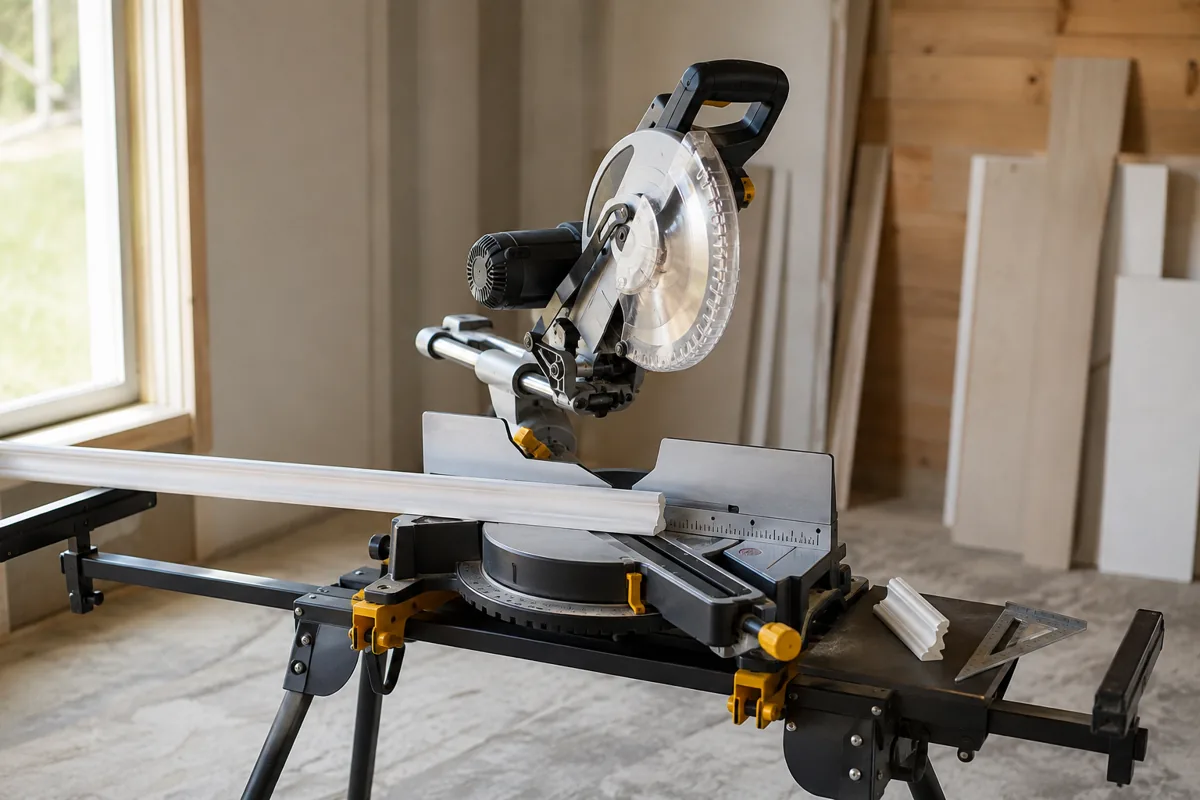
The C10FCGS is a fixed-head saw. Its advantage is rigidity: the blade travels down through the work rather than moving forward and backward on rails. The TSS102L adds sliding rails, allowing a substantially wider crosscut. That extra capacity is useful, but the rails introduce another source of movement. Even a small amount of rail looseness can produce a cut that is square at the front and slightly out at the rear.
| Feature | Metabo HPT C10FCGS | Ryobi TSS102L |
|---|---|---|
| Basic design | Non-sliding compound miter saw | Sliding compound miter saw |
| Blade size and motor | 10 inches, 15 amps | 10 inches, 15 amps |
| Bevel | Single bevel, left | Single bevel, left |
| Miter range | Typically 0–52 degrees, left and right | Typically 0–47 degrees left and 0–50 degrees right |
| Wide-board capacity | Limited by the fixed blade path | Much greater, thanks to the slide |
| Alignment difficulty | Lower | Moderate; slide play must also be checked |
Which one is easier to square?
On the Metabo HPT, alignment is mostly a matter of getting the blade square to the table and the fence square to the blade. Loosen the bevel lock, place a reliable combination square against the blade, and adjust the stop or bevel setting until there is no visible gap. Then check the fence with the miter table set to zero.
The fixed design helps because the blade follows a predictable arc. If the saw is square at the front of the blade, it is usually consistent through the cut. A poor factory setup, a bent blade, or a fence that was knocked during transport can still cause trouble, but the fault is easier to find.
The Ryobi requires those same checks plus a slide check. Pull the head toward you, lower it without powering the saw, and push it through its travel. Watch whether the blade shifts sideways or twists as the rails extend. A small amount of movement may not matter on rough framing, but it can show up as a visible gap in a picture frame or baseboard joint.
For either saw, do not use the printed laser line as an alignment reference. Lasers can be useful for rough positioning, but they can shift, appear differently in bright light, and indicate the side of the blade rather than the exact finished edge. Align the blade itself with a marked cut line.
Fence and miter-scale accuracy
Fence accuracy matters more than the printed miter scale. A scale can read zero while the fence is slightly out of square. Place a straight reference board against the fence, make a cut, and compare the two cut faces by flipping one piece over and bringing the edges together. If the joint forms a gap, adjust the fence rather than trusting the dial.
The C10FCGS has the simpler fence arrangement and is less likely to develop alignment issues during normal use. Its miter detents are convenient for common angles, but detents are not proof of precision. Sawdust under the table, a loose pivot, or a fence that is not firmly tightened can move the setting by a fraction of a degree.
The TSS102L’s sliding function makes fence setup more important. A board can rest against one portion of the fence while the blade travels across another, exposing any mismatch between fence sections. Keep both fence faces coplanar. If one side is slightly forward, the workpiece can rock as it is cut.
A practical alignment test
After setup, install a sharp, good-quality blade and secure the saw to a solid bench. Cut a piece of straight scrap at 90 degrees. Check the cut with a square on both faces. Next, cut two pieces at 45 degrees and bring the mitered ends together. Finally, on the Ryobi, make a wide sliding cut near the saw’s rated capacity and check the cut at both ends.
If a narrow cut is square but a wide Ryobi cut is not, inspect the rails and your cutting technique before changing the fence. Pull the head fully forward, start the blade, lower it into the work, and push it steadily through the board. Dragging the head backward into the cut can make the blade grab and deflect.
Which one should you buy?
For a homeowner or trim installer who values quick setup, the C10FCGS is the better alignment choice. It is also a sensible option if you already own a miter saw stand and cut mostly narrow stock. The cheaper fixed saw is fine when its capacity matches the job; buying a slider does not automatically produce better joints.
The TSS102L earns its place when wide boards are part of the work. It can save time compared with making multiple passes or using a circular saw for shelving, deck boards, and wider trim. If you select it, plan to verify the slide and fence during setup and after moving the saw. A precision combination square is more useful for this job than relying on the built-in laser.
In short, the Metabo HPT has the easier path to accurate cuts because it eliminates the slider from the alignment equation. The Ryobi is the more capable saw, but that capability comes with an alignment checklist. For clean, repeatable work, the simpler machine is often the one that gets used correctly.