What's inside
As an Amazon Associate I earn from qualifying purchases. This post may contain affiliate links at no extra cost to you.
A dial caliper is a practical choice for checking router-bit shanks and saw arbors because it gives a direct, readable measurement without batteries. The important decision is not which caliper has the fanciest case. It is whether its range, resolution, jaw shape, and condition suit the measurements you need—and whether you measure clean, accessible surfaces accurately.
As an Amazon Associate we earn from qualifying purchases at no extra cost to you.


Our Top Picks
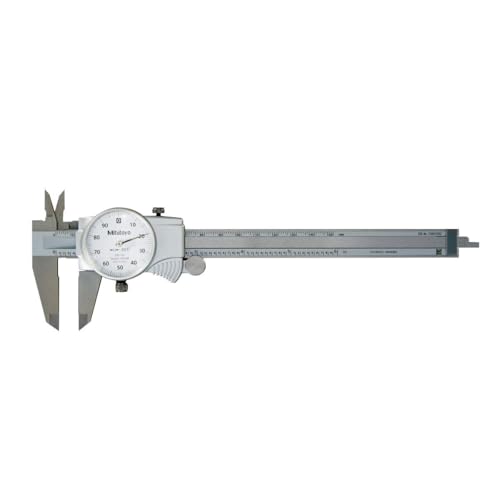 Mitutoyo 505-742J Dial Caliper10.6"L x 4.5"W x 1.4"H10.6 x 4.5 x 1.4 inches0.01 PoundsCheck on Amazon


What you need to measure
Router-bit shanks are commonly 1/4 inch or 1/2 inch. A caliper helps confirm the shank size before you buy a collet or install a bit, and can reveal a shank that is undersize, damaged, or coated with debris. Do not use a 1/4-inch bit in a 1/2-inch collet with a reducing sleeve unless the router and sleeve maker specifically allow it. A caliper is a check, not a substitute for the correct collet.
Saw arbors vary by machine. Measuring an exposed arbor can help identify its diameter when replacing a blade, spacer, or flange. But the arbor’s diameter alone does not establish that a blade fits: arbor-hole size, blade thickness, flange condition, thread direction, and the saw’s specifications also matter. Unplug the tool before measuring, and do not measure a spinning or energized machine.
Dial versus digital
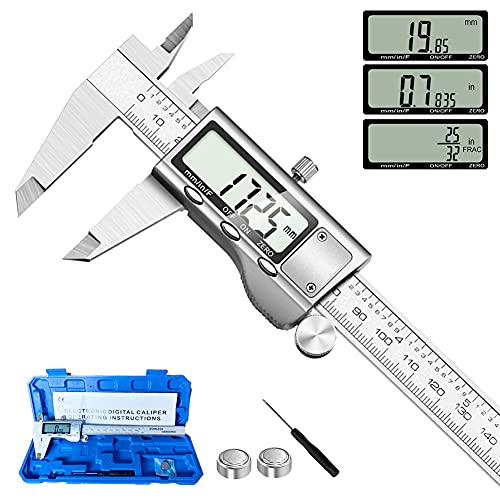
A dial caliper has a rack-and-pinion movement and a pointer that turns around a graduated face. Most common inch models display thousandths of an inch (0.001 inch); some have a dial marked in 0.001-inch increments with a revolution counter. Digital calipers usually show a direct decimal reading and can switch between inch and metric, but need a battery and may be less convenient if left in a damp shop or stored with the jaws under pressure.
For occasional woodworking checks, a sound entry-level dial model is usually enough. Paying more can buy smoother movement, better fit and finish, and more dependable repeatability. It does not make a caliper accurate enough to replace a micrometer for close-tolerance work. If you routinely need to distinguish a few ten-thousandths of an inch, consider a micrometer instead.
Start with a 6-inch inch-reading dial caliper if you want a straightforward tool for router shanks and most small arbors. That range covers typical woodworking measurements while remaining easier to handle than a long caliper.
What to buy for the job
| Type | Good fit for | Trade-off |
|---|---|---|
| Basic 6-inch dial caliper | Router-bit shanks, small parts, accessible arbors | May need careful zeroing; quality varies |
| Better-finished 6-inch dial caliper | Frequent checks and smoother, more repeatable operation | Higher price; still not a micrometer |
| Digital caliper | Quick inch/metric readings and occasional depth checks | Battery dependence; display does not guarantee accuracy |
| Micrometer | Close-tolerance diameter checks | Narrower range and slower to use |
A stainless-steel 6-inch dial caliper is a sensible upgrade if you use one regularly. Look for a clear, legible dial, a lock screw, a thumbwheel or smooth slider, and jaws that meet without visible gaps. A fitted case is useful: chips and grit can damage the rack or keep the jaws from closing fully.
A budget tool is fine for confirming whether a clean router shank is near 1/4 or 1/2 inch, provided it returns to zero and repeats the same reading. Skip a caliper with a loose slider, a sticky pointer, bent jaws, or a dial that shifts when you lock it. Those faults can produce plausible-looking numbers that are not dependable.
How to measure without fooling yourself
Wipe the shank or arbor and the caliper jaws clean. Close the jaws gently, check that the pointer reads zero, and use the bezel to set zero if the design allows it. If the pointer does not settle consistently, do not trust the measurement. Avoid squeezing hard: caliper jaws are easy to deflect, and excessive force can distort a reading on small or flexible parts.
For an outside diameter, place the part squarely between the large outside jaws. Measure a router shank on a smooth, unworn section rather than across a flute, burr, or mark. Take readings at several positions, rotating the part about 90 degrees between checks. A difference between directions may indicate damage, dirt, or out-of-roundness—not necessarily a different nominal size.
On an arbor, measure only an accessible cylindrical section, not the threads or a shoulder. If the arbor is still mounted, restricted access can tilt the jaws and give a false reading. Remove the blade and follow the saw manual’s safety and service instructions where needed; do not force the caliper into a tight gap. If you cannot seat the jaws squarely, use the machine’s stated arbor size or have the part measured with suitable equipment.
Limits and care
A dial caliper marked in 0.001-inch divisions does not promise every reading is accurate to 0.001 inch. Dirt, jaw wear, misalignment, backlash, and hand pressure all affect results. A caliper may also read differently near the tips than farther along the jaws. For a critical fit, compare against a known standard or use a calibrated micrometer.
Keep the rack and jaws free of sawdust and resin, and store the caliper closed lightly or with a small gap—not clamped hard in its case. Never use it as a clamp or scribe. If you work in metric as often as inches, a digital inch/metric caliper may be more convenient. For the specific task of checking router shanks and ordinary saw arbors, though, a clean, zeroing 6-inch dial caliper is usually the simpler buy.