What's inside
As an Amazon Associate I earn from qualifying purchases. This post may contain affiliate links at no extra cost to you.
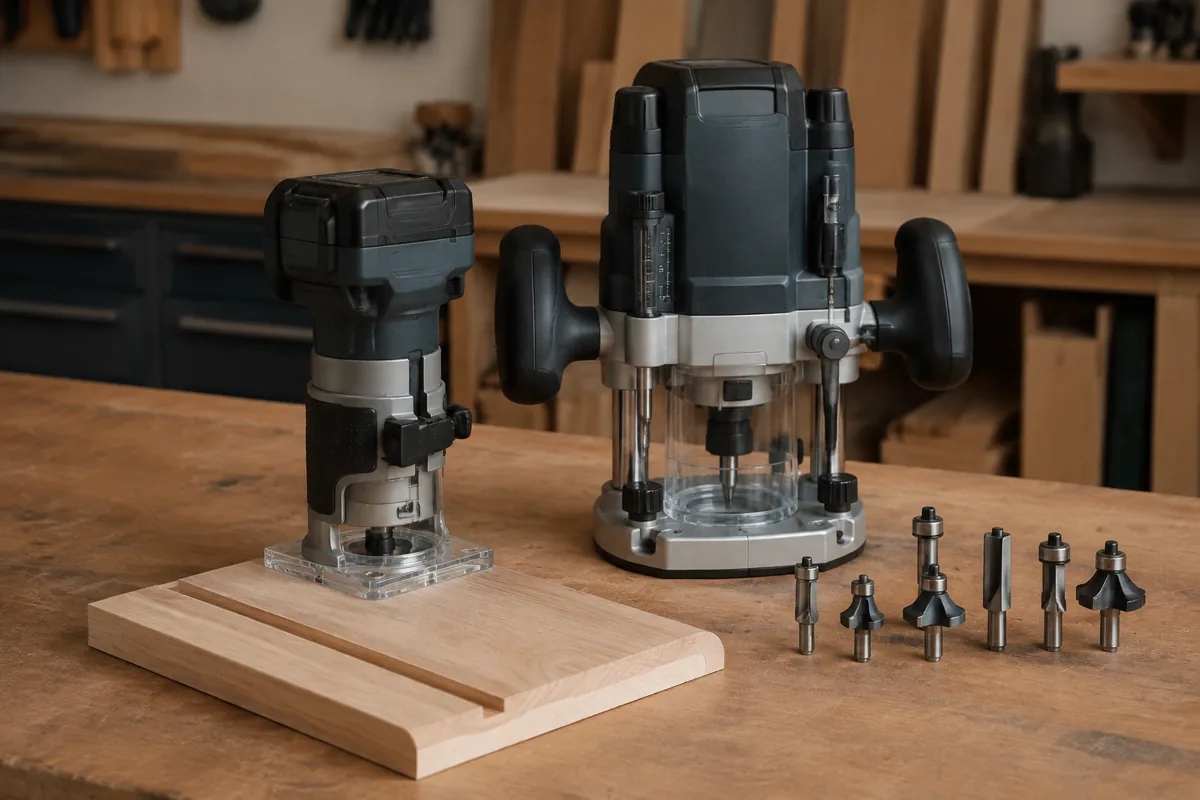
Choosing a router bit shank is mostly a matter of matching the bit to the router’s collet. A 1/2-inch shank will not fit a 1/4-inch collet, and a collet that accepts a larger shank should not be treated as a reason to buy the biggest bit available. The right choice also depends on the cut: bit diameter, cutting depth, material, and how steadily the router can control the tool.
Match the shank to the collet
Common router-bit shank diameters are 1/4 inch, 1/2 inch, 8 mm, and 12 mm. These sizes are not interchangeable. An 8 mm shank is about 0.315 inch, not 5/16 inch; a 12 mm shank is about 0.472 inch, not 1/2 inch. Use a collet made for the exact shank size. Do not force a bit into a collet or use an improvised sleeve.
Check the router manual and the markings on the collet before buying. Some routers accept only 1/4-inch bits; others include separate 1/4-inch and 1/2-inch collets. A replacement collet must be approved for that router. A loose fit, damaged collet, or bit held too shallowly can let the cutter slip or eject during use.
Insert the shank as directed in the manual. In most cases, it should go fully into the collet and then be backed out slightly before tightening, so the end does not bottom out. Keep enough shank engaged for a secure grip, and never clamp onto the fluted cutting section.
Compare the common shank sizes
| Shank | Typical advantage | Trade-off | Best fit |
|---|---|---|---|
| 1/4 inch | Fits many compact routers; often cheaper and widely available | More prone to flex and vibration with large cutters or heavy cuts | Small profiles, laminate trimming, light routing |
| 1/2 inch | Stiffer, with a larger gripping area | Needs a compatible router and collet; bits can cost more | Large-diameter cutters, deep or demanding cuts |
| 8 mm | Common on some imported routers and bit sets | Not interchangeable with 1/4 inch | Routers supplied with an 8 mm collet |
| 12 mm | Used on some larger routers and regional tool lines | Not interchangeable with 1/2 inch | Routers with a matching 12 mm collet |
For a small round-over or flush-trim bit taking a light pass, a 1/4-inch shank is often entirely adequate. The cheaper option makes sense if it matches the router, the cutter is modest in size, and the cut is not demanding. For a larger profile bit or sustained work in hardwood, the added stiffness of a 1/2-inch shank can help reduce chatter and deflection. It does not make an unsafe cut safe, and it does not guarantee a better finish by itself.
Consider the cut and bit diameter
Shank size matters more as cutter diameter, cutting depth, and feed resistance increase. A wide cutter puts more leverage on the shank than a narrow one. If a small router is vibrating with a large bit, moving to a thicker shank may not solve the problem: the router may lack the power, speed range, or capacity for that cutter.
Check the router’s maximum bit diameter and speed guidance. Large-diameter bits often require lower speeds. Running one too fast can increase vibration and heat, damage the workpiece, or cause the cutter to fail. Make several shallow passes instead of trying to remove the full depth in one go. For a deep groove, step down gradually and clear chips, especially in dense wood.
For common light tasks—such as easing an edge or trimming a thin laminate layer—a properly fitted 1/4-inch bit is usually the practical buy. For a large raised-panel cutter, heavy dado work, or repeated cuts in hardwood, choose a bit with a larger shank only if your router and collet are rated for it. In that situation, a 1/2-inch-shank router-bit assortment may be useful, but check that its cutters suit your router and planned work rather than buying by set size alone.
When a compact router is enough
Compact routers are commonly built around 1/4-inch collets. That setup is convenient for one-handed control and lighter work, and it avoids paying for a larger router if you do not need one. A 1/4-inch router-bit set can cover basic edge profiles and trimming tasks at modest cost. Look for sharp cutters, secure bearings where applicable, and a usable range of profiles; a large assortment of poor-quality bits is not a bargain.
Do not put an oversized cutter into a compact router just because its shank fits. The bit’s maximum diameter, router speed, and manufacturer limits still apply. If a job regularly calls for large cutters or sustained material removal, compare a full-size router with a 1/2-inch collet instead of trying to stretch a compact tool beyond its intended work.
Check quality and avoid failures
Before each cut, inspect the bit for chips, cracks, resin buildup, and a bent or damaged shank. Tighten the collet with the correct wrench, and make sure the bit is seated as specified. A dull cutter often burns wood and encourages the operator to push harder; that extra force can worsen chatter and reduce control. Clean pitch from the cutter and replace damaged bits rather than hoping they will behave at speed.
Use eye and hearing protection, secure the workpiece, and keep hands clear of the cutter path. Feed in the direction recommended for the operation; an uncontrolled climb cut can pull the router forward. If the router chatters, stalls, or leaves burns, stop and check the feed rate, bit sharpness, cut depth, speed, and workholding. A larger shank is one factor in the setup, not a substitute for correcting the actual cause.