What's inside
As an Amazon Associate I earn from qualifying purchases. This post may contain affiliate links at no extra cost to you.
Our Top Picks
 110" Track Saw Guide Rail for DeWalt Track110 in guide rail for Dewalt56 x 8.5 x 2.99 inchesCheck on Amazon


The short answer
A track saw usually makes straighter cabinet cuts with less setup and less risk of the saw wandering. Its splinter guard, enclosed blade housing, and guided plunge action make it especially good for breaking down plywood and trimming panels to finished size.
A circular saw with a guide rail can produce equally straight cuts, and sometimes cleaner ones, but it demands more care. You must position the rail accurately, account for the saw’s offset from the blade, and keep the saw firmly against the guide surface. For occasional cabinet work, the cheaper setup is often the better value. For repeated sheet-goods work, a track saw kit is easier to use consistently.
As an Amazon Associate we earn from qualifying purchases at no extra cost to you.


What “straight” means in cabinet work
For a cabinet side, shelf, or gable, a straight cut is only useful if it is also square, clean, and placed accurately. A cut that is straight but 1/16 inch off the layout line can still ruin a face frame or expose an uneven reveal.
On a 24-inch-wide plywood panel, a visible deviation of 1/16 inch is enough to create a gap or force you to hide an edge with trim. Blade deflection, a loose guide, and pushing the saw too quickly are common causes. A sharp, fine-tooth plywood blade matters more than many buyers expect. The guide can keep the saw moving straight, but it cannot make a dull blade cut cleanly.
Track saw vs. circular saw with guide rail
| Feature | Track saw | Circular saw with guide rail |
|---|---|---|
| Typical straight-cut accuracy | Excellent with a properly seated track | Excellent, but more dependent on setup and technique |
| Cut starts and stops | Plunges cleanly anywhere on the panel | Usually needs an edge or a starter opening |
| Splinter control | Very good with a fresh splinter strip | Good with the right blade and guide, but more variable |
| Repeatability | High; the track registers the same way each time | High after careful marking and clamping |
| Versatility outside cabinet work | Best for panel and long straight cuts | Better general-purpose saw for framing and construction |
| Cost | Higher, especially when buying extra tracks | Lower if you already own the saw |
Where track saws have the advantage
The biggest advantage is controlled starting. A track saw can plunge into the middle of a sheet, which is useful for cutting a countertop opening, shortening a large panel, or making a stopped cut. The plunge mechanism also keeps the blade hidden until you lower it into the material.
Most tracks have a rubber splinter strip that sits directly on the cut line. It supports the top veneer and shows where the blade will cut. Once the strip is trimmed to a particular saw and blade, you can align it directly with your pencil mark instead of measuring a blade offset. That removes one of the easiest ways to make a 1/8-inch mistake.
Tracks also make narrow offcuts safer to manage. The saw rides on the rail rather than balancing on a small strip of plywood. Add a pair of clamps when the panel is awkward or the cut is long. For a 96-inch rip, even a small amount of sideways pressure can move a loose guide.
The trade-off is cost and specialization. A track saw is not a replacement for a regular circular saw when you need to cut framing lumber, rough construction materials, or small pieces quickly. Tracks are also not magically straight if they are dirty, bent, poorly joined, or allowed to shift.
Where a circular saw with a rail makes sense
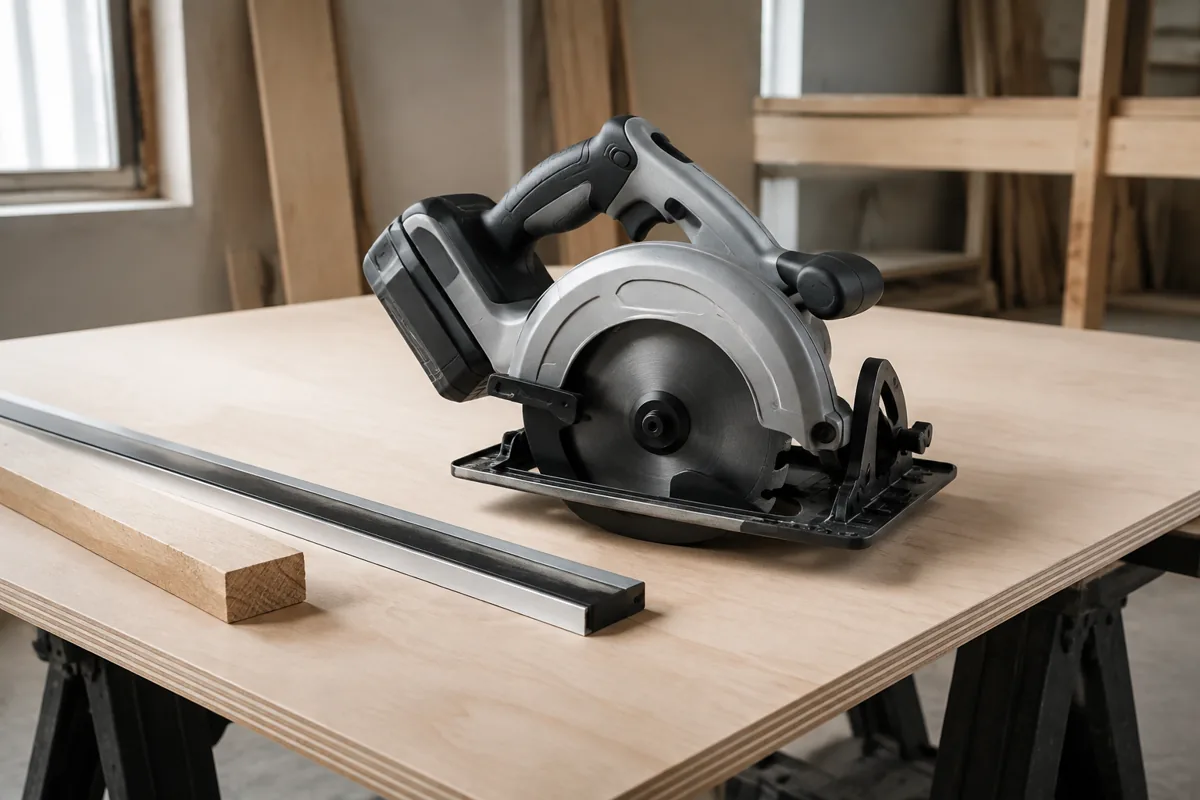
If you already own a good circular saw, a circular saw guide rail can handle cabinet plywood at much lower cost. Some rails are designed for a specific saw, while universal systems use an edge or carriage to guide different saws. Check compatibility before buying: the saw’s base must sit flat and remain captured against the guide throughout the cut.
The main difficulty is registration. You need to know the distance from the rail’s guide edge to the blade, or use a rail with a cut-line strip. Measure from the actual blade tooth, not just the edge of the shoe. Different blades can change the kerf and slightly change the cut position.
Starting a circular saw at the edge is straightforward. Starting in the middle of a panel is not. You may need a plunge cut, a drilled starter hole, or a jig. A standard saw also exposes more blade during the cut, so kickback control and support are more important. Keep the panel fully supported, but position the supports so the blade does not cut into them.
Cut quality depends on more than the guide
Use a sharp 40-tooth or higher-count blade intended for plywood or fine crosscutting. A general-purpose 24-tooth blade is fast and useful for construction, but it commonly leaves rougher veneer edges and more tear-out. For premium melamine or veneered plywood, a high-quality 60-tooth plywood saw blade is a worthwhile upgrade.
Cut with the finished face positioned appropriately for the saw. On most standard circular saws, the blade enters from the bottom and exits through the top, so tear-out is usually worse on the top face. Verify this with a test cut because blade geometry and saw orientation can change the result.
Support the sheet on rigid foam insulation or a properly arranged cutting table. Letting the panel sag can pinch the blade near the end of the cut, causing wandering, burning, or kickback. Keep the track clear of dust and make sure its anti-slip surface contacts the panel.
Which should you buy?
Choose a track saw if you regularly break down full 4-by-8-foot sheets, need clean cabinet-grade edges, make stopped cuts, or value repeatable setup more than the lowest purchase price. It is also the better choice for one person handling large panels.
Choose a circular saw and guide rail if cabinet work is occasional, you already own a reliable saw, and most cuts start at a panel edge. The money saved can go toward a better blade, clamps, and a flat support surface. Those accessories often improve results more than replacing a capable saw.
For the most economical setup, use a circular saw with a straight, rigid guide and test the offset on scrap. For the least fuss and the most consistent cabinet cuts, buy a plunge track saw with rail. Neither option eliminates measuring, supporting the work, or controlling the saw, but the track saw gives you more margin for error where cabinet panels show every mistake.