What's inside
As an Amazon Associate I earn from qualifying purchases. This post may contain affiliate links at no extra cost to you.
For making a straight cut with a circular saw, the choice usually comes down to two accessories: a dedicated track guide or a clamped straightedge. Both can produce accurate cuts, but they solve the problem differently. A track guide is faster and cleaner once set up. A straightedge clamp is cheaper, more flexible, and often good enough for occasional sheet-goods work.
As an Amazon Associate we earn from qualifying purchases at no extra cost to you.


Our Top Picks
 110" Track Saw Guide Rail for DeWalt Track110 in guide rail for Dewalt56 x 8.5 x 2.99 inchesCheck on Amazon


The basic difference
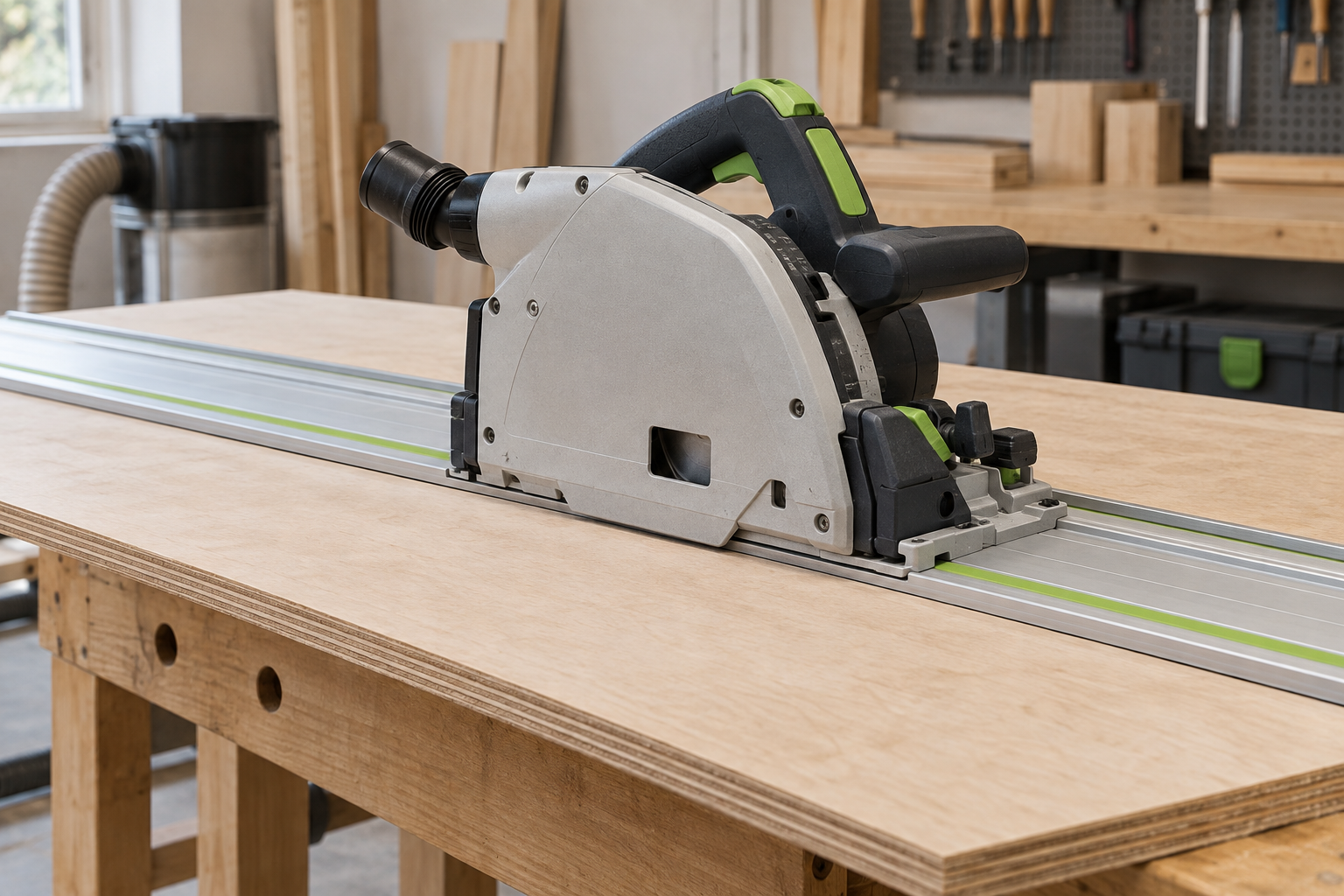
A circular saw track guide is a rigid guide rail that the saw rides against. Many systems use a guide strip or channel that keeps the saw aligned, while an anti-splinter edge shows the cut line and helps support the fibers. Some tracks are designed for a particular saw or plunge-saw system; others use adapters or a guide edge that works with ordinary circular saws.
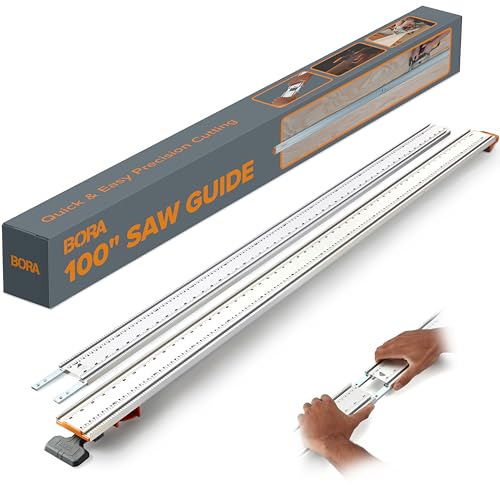
A straightedge clamp is a ruler-like bar with one or two clamps built into it. You mark the cut, measure the offset from your saw’s base plate to the blade, then position the guide away from the line by that distance. The saw’s shoe rides against the guide as you cut.
The practical distinction is setup. With a track, you normally align the edge directly to the cut line. With a straightedge clamp, every cut requires an offset measurement. That extra step is where many otherwise straight cuts go wrong.
Which produces straighter cuts?
A track guide generally wins, especially on long cuts. Once its edge is aligned, the saw cannot drift away from the line unless the saw lifts off the track or the track moves. A quality rail can hold a straight line over 4 to 8 feet with very little visible deviation.
A straightedge clamp can be just as straight if it is rigid, firmly clamped, and positioned correctly. The limitation is not usually the bar itself. It is setup error. Being off by 1/16 inch at the first end, clamping the guide at a slight angle, or measuring from the wrong side of the saw shoe can leave the cut visibly misplaced.
| Factor | Circular saw track guide | Straightedge clamp |
|---|---|---|
| Typical alignment | Align rail edge directly with cut line | Measure and allow for saw offset |
| Repeatability | Excellent once the rail is positioned | Good, but depends on careful measuring |
| Long cuts | Usually the easier option | Works if the guide is rigid and well clamped |
| Portability | Rails can be bulky, especially in 55- or 96-inch lengths | Often simpler to carry and store |
| Compatibility | May require a matching saw or adapter | Works with most circular saws |
| Typical cost | Higher, particularly with multiple rails | Lower to moderate |
When a track guide is the better buy
Choose a track guide if you regularly break down plywood, trim doors, install cabinets, or need repeatable cuts with minimal layout work. It is particularly useful when cutting expensive sheet material, where a misplaced line can waste a $60 to $100 panel.
The track is also the better choice for clean finished edges. Its anti-splinter strip supports the top veneer right at the blade, reducing tear-out. The result still depends on using the correct blade and cutting with the finished face oriented properly, but the guide removes one common source of damage.
A circular saw guide rail makes the most sense when you make several cuts per project. Some rails can be joined with connectors, though the joint must be straight and tight. A poor rail connection can create a small kink that the saw follows for the rest of the cut.
Tracks are also safer in one specific way: they reduce the need to concentrate on keeping the saw shoe against a narrow straightedge. You still need to control the saw, support the work, and keep the cord clear, but the guide does more of the tracking work.
When a straightedge clamp is enough
A straightedge clamp is the sensible choice for occasional cutting, especially if you already own a circular saw and need to cut a few shelves, fence boards, or plywood panels. It costs less than a full track system and does not tie you to a particular saw brand.
It is also more adaptable for unusual cuts. You can clamp it across narrow stock, use it as a layout reference, or position it at an angle without worrying about track length. For short cuts under 24 inches, the difference in speed between the two systems is small.
A straightedge clamp guide is a good value when the bar is stiff enough not to bow and the clamps hold securely. Avoid flimsy aluminum guides that flex when you press the saw against them. A 4-foot guide that bows 1/8 inch in the middle will produce a visibly hollow cut.
How to get accurate results with either guide
Support the workpiece on sacrificial foam or evenly spaced supports so the offcut does not pinch the blade. For a 4-by-8-foot sheet, place supports roughly 16 to 24 inches apart. Keep the waste side supported, but make sure the blade will not cut into a hidden support.
Check the saw’s shoe for burrs, packed dust, or a bent edge. A damaged shoe can make a straight guide behave badly. Use a sharp blade with the right tooth count: a 40- to 60-tooth finish blade is generally better for plywood than a coarse framing blade.
With a straightedge clamp, measure from the guide edge to the blade on the same side of the shoe that will contact the guide. Do not measure from the blade guard or from the opposite edge. Make a test cut in scrap and verify the actual distance; common saw offsets range from about 1-1/2 to 2-1/2 inches, but they vary by saw.
With a track, inspect the rubber edge before cutting. If it is worn, curled, or no longer touches the material, it will not prevent tear-out or accurately indicate the blade path. Clamp or use the rail’s grip strips when cutting slippery laminates, and avoid pushing the saw faster than the blade can clear material.
The buying decision
Buy a track guide if straight cuts are frequent, finish quality matters, or you want the least measuring for long plywood cuts. A plunge-saw-compatible system is worth considering if you also need controlled cuts inside a panel, but it may cost more than the circular saw it guides.
Buy a straightedge clamp if you cut only occasionally, use different brands of saws, or want the lowest-cost solution. Spend the savings on a rigid guide, accurate clamps, and a good blade rather than choosing the cheapest flexible bar.
For many homeowners, the straightedge clamp is the better first accessory. For cabinet work, repeated sheet breakdown, and production-like accuracy, a track guide earns its higher price through faster setup and fewer ruined panels.