What's inside
As an Amazon Associate I earn from qualifying purchases. This post may contain affiliate links at no extra cost to you.
Our Top Picks



The short answer
For fitting tenon cheeks, a shoulder plane is usually the better first tool. Its blade runs across the full width of the tenon cheek and its sides can reach right into the shoulder corner. That makes it quick for removing a high spot, correcting a slightly fat tenon, or cleaning a cheek after sawing.
A router plane is better at a different job: bringing a broad surface to a controlled depth. It is especially useful when a tenon cheek must be recessed evenly, when several tenons need to match, or when you are working from a layout line and want a repeatable stop. It is slower and less natural for general cheek fitting, but more controlled for removing a known amount.
As an Amazon Associate we earn from qualifying purchases at no extra cost to you.


If you are buying one tool specifically for ordinary mortise-and-tenon work, start with a shoulder plane. Choose a router plane instead if your work regularly involves housed joints, recessed tenons, or precision leveling.
What each plane is designed to do
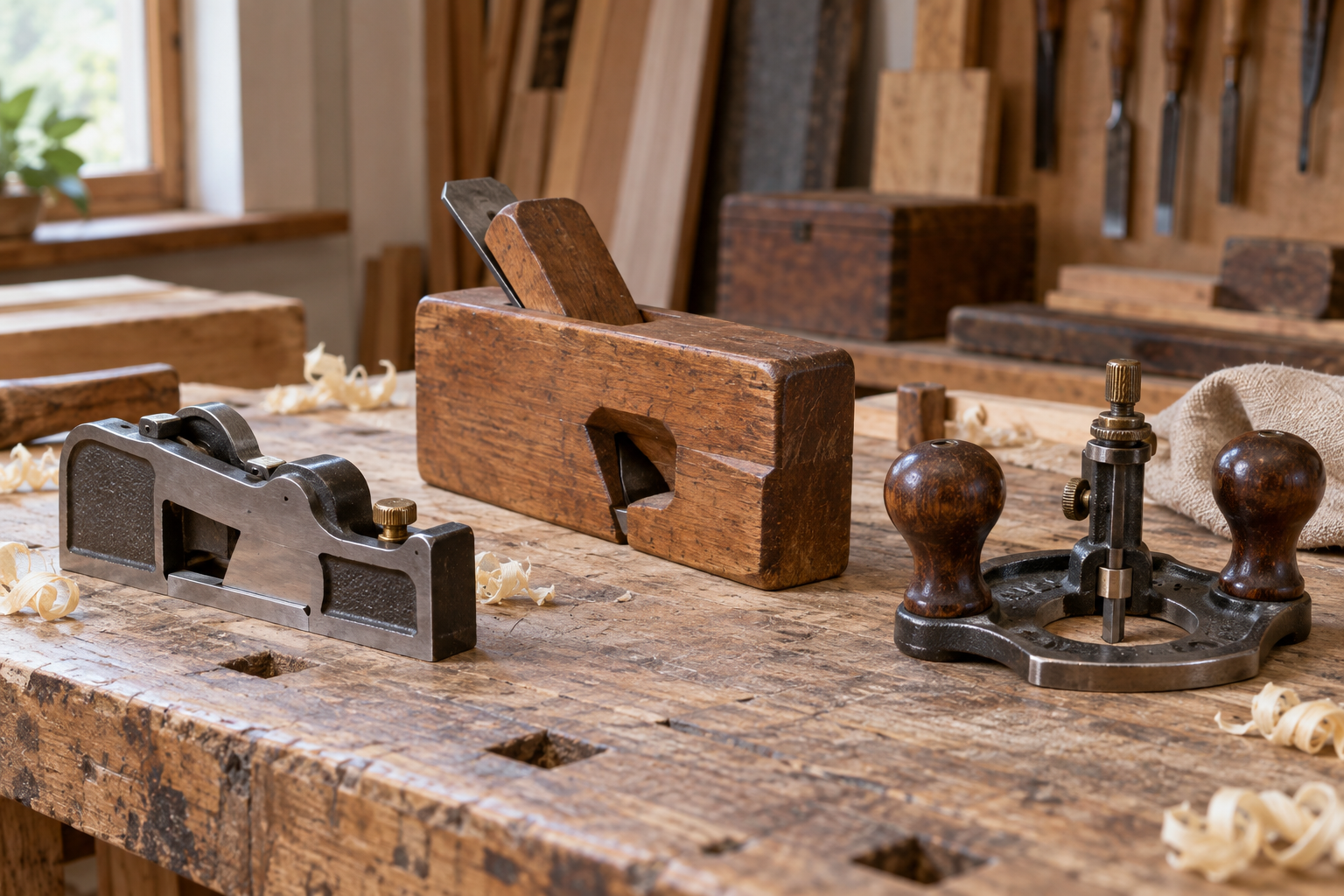
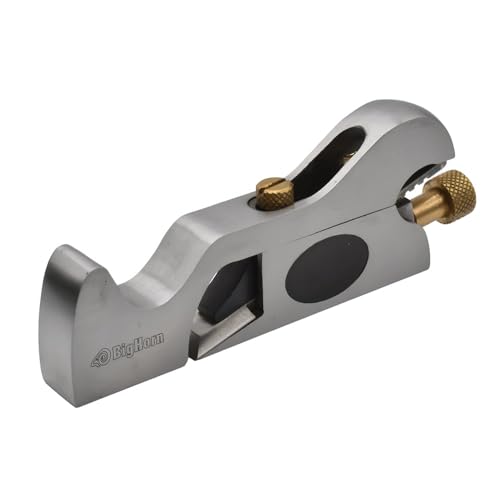
A shoulder plane is essentially a rabbet plane with a blade extending across the width of the tool. The blade is set close to the front and side edges, so it can cut right into the inside corner between a tenon cheek and shoulder. That is the important feature. A standard bench plane cannot reach that corner without its side getting in the way.
Shoulder planes are commonly used with the blade bevel down, although designs vary. They take fine, slicing cuts across the cheek. A well-tuned plane can remove roughly 0.1 to 0.25 mm per pass without tearing the fibers, assuming the grain is reasonably cooperative and the blade is sharp.
A router plane has a cutter projecting below a flat sole. You set the cutter to a measured depth, then push or pull the plane over the work. The sole bridges high areas, so the cutter gradually levels the surface to a consistent plane. This is the same basic principle as a router bit, but with slower hand-powered movement and much better visual feedback.
That geometry makes a router plane excellent for flattening the bottom of a groove or housing. On a tenon cheek, however, the sole needs enough surrounding surface to bear against. A narrow tenon can provide too little support, and the tool can rock or remove material unevenly.
Shoulder plane vs router plane
| Factor | Shoulder plane | Router plane |
|---|---|---|
| Best use | Fitting and trimming tenon cheeks | Leveling a surface to a set depth |
| Corner access | Excellent; reaches the shoulder directly | Limited; sole needs bearing area |
| Material removal | Fast for small corrections | Slow but consistent |
| Width control | Depends on your layout and passes | Very good once the depth is set |
| Risk on narrow tenons | Low if the plane is supported | High if the sole rocks |
| Learning curve | Moderate; grain direction matters | Moderate; setup and registration matter more |
| Typical price | Often less expensive than a quality router plane | Usually costs more, especially with extra cutters |
Using a shoulder plane on tenon cheeks
Mark the cheek with a knife line or pencil crosshatching, then clamp the tenon so the cut is supported. Set the plane for a very fine cut and begin at the shoulder, working toward the end grain or from the end toward the shoulder depending on the grain. The goal is to avoid levering fibers out at the shoulder corner.
Take two or three passes, check the fit, and repeat. If a tenon is 0.5 mm too thick, do not try to remove the whole amount in one aggressive cut. A safer sequence is to remove about 0.2 mm, test the joint, and then take another fine pass. Stop when the tenon enters the mortise with firm hand pressure and seats fully without hammering.
Keep the plane sole flat against the cheek. If you lift the rear of the plane, you create a hollow near the shoulder; if you press down hard at the front, you can create a taper. Both defects may be hidden until glue-up, when the joint closes at one end but leaves a visible gap at the other.
For a tenon that is already close to size, a precision shoulder plane is easier to control than a large general-purpose plane. A cheaper plane is fine if its sole is flat, the blade sits securely, and the mouth does not chatter. Paying for a premium name will not compensate for a dull or poorly set blade.
Using a router plane on tenon cheeks
Use a router plane when the cheek needs to be recessed to a precise, repeatable depth rather than merely trimmed to fit. Scribe the finished surface, set the cutter just below that line, and make light passes. The sole will ride on the high areas while the cutter removes the peaks.
This is useful when making multiple identical tenons. For example, if a shoulder layout shows that every cheek needs to be 1 mm thinner, a router plane can be set once and used consistently. It is also helpful for correcting a cheek that has been left rough by a dado blade or bandsaw.
There are limits. On a 6 mm-wide cheek, a full-size router plane may have barely enough purchase to stay stable. On end-grain shoulders, the cutter can catch and bruise the edge. A router plane also struggles with a cheek that is badly out of flat; you may spend more time managing the tool than removing wood.
A router plane becomes more attractive if you also cut grooves, dados, hinge recesses, or housed joints. Those jobs use its depth-control advantage directly, so it earns space in the tool cabinet beyond tenon fitting.
Which one should you buy?
Buy a shoulder plane if your main work is traditional mortise-and-tenon joinery, chair parts, doors, tables, or frame construction. It is faster for the final fitting operation and gives the best access to the shoulder line. A small shoulder plane is also easier to control on narrow work.
Buy a router plane if you value repeatability over speed, routinely make several matching parts, or need one tool for both tenon cheeks and recessed surfaces. If budget is tight, the cheaper option is perfectly adequate when your tenons are cut close to size and you only need occasional fitting. A sharp chisel and careful paring can handle the last fractions of a millimeter.
For many shops, the practical order is shoulder plane first, router plane later. Use the shoulder plane to fit the joint, then add a router plane when its depth-setting ability solves a recurring problem rather than buying it in hopes that it will replace the shoulder plane.