What's inside
As an Amazon Associate I earn from qualifying purchases. This post may contain affiliate links at no extra cost to you.
The Short Answer
A crowfoot extension changes the applied torque when it extends the torque wrench in a straight line. It increases the effective lever length, so the fastener receives more torque than the wrench setting indicates.
When the crowfoot is installed at 90 degrees to the wrench handle, it normally does not change the applied torque. The crowfoot shifts the fastener sideways rather than lengthening the lever arm. This is the usual way to use one without recalculating the setting.
The important distinction is the angle between the crowfoot and the torque wrench—not simply whether the adapter is “straight” or “sideways.”
Why a Straight Crowfoot Changes Torque
A torque wrench measures force applied over a known distance. If the wrench has an effective length of 18 inches and you add a 2-inch crowfoot in line with the handle, the fastener sees force acting through roughly 20 inches.
For example, setting the wrench to 100 lb-ft with that arrangement produces approximately:
100 × (18 + 2) ÷ 18 = 111.1 lb-ft
That 11% increase can be enough to damage aluminum threads, distort a gasket, stretch a fastener, or exceed the specification for a wheel or suspension component.
This applies to click-type, beam-type, dial, and electronic torque wrenches. The wrench does not know that you added an adapter; it only measures the force and lever length built into its calibration.
The Correct Formula
For an in-line crowfoot, use this formula:
Wrench setting = desired fastener torque × wrench length ÷ (wrench length + crowfoot length)
Measure the wrench length from the center of the square drive to the point where your hand applies force. In practice, use the manufacturer’s stated effective length when available. Measure the crowfoot from the center of its drive opening to the center of the fastener.
Using the previous example, to obtain 100 lb-ft at the fastener:
100 × 18 ÷ (18 + 2) = 90 lb-ft
Set the wrench to 90 lb-ft, not 100 lb-ft.
For adapters installed at an angle, the more general relationship is:
Wrench setting = desired torque × L ÷ (L + A × cos θ)
Here, L is wrench length, A is crowfoot length, and θ is the angle between the crowfoot’s length and the wrench handle. At 0 degrees, the full crowfoot length counts. At 90 degrees, the cosine is zero, so there is no lever-length correction.
Crowfoot Position and Torque Effect
| Crowfoot position | Torque effect | What to do |
|---|---|---|
| In line with wrench | Increases applied torque | Use the correction formula |
| 90 degrees to wrench | Normally no change | Set the wrench to the specified torque |
| 45 degrees | Partial increase | Use the cosine formula or reposition it |
| Loose or swiveling adapter | Unpredictable | Do not torque until the setup is stable |
A 90-degree arrangement is usually the best choice because it avoids math and makes the setup easier to repeat. It is not a license to pull at any angle, however. Keep the force perpendicular to the wrench and avoid letting the crowfoot rotate while tightening.
When a Crowfoot Is the Right Tool
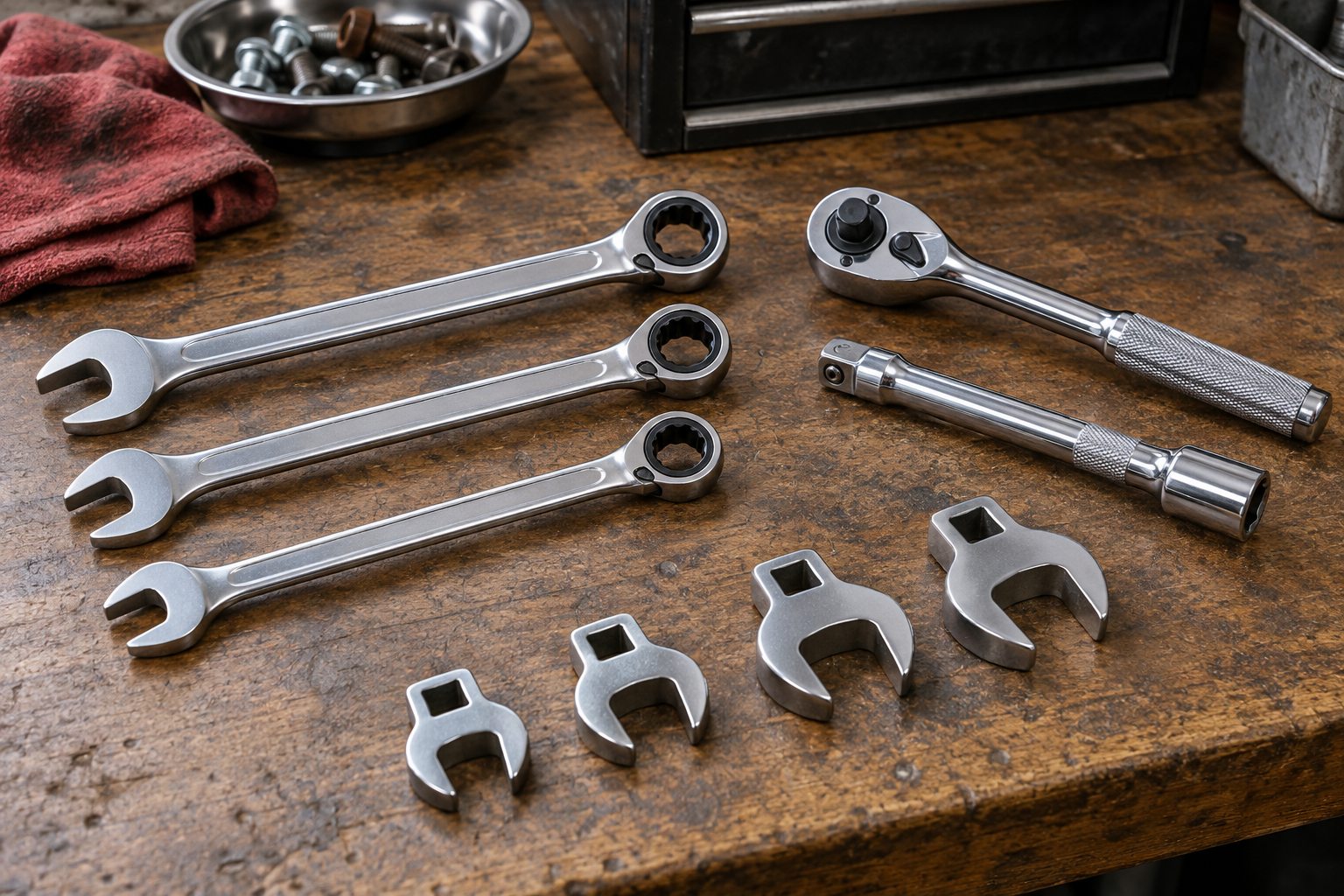
Crowfoots are useful for brake lines, fuel lines, hydraulic fittings, flare nuts, recessed fittings, and fasteners blocked by tubing or brackets. A regular socket cannot reach some of these locations, while an open-end crowfoot can slide over the line.
For general automotive work, a set of metric crowfoot wrench sets is often the cheaper and more flexible purchase. For plumbing, industrial maintenance, or older vehicles, SAE sizes may matter. Check whether the set is flare-nut style, standard open-end, or a mix.
Use a flare-nut crowfoot on soft tubing and hex fittings whenever possible. Its extra contact area reduces the chance of rounding the fitting. A standard open-end crowfoot is acceptable for robust hex fasteners, but it is a poor choice for a stuck brake-line fitting.
Failure Modes to Avoid
The most common mistake is treating every crowfoot position as torque-neutral. A straight extension can over-tighten a fastener significantly, especially with a short torque wrench. The shorter the wrench, the larger the percentage change from a given crowfoot length.
Another mistake is using a crowfoot that is too narrow or too shallow for the fastener. It may slip off under load, damaging the fitting or injuring your hand. Do not use a crowfoot as a substitute for a normal socket when access is not the problem.
Do not stack several adapters casually. A socket, universal joint, extension, and crowfoot can introduce flex and make the final position difficult to control. A straight socket extension does not change torque by itself because it adds distance along the drive axis, not the handle’s lever arm. A universal joint can change the feel and accuracy, particularly when it is bent sharply.
What to Buy for Accurate Work
If your work involves occasional brake or fuel-line repairs, a modest 3/8-inch-drive crowfoot flare-nut set is usually enough. Choose forged or machined steel, clear size markings, and a drive opening that fits your wrench without excessive play.
For high-torque suspension or industrial jobs, look for larger drive sizes and a crowfoot rated for the required load. A cheap stamped set may be fine for light-duty fittings, but it is not the place to save money when the tool will see hundreds of pound-feet.
If access is frequent and the specification is critical, a digital torque wrench with angle measurement can make verification easier, but it does not eliminate the crowfoot correction. You still need to account for the adapter’s position.
Best Practice at the Fastener
First, try to place the crowfoot at 90 degrees. Confirm the drive size and fitting engagement, clean the threads, and apply the manufacturer’s specified lubricant or anti-seize only if instructed. Pull smoothly from the marked grip, stop at the click, and do not add a cheater pipe.
If the crowfoot must be in line, measure its effective length and calculate the reduced wrench setting before tightening. When the specification is safety-critical or the geometry is unusual, verify the setup against the torque wrench manufacturer’s instructions rather than relying on a rule of thumb.