What's inside
As an Amazon Associate I earn from qualifying purchases. This post may contain affiliate links at no extra cost to you.
Our Top Picks
 MaxWorks Heavy Duty 2‑Shelf Service Cart 500 lb30 Inch X 16 Inch32.25 x 16 x 30 Inches30 poundsCheck on Amazon
 JUNNUJ Power Tool Organizer Cart with Charging Station6 ft Power Cord11.8 x 17.7 x 34.3 inchesCheck on Amazon

Best Rolling Tool Carts for Different Workshop Layouts
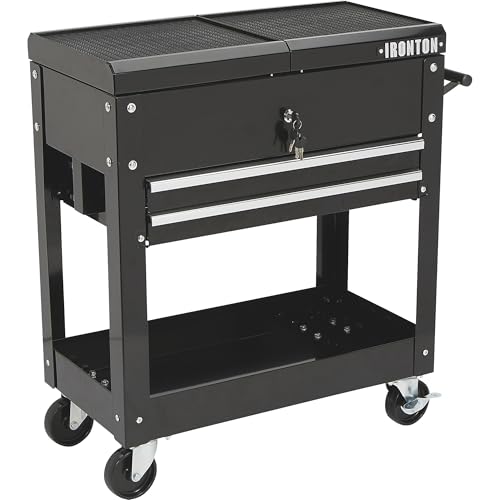
The best rolling tool cart is the one that fits your narrowest route, carries the tools you use most, and stays stable when loaded—not necessarily the cart with the most drawers. For a compact garage, prioritize a small footprint and a low center of gravity; for frequent tool changes, choose a shallow top tray with drawers below; for rough floors, favor larger wheels and a handle you can reach from the direction you actually push.
Compare the main cart types
Dimensions and capacities vary by model, so the figures below are practical selection ranges, not specifications for a particular product. Check a manufacturer’s measurements before buying, especially for drawer capacity and overall width.
As an Amazon Associate we earn from qualifying purchases at no extra cost to you.


| Cart type | Typical footprint | Typical wheel diameter | Best for | Main trade-off |
|---|---|---|---|---|
| Open three-tier utility cart | 24–32 in. wide × 16–22 in. deep | 3–5 in. | Bulky supplies, bins, and quick access | Tools are exposed to dust and can shift in transit |
| Rolling chest with drawers | 26–36 in. wide × 18–24 in. deep | 4–6 in. | Hand tools and small parts that need sorting | Drawers add weight and may be awkward to reach from one side |
| Compact service cart | 18–24 in. wide × 14–20 in. deep | 2–4 in. | Tight aisles and smaller garages | Less storage; small wheels struggle with cords and floor joints |
| Heavy-duty industrial cart | 30–48 in. wide × 20–30 in. deep | 5–8 in. | Heavy loads and uneven shop floors | Large footprint and higher purchase cost |
Choose by shop layout and work style
For a small garage or narrow aisle: compact service cart
Measure the tightest doorway, aisle, and gap between parked equipment—not just the open floor area. Leave enough clearance to turn: a cart that fits through a doorway may still be too wide to pivot in the space beyond it. A compact cart with a single top tray and lower shelf is usually easier to maneuver than a wide drawer chest.
Look for a handle that does not add excessive width and can be reached from the side you use most. If the cart will be parked between jobs, confirm that its footprint does not block cabinet doors or vehicle access. Smaller wheels are acceptable on smooth concrete, but they catch more readily on extension cords, floor seams, and debris.
For hand-tool organization: drawer cart
Drawers make sense when you regularly move a defined set of wrenches, measuring tools, fasteners, or finishing supplies between work areas. Shallow top drawers keep small tools visible and reduce the temptation to pile everything together. Deeper drawers suit bulkier items, but they can become difficult to search unless you add dividers or bins.
Check the drawer extension and locking arrangement. A latch that secures drawers during movement helps prevent them sliding open when the cart turns. Avoid placing the heaviest tools in top drawers: a high, forward-shifted load makes a cart more likely to tip, especially when crossing a threshold.
For changing jobs: open tray cart
Open trays are useful when parts and tools change throughout the day. They provide quick access without repeated drawer opening, and larger trays can hold power tools or supplies that do not fit neatly in shallow compartments. The downside is that loose items can rattle or fall off when the cart crosses an uneven floor. Use removable bins for small parts, and keep the upper tray’s load low and contained.
For rough floors or heavy loads: large-wheel cart
Wheel diameter matters most when the cart must cross floor joints, cords, ramps, or rough concrete. Larger wheels generally roll over obstacles more easily, but they raise the cart and may make the handle or top tray less comfortable to reach. Wheel material and bearing quality also matter: hard wheels can be noisy on imperfect floors, while softer wheels may roll more quietly but collect debris or resist rolling under heavy loads.
At least two locking casters are useful for keeping the cart still while you work. If it will carry a heavy load, check the rated capacity of the complete cart and its casters—not just the shelf material. Treat a published capacity as a limit, not a target for routine overloading.
Decision matrix: what to buy for your situation
| Your situation | Prioritize | Suitable layout | Why |
|---|---|---|---|
| Occasional DIY, tight budget | Stable frame, locking casters, useful tray depth | Basic two- or three-shelf cart | Simple storage covers general tasks without paying for drawers you may not use |
| Frequent repairs, many small tools | Drawer retention, shallow drawers, dividers | Drawer chest with an accessible top | Sorting reduces rummaging and keeps loose tools contained in transit |
| Shared shop, carts move between stations | Handle access, durable casters, protected storage | Mid-size mixed tray-and-drawer cart | Combines fast access with storage that stays organized and secured |
| Uneven floor, heavy equipment | Larger wheels, wide stance, stated load rating | Heavy-duty utility or industrial cart | More forgiving over obstacles, though it needs more turning space |
| Very limited parking space | Narrow frame, compact depth, easy-to-reach handle | Compact service cart | Less likely to obstruct walkways, cabinets, or vehicle doors |
Measure the route, not just the parking spot
Before choosing a cart, measure its full outside width and depth, including the handle and caster brackets. Compare those numbers with the narrowest doorway and aisle on the route. Then check turning space at corners. A useful practical allowance is at least 2 in. of clearance on each side in a straight passage; more is preferable where the floor is uneven or the cart is heavily loaded.
For example, if an aisle is 30 in. wide and the cart is 26 in. wide, only 2 in. remain on either side. That may be manageable in a straight run, but it leaves little room to correct direction around a cabinet or wall. A 22-in.-wide cart would leave 4 in. per side and be easier to steer, even if its storage capacity is lower.
What wears out—and how to extend cart life
- Casters and bearings: Sawdust, chips, and finish debris can jam wheels or increase rolling resistance. Clear buildup regularly, and check that caster fasteners remain tight.
- Drawer slides and latches: Overloading or slamming drawers accelerates wear. Keep heavy tools low, close drawers before moving, and use dividers to prevent contents shifting.
- Tray surfaces: Metal trays can dent; coated surfaces can scratch or chip. Use a removable mat or bins if the cart carries sharp tools or parts likely to spill.
- Frame and stability: A loose joint or uneven load can make the cart wobble. Recheck fasteners after assembly and redistribute heavy items near the bottom and center.
One common mistake is steering a loaded cart by pushing hard on a high, flexible tray edge. Use the intended handle instead, move slowly over thresholds, and avoid pulling a tall cart backward where you cannot see the wheels. If it needs to cross a ramp, secure loose items first and keep the heaviest load low.
Bottom line
For most mixed-purpose workshops, a mid-size cart with a shallow top tray, a few useful drawers, a reachable handle, and locking casters is the most adaptable choice. Choose an open utility cart when bulky items and quick access matter more than containment, a compact cart when the route is tight, and larger wheels when floor conditions—not storage—are the main obstacle. Match the cart to the narrowest part of its route, then load it so the heaviest tools stay low.