
What's inside
As an Amazon Associate I earn from qualifying purchases. This post may contain affiliate links at no extra cost to you.
The best tool cart for most garages in 2026 is a 26–30 inch steel service cart with at least three full-extension drawers, a combined drawer capacity of 250 lbs or more, and 5-inch casters rated as a set — not per wheel — for the load you actually intend to roll. That spec floor eliminates most of the wobbly budget carts before you even compare prices.
As an Amazon Associate we earn from qualifying purchases at no extra cost to you.


Our Top Picks
 MaxWorks Heavy Duty 2‑Shelf Service Cart 500 lb30 Inch X 16 Inch32.25 x 16 x 30 Inches30 poundsCheck on Amazon
 JUNNUJ Power Tool Organizer Cart with Charging Station6 ft Power Cord11.8 x 17.7 x 34.3 inchesCheck on Amazon
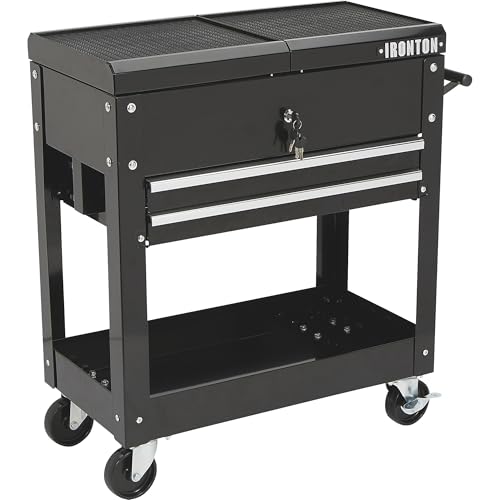

What Actually Separates a Good Tool Cart From a Cheap One
Tool carts fail in predictable ways, and almost none of them show up in a product listing’s marketing copy:
- Drawer slides under load. The rating that matters is per-drawer, not “total capacity.” Many budget carts advertise a 500 lb total capacity spread across drawers rated 30 lbs each — meaning you can’t put a set of deep sockets and a breaker bar in one drawer without the slides chattering or the drawer dragging shut at an angle.
- Caster quality at full load. Two fixed + two swivel casters is standard, but swivel casters with cheap bushings develop play within months of daily rolling. Look for casters with ball-bearing swivel races and a stated rating per caster of at least 100 lbs.
- Frame racking. Roll the cart diagonally over a 2×4 on the floor. If the drawers pop open or the frame visibly twists, the spot welds and frame gauge (18-gauge is common; 16-gauge is better) won’t hold up on a cracked or sloped garage slab.
- Footprint vs. capacity. A 30-inch cart is roughly double the footprint of an 18-inch rolling cabinet but typically carries 3–4x the usable drawer volume.
Best Tool Carts of 2026: Comparison
| Cart | Dimensions (W×D×H) | Drawers | Per-Drawer Rating | Caster Size | Best For |
|---|---|---|---|---|---|
| Husky 30″ 5-Drawer Tool Cart | 30″ × 18″ × 34″ | 5 | ~50 lbs | 5″ | Overall best value |
| US General 30″ 5-Drawer Service Cart | 30″ × 18″ × 34″ | 5 | ~50 lbs | 5″ | Budget pick, proven longevity |
| Snap-on Classic 60 Roll Cart | 40″ × 20″ × 39″ | 5–6 | ~120 lbs | 6″ | Professional daily use |
| Milwaukee Steel Tool Cart | ~33″ × 20″ × 39″ | 5 | ~100 lbs | 5″–6″ | Heavy loads, rough floors |
| WEN 26″ Rolling Tool Cart | 26″ × 16″ × 32″ | 3–4 | ~35 lbs | 4″–5″ | Tight garages, light duty |
| Trinity II Steel Service Cart | ~26″ × 15″ × 32″ | 3 | ~35 lbs | 4″ | Occasional DIY use |
Prices in this category run roughly $120–$250 for budget 26-inch carts, $250–$500 for mid-range 30-inch carts, and $1,000+ for truck-brand professional carts.
Picks by Situation
Best for most home garages: Husky or US General 30-inch, 5-drawer
These two dominate the category for a reason: roughly 50 lb drawer ratings, 5-inch casters, a keyed lock, and a top tray that works as a disassembly surface. The US General version has years of forum evidence that the slides and casters survive daily mechanic use; the Husky trades on wider availability. Either handles a socket set, power tools, and diagnostic gear without drawer sag.
Best for professional daily use: Snap-on Classic series
Double the drawer rating (~120 lbs per drawer), heavier-gauge steel, and casters engineered for concrete floors rolled over hundreds of times per week. The cost is hard to justify for weekend use, but for a tech opening drawers 50+ times a day, slide longevity is the whole value proposition.
Best for tight spaces: WEN 26-inch or similar compact carts
If your cart has to park between a workbench and a wall — say, 20 inches of clearance — a 30-inch cart becomes a daily annoyance. The tradeoff: narrower carts rack more easily on uneven slabs, so push on the frame, not the drawer fronts, and avoid parking them half on a crack.
Decision Matrix
| Your Situation | Recommended Type |
|---|---|
| Under $200, weekend DIY, light hand tools | 26″ budget cart, 3–4 drawers |
| $250–$400, regular use, mixed tools | 30″ 5-drawer mid-range cart |
| Daily professional use | Pro-brand cart, 100+ lb drawer rating |
| Uneven or cracked slab | 16-gauge frame, 5″+ casters, ball-bearing swivel races |
| Tools over 150 lbs total, or air tools/battery packs | Per-drawer rating ≥75 lbs; verify caster set rating |
A Quick Capacity Calculation Before You Buy
Weigh what you plan to store — or estimate: a full socket set runs 15–25 lbs, a drill/driver with batteries is 8–10 lbs, a pry bar set is 5 lbs. A typical home mechanic’s kit lands around 100–180 lbs. Now check the caster set rating: four casters rated 100 lbs each sounds like 400 lbs, but on a slope only three wheels carry the load, and the safe figure is closer to 3 × per-caster rating. A cart rated at 300 lbs total by that math is the minimum for a fully loaded setup.
Ownership Realities
- What wears first: drawer slides (lubricate yearly with white lithium grease) and swivel caster bearings (flush grit, re-grease). Drawer liners cost a few dollars and prevent the slide damage caused by tools skating into the drawer stops.
- Common mistake: overloading the top drawer. Heavy sockets belong in the bottom drawer — a top-heavy cart tips when a loaded drawer is fully extended, especially on a sloped floor.
- Setup: assemble on cardboard, torque frame bolts evenly in a cross pattern (uneven torque causes the racking that later makes drawers misalign), and check bolt tension once after the first month of use.