What's inside
As an Amazon Associate I earn from qualifying purchases. This post may contain affiliate links at no extra cost to you.
What the blade labels mean
Oscillating multi-tool blades move side to side through a short arc, so their tooth shape and material matter more than their size alone. The three common choices—wood, metal, and bi-metal—overlap, but they are not interchangeable in every job.
“Wood” usually means a blade with larger, widely spaced teeth for cutting timber and other soft materials. “Metal” generally means a finer-toothed blade, often made from high-speed steel (HSS), intended for nails, screws, thin sheet metal, and similar stock. “Bi-metal” blades combine a tougher flexible body with HSS teeth. They cost more, but are less likely to lose teeth or snap when they hit an embedded fastener.
Check the blade’s stated material rating, not just its color or shape. Manufacturers use different labels, and a blade marked for wood may still tolerate occasional nails—or may be intended for clean wood only.
Wood, metal, or bi-metal?
| Blade type | Best for | Main trade-off | Good buy when |
|---|---|---|---|
| Wood | Clean lumber, trim, drywall and some plastics | Teeth can be damaged quickly by nails or hard fixings | You know the cut is nail-free and want a fast, inexpensive blade |
| Metal | Thin metal, small fasteners and controlled flush cuts | Fine teeth can clog or cut slowly in thick material | You are cutting metal, not expecting the blade to chew through mixed debris |
| Bi-metal | Demolition cuts through wood with nails, screws or mixed materials | Costs more; may cut clean wood less aggressively than coarse wood teeth | You cannot see what is inside the workpiece or expect intermittent metal contact |
When a wood blade makes sense
Choose a coarse wood blade for clean framing lumber, plywood, door jambs, and trim where speed matters. Its larger gullets clear chips quickly, which helps it cut faster than a fine metal blade in soft wood. A plunge-cut blade is useful for starting a cut in the middle of a panel; a wider segment blade suits longer, straighter cuts along an edge.
The failure mode is simple: one hidden nail can blunt or break the teeth. That makes a cheap wood blade a poor gamble in old framing, pallets, or demolition work where fasteners are likely. If you are certain the stock is clean, however, there is little reason to pay extra for bi-metal. A basic oscillating multi-tool wood blade is often the economical choice for routine trim cuts.
For clean cuts in finished wood, use a sharp blade and let the tool do the work. Pressing hard adds heat and vibration without reliably improving cutting speed. If the cut edge will be visible, test on scrap first: multi-tool blades can leave a rougher finish than a handsaw or circular saw, especially when the blade wanders.
When to choose a metal blade
Fine-toothed metal blades suit small nails, screws, thin steel, copper pipe, and similar jobs. They offer more tooth engagement than a coarse wood blade, which helps control the cut and reduces the chance of immediately stripping the teeth. A dedicated metal-cutting oscillating blade is a sensible choice when the workpiece is mostly metal.
Do not expect a multi-tool to cut thick steel quickly. It is a short-stroke tool, and a fine blade can heat up, clog with swarf, and wear down when asked to cut a large section of metal. Keep the blade moving, use light pressure, and pause if it becomes hot. Eye protection is essential: small metal fragments can fly from the cut. For frequent cuts through thick stock, a reciprocating saw, angle grinder, or hacksaw may be a better fit.
Metal blades also tend to cut wood more slowly. They can work in a pinch, but using one for a long timber cut is a good way to spend more time and wear out a blade designed for another material.
Why bi-metal is the mixed-material pick
Bi-metal blades are built to withstand impacts and flex better than many one-piece steel blades. That makes them useful when cutting wood that may contain nails, screws, or other hidden hardware—such as old trim, renovation lumber, or a wall opening. They are not indestructible: a direct hit on masonry, hardened steel, or a large fastener can still ruin the teeth.
Bi-metal is usually the safer general-purpose choice for demolition, but it is not automatically the best value. If you only make a few cuts in clean pine, an inexpensive wood blade may last just as long and cut faster. If every cut is in thin metal, a blade rated specifically for metal may be more appropriate. For uncertain, mixed material, a bi-metal oscillating blade is worth the premium because one hidden nail is less likely to end the cut.
Match blade shape and fit to the job
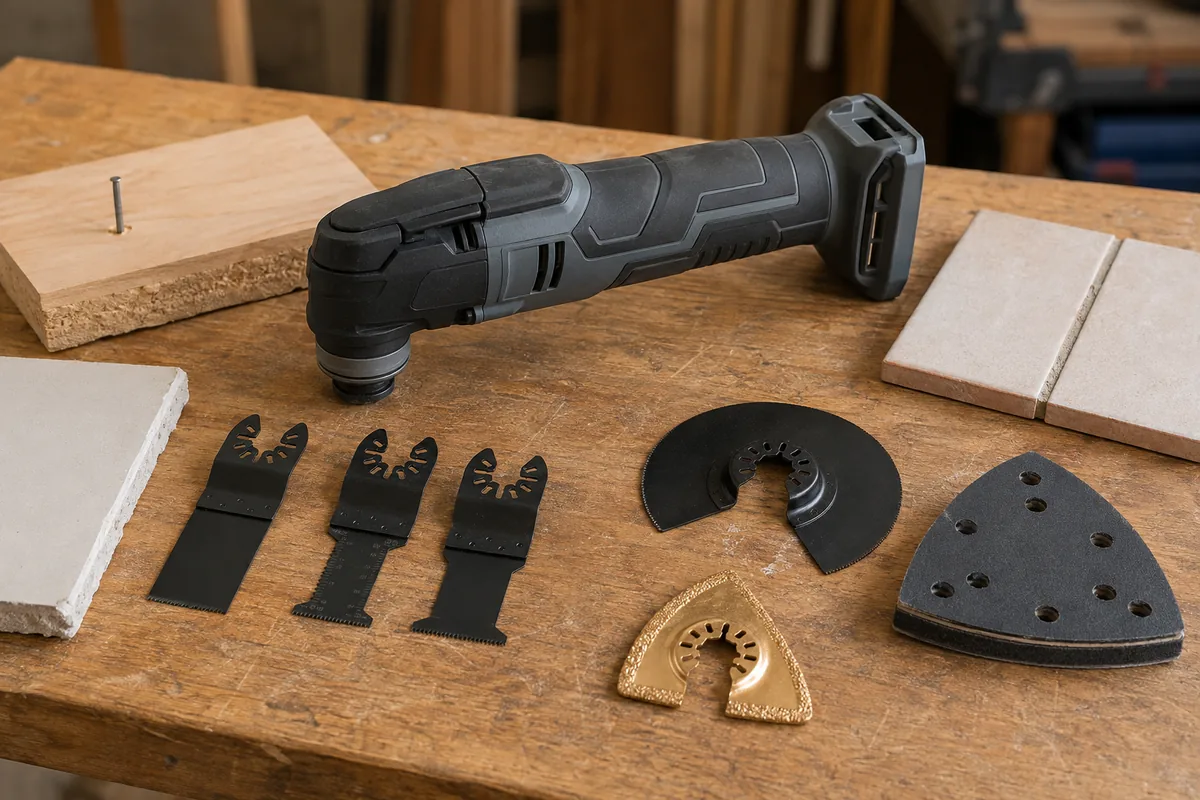
Material is only part of the decision. Narrow blades reach into corners and make plunge cuts; wider blades cover more area but can be harder to steer precisely. A scraper or carbide-grit accessory is better for adhesive, grout, or other abrasive material than a toothed wood blade. For grout removal, use an accessory specifically rated for grout and check that its width suits the joint.
Also check the mounting system. Many modern blades use universal-style open mounts, but not every accessory fits every tool without an adapter. Confirm compatibility before buying a multipack, and check whether the blade’s stated cutting depth is enough for the material. A blade that is too short may force you to tilt the tool, increasing the chance of a crooked cut or damage to the surface behind it.
Cut without wasting blades
Mark the cut and, where practical, use a depth stop or a scrap backer to protect what is behind the work. Start at a low or moderate speed to establish the cut, then increase speed if the blade is cutting cleanly. Keep the shoe or blade steady; twisting sideways can bend the blade, strip teeth, or make it bind. Let the teeth cut rather than forcing the tool.
If a blade stops cutting efficiently, inspect it for packed debris, missing teeth, or discoloration from excess heat. Cleaning may help with debris; missing teeth mean replacement. For an unknown demolition cut, begin with bi-metal, expect the blade to wear, and keep a spare nearby. For known clean wood, choose wood. For mostly metal, choose a metal-rated blade. That simple match usually saves more time and money than buying the largest assortment in the store.