What's inside
As an Amazon Associate I earn from qualifying purchases. This post may contain affiliate links at no extra cost to you.
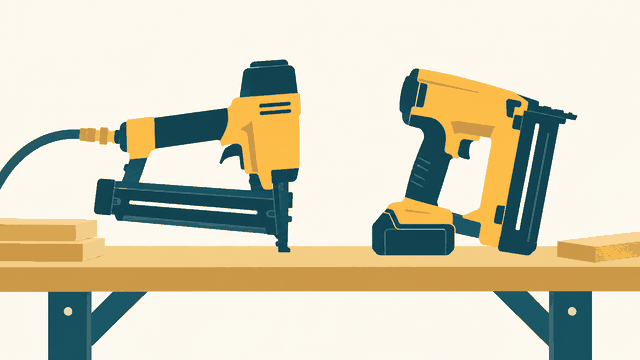
The Milwaukee M18 16-gauge finish nailer and DeWalt DCN660 are both cordless, angled finish nailers for trim work. Either can install door casing, baseboard and crown without an air hose or compressor. The choice is less about which one can drive a finish nail and more about which battery system you own, how the tool behaves in your hands, and whether its weight is acceptable for a day of overhead work.
As an Amazon Associate we earn from qualifying purchases at no extra cost to you.


Our Top Picks

At a glance
| Feature | Milwaukee M18 16-gauge finish nailer | DeWalt DCN660 |
|---|---|---|
| Nail angle and gauge | 16-gauge, 20-degree angled | 16-gauge, 20-degree angled |
| Nail length range | 1¼ to 2½ inches | 1¼ to 2½ inches |
| Power source | M18 battery | 20V MAX battery |
| Drive system | Battery-powered, flywheel-style mechanism | Battery-powered, flywheel-style mechanism |
| Best fit | Users already invested in M18 | Users already invested in DeWalt 20V MAX |
Both tools use angled 16-gauge nails, which are thicker and hold more securely than 18-gauge brads, but leave a more noticeable hole to fill. Confirm the nail angle and collation type before buying nails; 16-gauge does not mean every strip fits every nailer.
What they do well
Both nailers are designed to replace a pneumatic setup for finish work. There is no compressor to haul, hose to drag through a finished room, or need to manage air pressure. For a punch-list job or a room of trim, that convenience is substantial. They can also be used where a hose would snag on ladders or finished flooring.
The 1¼-to-2½-inch range covers common casing and baseboard fastening. A 2½-inch nail can reach through trim and drywall into framing when the layout allows, while shorter nails suit thin trim and attachment to backing. Still, nail length is not a substitute for finding studs: a long nail driven into empty space can leave trim loose and create a difficult-to-hide hole.
Neither is a framing tool. The 16-gauge nail is useful for fastening substantial trim, but it is not the right choice for delicate shoe molding or narrow profiles that may split. Use an 18-gauge brad nailer for lighter trim, and a 15-gauge nailer when the extra holding power and larger hole are justified.
Handling and performance
Both cordless nailers are heavier and bulkier than pneumatic nailers. Add a battery and the difference becomes more apparent when fastening crown overhead or working at arm’s length. If you are installing a few door casings, the weight may be a fair trade for skipping the compressor. If you are trimming a whole house, pick each tool up with a battery installed and test the grip, balance and belt-hook position before deciding.
Depth adjustment matters on painted or stained trim. Start on scrap made from the same material, then adjust until the nail head sits just below the surface without crushing the fibers. Too shallow means more hand-setting and filling; too deep can split a narrow edge or leave a crater. Wood density, nail length and battery charge all affect the result, so a setting that works on pine may not work on hardwood.
Like other cordless finish nailers, both can occasionally fail to drive a nail fully, especially in dense stock or near the end of a battery charge. A nail jam is another possible interruption. Keep the correct hex key or release tool handy, disconnect the battery before clearing a jam, and follow the manufacturer’s instructions rather than prying against the magazine. If a nailer starts leaving proud nails repeatedly, check the depth setting, stock hardness, fastener compatibility and battery condition before assuming the tool is defective.
Battery system and running cost
For most buyers, the battery platform is the practical tie-breaker. An existing M18 owner can use Milwaukee batteries and chargers already on hand; a DeWalt 20V MAX owner has the same advantage with the DCN660. Buying into a second platform adds the cost and storage of batteries and a charger, which can outweigh a small difference in the bare-tool price.
If you have neither system, compare the cost of a usable kit, not just the tool alone. A bare tool is a poor bargain if you also need a battery and charger. Look at current Milwaukee M18 16-gauge finish nailer options and DeWalt DCN660 listings, checking whether the listing is tool-only or includes a battery.
Which one should you buy?
Choose the Milwaukee if your shop already runs on M18 batteries, local availability is better, or its handle and balance feel more comfortable to you. Choose the DCN660 if you already own DeWalt 20V MAX batteries or prefer how it sits in your hand. For an occasional interior-trim project, either is capable; there is no strong reason to pay extra to switch battery ecosystems for a marginal spec difference.
The cheaper option is fine when it includes the battery and charger you need, accepts readily available nails, and has a service or return option you can use. Do not save a small amount by buying incompatible fasteners or a bare tool that leaves you without a power source. If neither cordless model makes sense for a one-time job, a pneumatic nailer with a borrowed or rented compressor may cost less overall. For repeat work or rooms where hoses are a nuisance, a cordless 16-gauge nailer is easier to justify.
Before you start
Dry-fit the trim, mark stud locations, and test the nailer on offcuts. Keep fasteners back from thin edges to reduce splitting, especially near miters. For casing, use enough nails to hold the piece flat without peppering the face; for long baseboards, fasten into studs and add adhesive only where the installation calls for it. Fill holes after the trim is secure, then caulk the appropriate joints. A well-set nailer saves time, but careful layout and the right fastener length are what keep the finished work tight.