What's inside
As an Amazon Associate I earn from qualifying purchases. This post may contain affiliate links at no extra cost to you.
Choosing between a Japanese waterstone and an oilstone for honing plane irons is mostly a decision about speed, mess, and maintenance. Both can produce a sharp edge. Neither fixes a badly damaged iron or replaces a reliable sharpening routine. The better choice depends on how often you sharpen, how much steel you remove, and whether you value fast cutting over low upkeep.
As an Amazon Associate we earn from qualifying purchases at no extra cost to you.


Our Top Picks
The short answer
Buy a Japanese waterstone if you want quick sharpening, easy access to fine grits, and a clean process that suits frequent woodworking. A practical set is a 1,000-grit stone for establishing the edge and a 4,000- to 8,000-grit stone for finishing. You will also need to flatten the stones regularly.
Choose an oilstone if you want a durable, low-cost setup that can stay in a workshop for decades. A combination medium/fine bench oilstone is enough for many plane irons, especially when you are happy with a slightly slower sharpening process and do not need a mirror polish.
How the stones cut
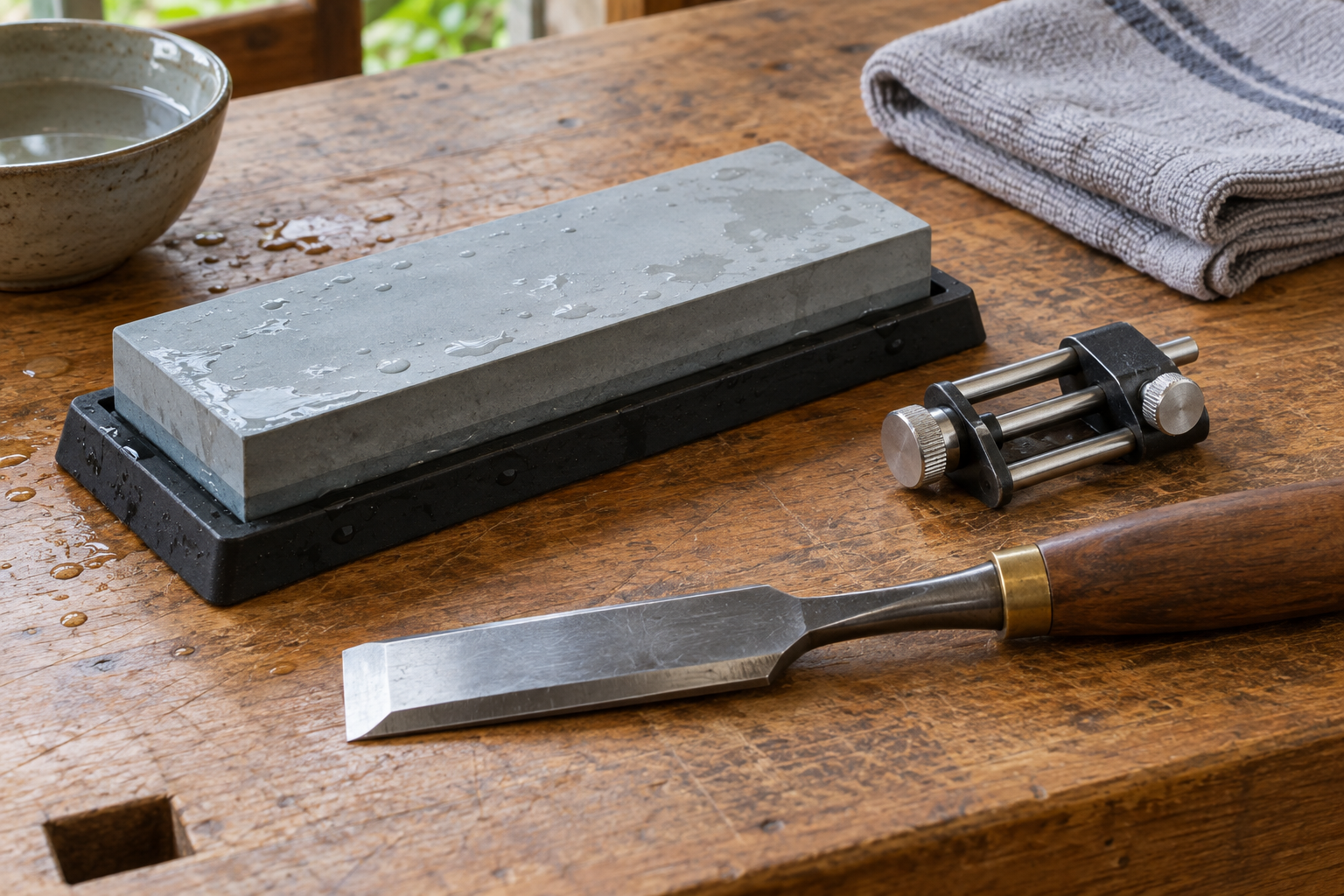
Waterstones use relatively soft abrasive material. The surface sheds worn abrasive and exposes fresh particles, so the stone cuts quickly. That is useful when a plane iron has a nick, a rounded bevel, or needs a new primary bevel. The same softness means the stone wears hollow, particularly under the center of a wide plane iron.
Oilstones use a harder bonded abrasive, commonly aluminum oxide or silicon carbide. They cut more slowly but hold their shape far better. A good oilstone can remain flat for years of ordinary honing. The slower action is not necessarily a problem: honing a lightly dulled iron may take only a minute or two on a medium oilstone followed by a fine stone.
Both types can leave a sharp, durable edge. The abrasive type and technique matter more than the lubricant’s name. A properly honed iron with a small, polished secondary bevel will outperform a poorly maintained iron sharpened on an expensive stone.
Japanese waterstone vs oilstone
| Factor | Japanese waterstone | Oilstone |
|---|---|---|
| Cutting speed | Fast, especially in coarse and medium grits | Slow to moderate |
| Flattening | Often needed every few sharpening sessions | Rarely needed for normal use |
| Lubricant | Water; some stones need soaking, others only wetting | Honing oil or a suitable light mineral oil |
| Typical working range | 1,000 to 8,000 grit | Medium to fine; grit ratings are not directly comparable |
| Mess | Water and abrasive slurry | Oily surface and rags |
| Best advantage | Fast metal removal and polished finishes | Low maintenance and long service life |
| Main drawback | Wears hollow and must be flattened | Slower cutting and less convenient cleanup |
What a plane iron actually needs
Most plane irons do not need a perfectly polished back across their entire width. The important area is the first 1/8 to 1/4 inch behind the cutting edge. Flatten that portion until it is uniformly scratched, then maintain it. Spending an hour polishing the whole back wastes steel and time.
For general bench-plane work, a bevel angle around 25 degrees with a small 30-degree secondary bevel is a sound starting point. A honing guide makes this repeatable, especially on a wide iron. A cambered iron may be sharpened freehand, but the edge still needs a consistent curve and an even burr removal.
Use a coarse stone, roughly 220 to 400 grit, only when repairing a chip or changing the bevel. For routine honing, start around 800 to 1,200 grit. Finish around 4,000 to 8,000 grit if you want a very keen edge for fine shavings. Going beyond 8,000 grit can improve feel, but the gain is small if the bevel is uneven or the burr remains.
When a waterstone is the better buy
Waterstones make sense for a woodworker who sharpens several times a week or routinely works with hard woods. Their rapid cutting reduces the temptation to keep using a dull plane iron. A 1,000-grit stone followed by a 5,000- or 6,000-grit stone covers most work. Add a coarse repair stone only if you regularly deal with nicks.
Plan on flattening the stones. Use a diamond flattening plate, a dedicated lapping stone, or wet abrasive paper on a flat surface. Check the stone with a straightedge; a hollow of even 0.5 mm can make it difficult to maintain a flat bevel on a plane iron. Draw pencil lines across the stone before flattening and continue until they disappear.
Do not leave a waterstone soaking indefinitely unless its instructions specifically allow it. Some stones crack, soften, or separate after prolonged immersion. Store it dry after use, and allow it to dry gradually rather than placing it against a heater.
When an oilstone is the better buy
Oilstones suit occasional users, traditional workshops, and anyone who values a stone that does not change shape quickly. They are also a sensible budget choice. A medium/fine combination oilstone can handle routine plane-iron honing for less money than a complete waterstone system, and it may never need replacing.
The trade-off is speed. Do not press hard and expect an oilstone to behave like a coarse waterstone. Use steady, moderate pressure and enough oil to carry away swarf. Wipe the surface when it loads with metal. A clogged oilstone can skate over the bevel instead of cutting it.
Oilstones are not automatically cleaner. Oil attracts dust and leaves a film on the bench and tool. Keep the stone in a covered box or tray, and use a rag that will not shed fibers onto the edge. If you dislike oily hand tools, waterstones are usually more pleasant despite the slurry.
Which should you buy?
For a first sharpening setup, buy a reliable 1,000-grit waterstone and a 5,000- or 6,000-grit finishing stone if you sharpen regularly. Include a flattening method in the budget; a waterstone without one is an incomplete system. A two-stone waterstone set is usually more useful than a large collection of rarely used grits.
If you sharpen a plane iron once a month, already own honing oil, or want the least maintenance, choose an oilstone. The cheaper option is entirely adequate for occasional furniture repairs and general carpentry. Spend the difference on a simple honing guide or a flat surface for flattening the back.
Whichever stone you choose, stop sharpening when the edge raises a burr along its full width, then remove that burr with light strokes on the back and bevel. Test the iron by taking a thin shaving or shaving the end grain of soft wood. A clean, continuous shaving is a more useful result than a particular stone brand or an impressive-looking polish.