What's inside
As an Amazon Associate I earn from qualifying purchases. This post may contain affiliate links at no extra cost to you.
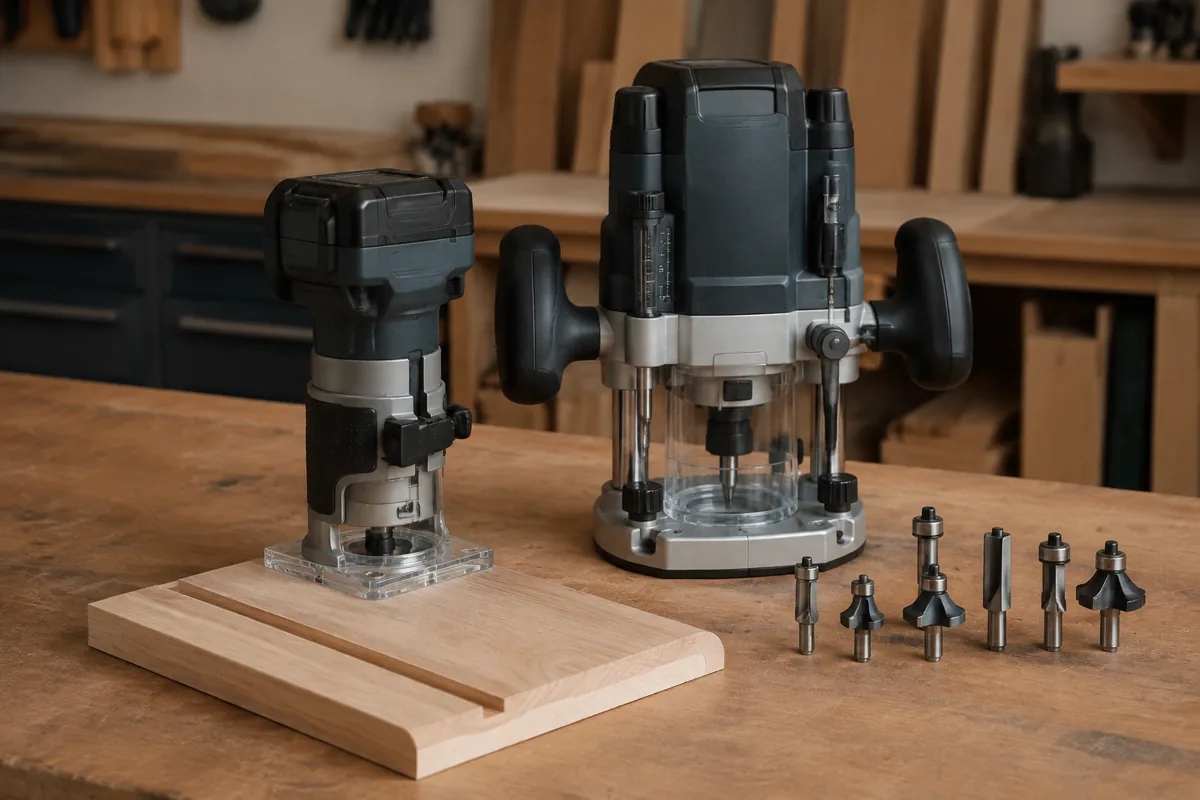
For rounding over small cabinet parts, a compact trim router is usually the right tool. It is lighter and easier to control than a full-size router, yet it has enough power for a 1/8-inch or 1/4-inch round-over bit in plywood, hardwood, and solid edging. The best choice depends less on maximum horsepower than on control, visibility, bit adjustment, and how often you work away from an outlet.
As an Amazon Associate we earn from qualifying purchases at no extra cost to you.


Our Top Picks
 BOSCH PR20EVS Colt 1.0 HP Variable-Speed Palm Router35 in9.41 x 7.43 x 4.7 inches3.3 PoundsCheck on Amazon
 Makita XTR01Z 18V LXT Lithium-Ion Brushless Cordless Compact6.2 x 8.5 Inches6.2 x 8.5 x 5.8 inches5.3 poundsCheck on Amazon


What matters in a compact router
Look for a motor in the roughly 1 to 1-1/4 horsepower class, or the cordless equivalent. That is sufficient for typical cabinet components up to about 3/4 inch thick. A variable-speed range is useful when working with larger bits or heat-sensitive materials, although it is not essential for a small round-over bit.
Depth adjustment is especially important. A round-over bit must be set so its bearing rides against the edge while the cutter removes only the intended corner. Rack-and-pinion adjustment is quick and repeatable; a threaded plunge-style adjustment offers finer control but can be slower. Whichever system you choose, the base should lock firmly without shifting when you tighten it.
A clear fixed base, broad enough to remain stable on narrow stock, is more valuable than an elaborate accessory package. LED lights help, but they do not compensate for a base that rocks or blocks your view of the bearing. A comfortable switch location and a motor that does not twist in your hand also reduce mistakes.
For a straightforward corded option, compare corded compact trim routers. They are generally the best value for a workshop where power is always available.
Compact router types compared
| Type | Best use | Advantages | Trade-offs |
|---|---|---|---|
| Corded fixed-base trim router | Regular cabinet edging and small parts | Low cost, consistent power, light weight | Power cord can catch on the work |
| Cordless compact router | Installation work and scattered jobs | No cord, good mobility, often smooth starting | Higher cost, added battery weight, runtime limits |
| Compact router kit with plunge base | Edge work plus occasional grooves or templates | More versatile, controlled entry cuts | Bulkier and usually more expensive |
| Full-size router | Large profiles and heavy stock removal | More power and larger bit capacity | Harder to control on small cabinet parts |
The best choice for most cabinet work
A corded fixed-base trim router is the sensible pick if you are rounding door edges, drawer fronts, shelf nosing, or small face-frame parts in a workshop. It usually costs less than a cordless tool and does not slow down when making a long series of parts. The cord is manageable if you route from the outside of the work and keep it over your shoulder or behind the router.
Choose a cordless compact router when you already own compatible batteries, work on installed cabinets, or regularly route where an extension cord is inconvenient. Battery models can be excellent, but the battery may make the tool noticeably taller and heavier. For a few small parts, that convenience may not justify the price.
A kit with both fixed and plunge bases is worthwhile if you also cut hinge recesses, start grooves inside a panel, or use template guides. If rounding over edges is the only job, the extra base is mostly storage clutter. A plunge base does not automatically make edge routing better; its height and spring pressure can make a narrow part harder to balance.
Bit size, speed, and setup
Use a 1/8-inch round-over bit for a subtle eased edge, or a 1/4-inch bit for a more noticeable furniture edge. On 3/4-inch stock, a 1/4-inch radius normally leaves a small flat section between the rounded corner and the opposite face. Check the bit’s bearing and cutting diameter before assuming the label tells the whole story.
Set the bit in several small steps rather than trying to find the perfect height immediately. With the router unplugged or the battery removed, place the base on the workpiece and adjust until the bearing touches the edge. Rotate the bit by hand to ensure the cutters will not contact the bench, clamp, or a neighboring surface.
Make a test cut on scrap from the same material. This exposes three common problems: the bit is set too high or low, the edge is chipped, or the profile does not match the adjoining part. On painted or veneered cabinet pieces, a test cut also shows whether the finish will splinter.
How to round small parts safely
Clamp narrow cabinet parts firmly, but do not rely on your fingers to hold a piece that is only a few inches wide. A sacrificial extension board or a larger carrier board gives the router a wider support surface. This is particularly useful on short drawer parts, where the router base can tip as it leaves the work.
Feed the router from left to right when the workpiece is in front of you and the bit is rotating in the normal direction. This conventional cut keeps the router pulling into the material instead of climbing along the edge. A climb cut can grab suddenly, especially in end grain, and may pull the router out of your hands.
Take a light pass, roughly 1/16 inch or less of material removal, then inspect the edge. On hardwood, a final shallow pass often produces a cleaner profile than one deep pass. Slow down slightly in end grain, but do not creep so slowly that the bit burns the wood. Keep the base flat and move at a steady rate.
Common failures and useful upgrades
Chipping at the exit corner is the most common failure. Reduce it by routing end grain first, then the long edges, so the long-edge pass removes any breakout. Back up the exit area with scrap when possible. Sharp bits matter: a dull round-over bit increases feed pressure, heat, and tear-out.
Dust can obscure the bearing and your layout line. A compact router with a usable dust port is preferable when routing indoors, although small ports clog quickly with chips. Wear eye protection and hearing protection, and connect a shop vacuum where the port does not interfere with the base.
If you only need occasional edge easing, a sharp small edge-rounding hand tool can be cheaper and quieter. It will not match a router’s consistency on many identical parts, but it is adequate for softening a few exposed edges. For repeated cabinet work, however, a compact fixed-base router with a quality bearing-guided bit is faster, more repeatable, and easier to justify.