What's inside
As an Amazon Associate I earn from qualifying purchases. This post may contain affiliate links at no extra cost to you.
Choosing bolt cutters for a padlock is not just a matter of buying the longest pair. Jaw geometry determines whether the tool can reach the shackle, how close it cuts to the lock body, and whether the jaws bite cleanly or simply slide off hardened steel. “Flush cutting” also needs a precise definition: ordinary bolt cutters rarely cut a shackle perfectly level with the lock body. They can cut close to it, but a true flush cut usually requires end-cutting nippers or a powered abrasive tool.
What “Flush Cutting” Means
A flush cut leaves little or no projecting metal after the cut. With a padlock, that means cutting the shackle close to the lock case rather than slicing through its exposed middle. This matters when the remaining shackle stub must not catch on clothing, tools, or a replacement fitting.
Most bolt cutters use jaws that close toward the center of the head. Their bevels and pivot arrangement require clearance around the shackle, so the lock body often prevents the jaws from getting all the way down. A typical center-cut bolt cutter may leave 6 to 15 mm of shackle above the case, depending on the jaw shape and the lock’s shoulders.
If the goal is simply to open a discarded or authorized lock, that leftover stub may not matter. If the cut must be nearly level with the case, look at heavy-duty end-cutting nippers or a compact cutting tool designed to approach material from the end.
Bolt Cutter Jaw Geometries Compared
| Jaw style | Best use | Typical cut position | Main limitation |
|---|---|---|---|
| Center cut | General-purpose chain, rod, and exposed shackle cutting | Centered between the jaws | Needs clearance around the lock body; rarely truly flush |
| Angle cut | Material lying against a surface or in a narrow access area | Offset from the head | Can twist the shackle if only one edge engages |
| Shear cut | Soft to medium steel wire, cable, and small fasteners | Sliding shear action | Usually a poor choice for hardened padlock shackles |
| End cut | Cutting close to a surface or lock body | At the end of the tool head | Shorter handles and limited capacity are common |
| Compound center cut | Thicker shackles where leverage is the priority | Centered, with increased mechanical advantage | Bulky head and more room needed around the lock |
Center-Cut Jaws: The Safe Default
Center-cut bolt cutters are the common choice because both blades meet symmetrically. The shackle is held in the middle of the jaw, reducing the tendency to push sideways. That makes them predictable on mild-steel shackles, chain, and threaded rod.
For a padlock, measure the shackle diameter rather than relying on the lock’s advertised size. A tool rated for 10 mm mild steel may have much less capacity against a hardened shackle. The jaw opening must also be large enough to accept the shackle without forcing the handles apart at an awkward angle.
Long handles provide leverage, but they do not solve access problems. A 36-inch tool can generate substantially more force than an 18-inch tool, yet its large head may not fit between a lock body and a hasp. For exposed locks with at least 50 mm of working room, a 36-inch center-cut bolt cutter is often the sensible starting point.
Angle and Offset Jaws
Angle-cut jaws are useful when the shackle sits close to a flat surface. Their angled head lets the handles clear the work while the cutting edges approach from the side. This can improve access around a hasp, but it does not automatically make the cut flush.
The risk is uneven engagement. If the lock body blocks one side of the head, only part of the cutting edge may contact the shackle. The tool can then roll, deform the shackle, or chip the cutting edge. Keep both blades square to the shackle and support the lock so it cannot swing.
Offset-head cutters are a useful compromise when a straight head cannot line up with the lock. Choose them for access, not because “offset” implies greater cutting power. Jaw alignment and the stated capacity still matter more.
End-Cutting Jaws for Near-Flush Work
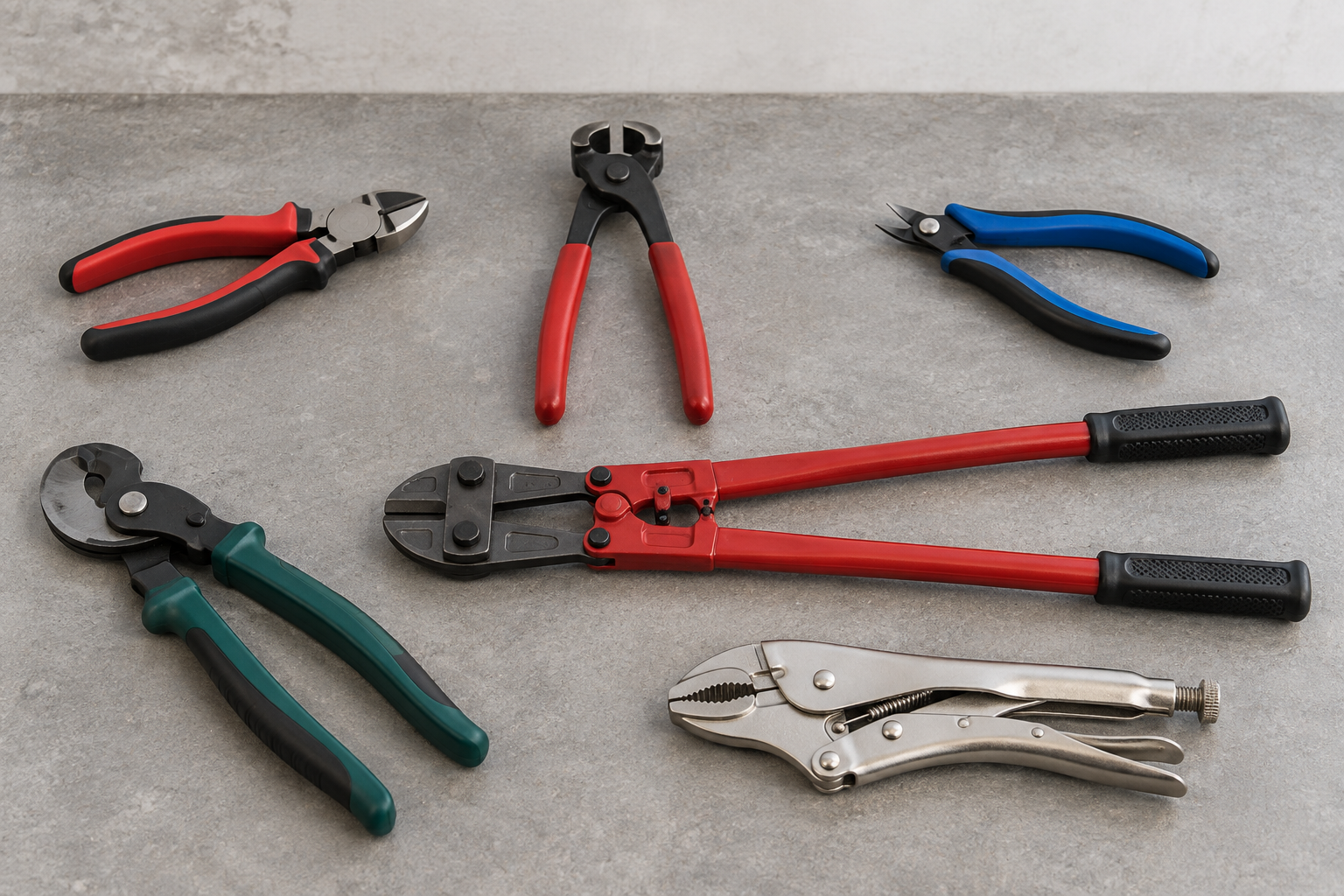
End-cutting nippers place the cutting edges at the end of the head, similar to large nail pullers. They can approach a shackle from above and cut closer to the lock case than standard bolt cutters. This is the right geometry when the stub is the problem.
There are trade-offs. End cutters generally have shorter handles, smaller openings, and less leverage than full-size compound bolt cutters. They are better suited to smaller shackles, exposed staples, and relatively soft steel. Do not assume that a heavy-looking end nipper can defeat a hardened boron or alloy-steel shackle.
For compact, authorized maintenance work, compare heavy-duty end nippers by jaw capacity, not only handle length. A stated 6 mm capacity in hardened steel is more useful than an unqualified “heavy duty” label.
Hardened Shackles Change the Decision
A padlock shackle may be only 8 mm thick but still defeat a large cutter if it is hardened. Common failure modes include jaws skating off the round shackle, visible edge dents without a complete cut, chipped cutting edges, and handles bending under excessive force. Cutting near the lock body can also force the blades against the case, damaging the tool before the shackle separates.
Check the manufacturer’s ratings for low-carbon steel and hardened steel separately. If no material rating is provided, treat the tool as intended for soft wire, chain, and mild steel—not security padlocks. A compact compound bolt cutter rated for hardened steel may outperform a longer bargain cutter, but only within its published capacity.
Buying and Using the Cutter
Match the jaw geometry to the available approach: center cut for open access, angle cut for surface clearance, and end cut for the closest possible approach. Measure the shackle, allow room for the head, and select at least 25 percent more rated capacity than the measured diameter when the steel type is uncertain.
Wear eye protection and gloves, keep bystanders clear, and never add a pipe over the handles. If the handles flex or the jaws begin to slip, stop. The cheaper standard center-cut tool is fine for an inexpensive mild-steel lock that is fully exposed. Paying more is justified for hardened shackles, restricted access, or a cut that must be close to flush—but jaw geometry still cannot overcome steel harder than the tool is designed to cut.