What's inside
As an Amazon Associate I earn from qualifying purchases. This post may contain affiliate links at no extra cost to you.
Start with the hole, not the cutter
An annular cutter removes a ring of metal, leaving a solid slug. That makes it faster and less demanding on a drill than a twist drill of the same diameter, especially for larger holes in plate. Choosing one comes down to two separate measurements: the finished hole diameter and the material thickness the cutter can reach.
Measure the required hole and the workpiece at the thickest point. If a hole must clear a 20 mm bolt, for example, a 20 mm cutter leaves little allowance for misalignment or coating. Check the drawing and fit requirements before choosing a larger diameter; a hole that is too large cannot be corrected by the cutter. Also confirm whether the cutter is intended for steel, stainless steel, or another material. A compatible diameter and cutting depth do not make an unsuitable cutter work well.
Match diameter to the job
Buy the diameter that matches the hole specification rather than rounding up to a convenient size. For repeated fabrication work, metric and imperial sets can save time, but a set is useful only if it covers the sizes you actually use. A single cutter is often the better buy for occasional work or a one-off hole.
Check the drill’s arbor and cutter shank before ordering. Annular cutters and magnetic drills use different shank and retention arrangements, and a cutter that does not match the arbor will not install securely. Verify the machine’s supported cutter diameter, too. Its published maximum capacity is a limit, not necessarily a comfortable production size.
For a few holes in mild steel, a basic high-speed-steel cutter may be adequate and less costly. For frequent work, harder material, or longer runs, a suitable cobalt or carbide-tipped cutter may last longer or cut faster, depending on the application and machine. Don’t pay for a premium coating or tooth design unless it fits the material and duty cycle. Compare high-speed-steel annular cutters with the cutters specified for your material and arbor.
Choose cutting depth with a margin
Cutting depth is the maximum material thickness the cutter can pass through in one setup. A 25 mm deep cutter is not the right choice for a 25 mm plate: chips, setup variation, and the cutter’s pilot-pin travel can leave the slug partly attached. Allow a practical margin where possible. For a 20 mm plate, a cutter rated around 25 mm deep gives more room than one rated exactly 20 mm.
Depth is not the same as overall cutter length. A long body may provide clearance above the work, while its listed cutting depth is shorter. Confirm the manufacturer’s cutting-depth specification, then check that the machine has enough stroke and that the pilot pin can eject the slug. Also check clearance behind the workpiece; the pilot and slug need room to move without hitting a fixture or another plate.
If the material exceeds the cutter’s rated depth, don’t assume you can simply push harder or cut from both sides. A two-sided approach may work when both faces are accessible and accurately aligned, but a small mismatch can leave a step or an uneven hole. For thick material, choose a cutter with sufficient depth or use a process intended for that thickness.
Compare cutter options
| Option | Best fit | Trade-off |
|---|---|---|
| High-speed steel | Occasional holes in mild steel | Lower upfront cost; may wear sooner in hard materials or sustained use |
| Cobalt high-speed steel | Regular work or tougher steels, when specified for the job | Often costs more; still needs correct speed, feed, and lubrication |
| Carbide-tipped | Applications suited to carbide and a stable machine setup | Can cut quickly, but teeth are vulnerable to impact and poor alignment |
| Longer cutting depth | Thicker plate within the cutter’s rated capacity | May cost more and needs adequate machine stroke and slug clearance |
For an occasional hole in mild steel, the cheaper cutter is fine if its diameter, depth, and shank match the machine. For production work, compare expected life and cut quality rather than purchase price alone. A cobalt annular cutter is worth considering when the cutter specification suits the material and repeated use justifies the extra cost.
Check the machine and setup
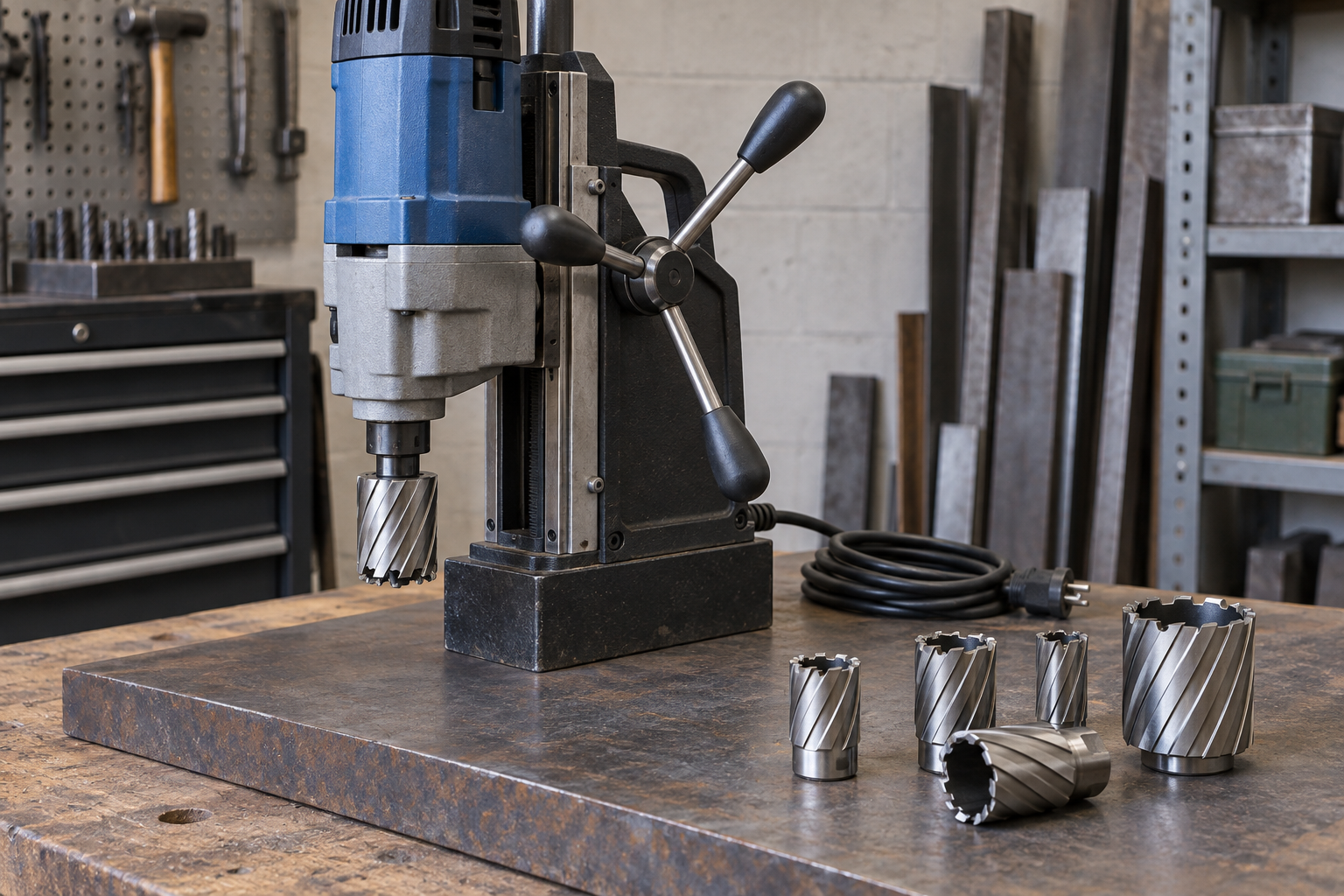
Annular cutters are commonly used with magnetic drills. Before buying, check the drill’s arbor type, cutter diameter capacity, spindle speed range, and available stroke. A magnetic drill needs a flat, clean surface and a secure hold. On thin, curved, painted, or uneven stock, the magnet may not grip reliably; do not treat the magnet as a substitute for clamping the work.
Use the speed and lubrication recommended for the cutter and material. Too much speed can overheat the teeth; too little feed can rub rather than cut. Excessive feed can chip teeth, stall the drill, or move the setup. Keep the cutter aligned, use cutting fluid where appropriate, and stop if the machine shifts, the magnet loses hold, or the cutter binds. Wear eye protection and keep hands clear of the cutter and ejected slug.
A pilot pin helps locate the hole and actuates slug ejection. Make sure the pin supplied or specified is compatible with the cutter and machine, and that it moves freely. A stuck slug can damage the cutter or create a sudden snag. Never try to catch a slug by hand; wait for the cutter to stop, then remove it safely.
Buy for the real workload
For one or two holes, a correctly sized cutter with enough depth is usually a better purchase than a large set. If you regularly make holes in several sizes, compare a cutter set compatible with your magnetic drill against the cost of buying individual sizes. Check that the set includes the diameters, depth, shank, and pilot pins you need; a low price is less useful if half the sizes will sit unused.
Before ordering, write down the finished diameter, maximum plate thickness, material, machine arbor, and available stroke. Those five checks prevent the common mistakes: buying the wrong hole size, choosing a cutter too shallow for the plate, or receiving one that does not fit the drill. When any measurement is close to the tool’s limit, choose a compatible cutter with more capacity rather than relying on extra pressure to make up the difference.