What's inside
As an Amazon Associate I earn from qualifying purchases. This post may contain affiliate links at no extra cost to you.
For stainless plate, the choice between carbide and high-speed steel (HSS) annular cutters comes down to hole size, plate thickness, machine rigidity and how many holes you need to make. Carbide usually cuts faster and lasts longer in production work, but it costs more and is less forgiving of vibration or a poor setup. HSS is cheaper and tougher when conditions are less than ideal, though it can run hot and wear quickly in stainless if you push it too hard.
As an Amazon Associate we earn from qualifying purchases at no extra cost to you.


Our Top Picks

The quick answer
Choose a carbide annular cutter for repeated holes, thicker plate, or a job where cutting time matters—provided your mag drill or other machine is rigid and has the correct speed range. Choose HSS for occasional holes, a smaller budget, or a setup that may see some vibration. For either cutter, use cutting fluid, steady feed pressure and a speed suitable for the cutter diameter. Stainless steel work-hardens if the tool rubs instead of cutting.
How annular cutters work
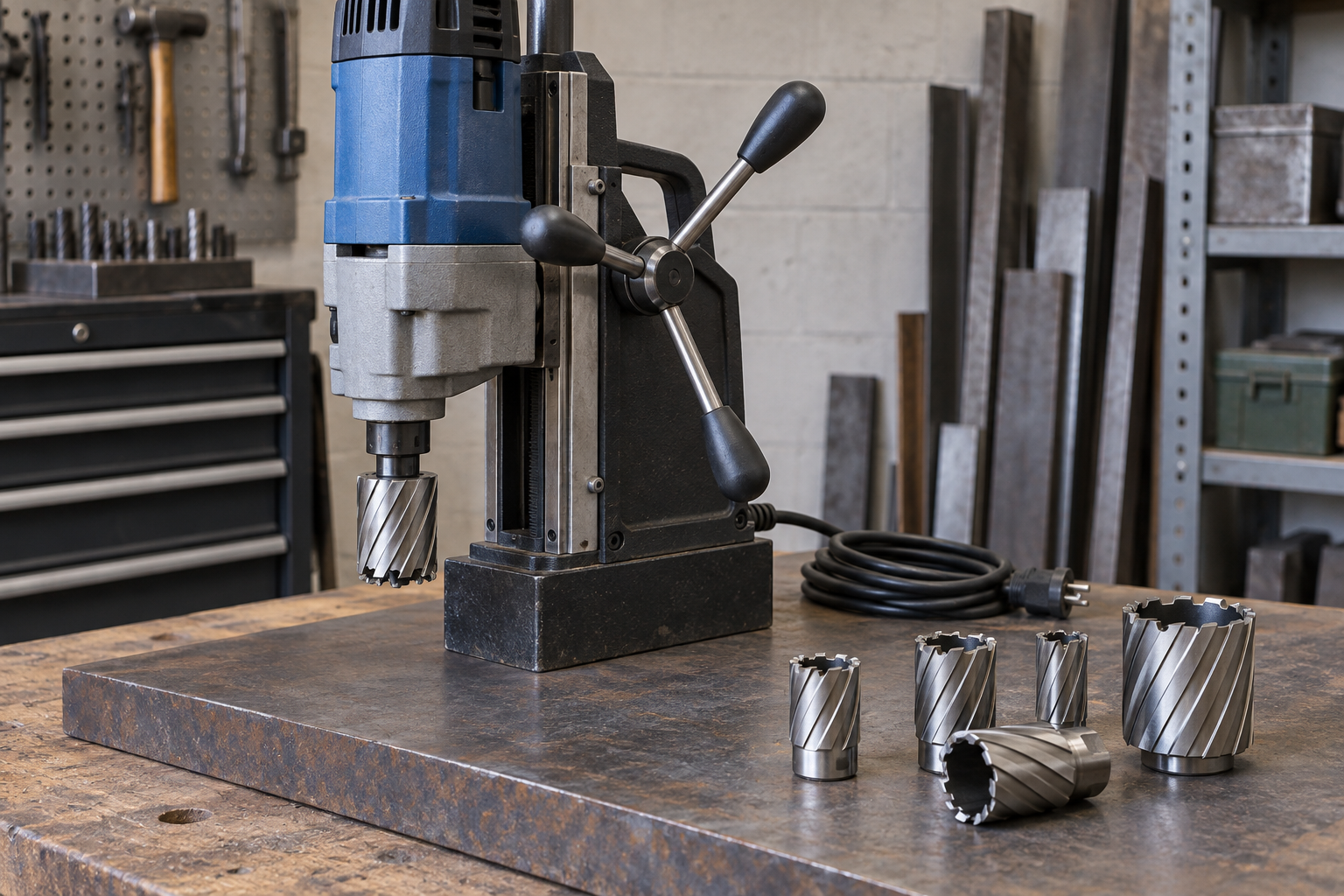
An annular cutter removes a ring of material rather than drilling out the entire center of the hole. Its teeth cut around the perimeter, leaving a slug that the pilot pin ejects. This reduces the amount of material being cut compared with a twist drill of the same diameter, which is one reason annular cutters are useful for larger holes in plate.
Carbide-tipped cutters have hard cutting edges that keep their sharpness at higher cutting temperatures. HSS cutters use a tougher, less brittle steel edge. Carbide can take more heat, but its cutting edges are more vulnerable to impact, chatter and side loading. HSS is more tolerant of a slightly unsettled setup, but heat and rubbing can dull it quickly.
Carbide vs. HSS at a glance
| Factor | Carbide annular cutter | HSS annular cutter |
|---|---|---|
| Best fit | Repeated holes, higher output, rigid machines | Occasional holes, lower tool cost, less rigid setups |
| Cutting speed | Often faster when the machine and cutter are matched | Usually slower, especially as diameter increases |
| Heat tolerance | Higher, but still needs proper feed and lubrication | Lower; overheating can quickly dull the teeth |
| Shock and chatter | Less forgiving; edges can chip | Generally more tolerant of minor vibration |
| Cost per cutter | Higher | Lower |
| Best reason to buy | Save time across many holes | Keep upfront cost down for limited work |
When carbide is worth the extra cost
Carbide makes sense when you have a run of holes to cut in stainless, particularly in plate thick enough that an HSS cutter would spend a long time engaged. A carbide cutter can maintain a sharp edge through more work when run correctly, reducing tool changes and downtime. Its higher allowable cutting temperature can also make it practical at higher surface speeds than HSS, subject to the cutter maker’s guidance and the limits of your machine.
That advantage depends on a firm setup. The magnet must sit flat on clean, suitable material, and the plate and workpiece should not flex. Keep the cutter square to the surface and avoid forcing it sideways. Chatter can chip carbide teeth; once an edge is damaged, the cutter may cut poorly or fail prematurely. If your drill cannot hold speed under load or the plate is bouncing, carbide’s speed advantage may disappear.
For a production job, compare the cutter price with the time saved across the full hole count, not just the cost of one tool. A carbide annular cutter for stainless work is a sensible category to consider when the machine is rigid and the job involves repeated cuts.
When HSS is the better buy
HSS is often the more sensible choice for a few holes, maintenance work or a job where you do not need the highest output. The lower upfront price matters when the cutter may only be used once or twice. HSS also tends to cope better than carbide with small amounts of vibration, though that is not a substitute for fixing a loose workpiece or an unstable drill.
Its main risk in stainless is work-hardening. If the teeth rub, stall or spin without making chips, the surface can harden and become much harder to cut. Signs include squealing, smoke, blue discoloration, a polished ring around the hole and chips that stop forming. Stop if this happens, let the cutter cool, check the speed and feed, and do not keep rubbing at the same hardened spot.
For occasional work with a controlled setup, an HSS annular cutter for stainless steel can deliver a clean hole without paying for carbide capacity you will not use.
Set the cutter up to avoid failure
Follow the cutter maker’s speed chart for the cutter diameter and material; there is no single correct RPM for every annular cutter. As a rough starting point, larger cutters generally need lower RPM than smaller ones. Do not assume a mag drill’s top speed is suitable. Too much speed raises heat, while too little feed pressure lets the teeth rub. Use a steady feed that produces chips, without leaning hard enough to stall the machine or deflect the cutter.
Use cutting fluid suitable for stainless and keep it at the cutting area. A pilot pin helps locate the hole and typically controls coolant flow or slug ejection, depending on the tool. Check that the pin moves freely and that the cutter is seated correctly in the arbor. Clamp the work where possible, clear chips safely, and keep hands away from the rotating cutter and hot slug. Never remove a slug while the tool is running.
Before buying, confirm the cutter’s shank matches your machine and that its cutting depth exceeds the plate thickness. If you are drilling near an edge, make sure the magnet has enough contact area and the cutter will not pull the drill off balance. A clean, secure setup often matters more to cutter life than the material printed on the package.
Make the buying decision
For a handful of holes in stainless plate, start with HSS if your machine is steady and you can keep the cutter cutting rather than rubbing. For a long run, thicker material or a schedule where time at the machine is expensive, carbide is worth considering—but only with a rigid drill, stable work and controlled feed. Neither type is immune to heat, bad alignment or a loose setup. Match the cutter to the job, follow its speed guidance, and stop at the first sign of chatter or work-hardening rather than trying to force the cut.