What's inside
As an Amazon Associate I earn from qualifying purchases. This post may contain affiliate links at no extra cost to you.
For cutting laminate flooring on a miter saw, the best general-purpose choice is a 10-inch, 80-tooth carbide blade with a triple-chip grind (TCG) or a very fine alternate-top-bevel (ATB) grind. It will not make every cut perfectly chip-free, but it gives you the best balance of clean edges, cutting speed, and reasonable blade life.
Laminate flooring is harder on blades than ordinary pine. The wear layer is a thin melamine surface over a dense HDF core. A coarse blade can tear the decorative face, while a standard high-tooth-count wood blade can become dull quickly if its carbide tips are too small or its grind is poorly suited to composite material.
As an Amazon Associate we earn from qualifying purchases at no extra cost to you.


Our Top Picks
 DEWALT DW7116PT DEWALT DW7116PT 60T Precision Trim Miter7-1/4"8.5 x 0.5 x 9.75 inches0.57 PoundsCheck on Amazon
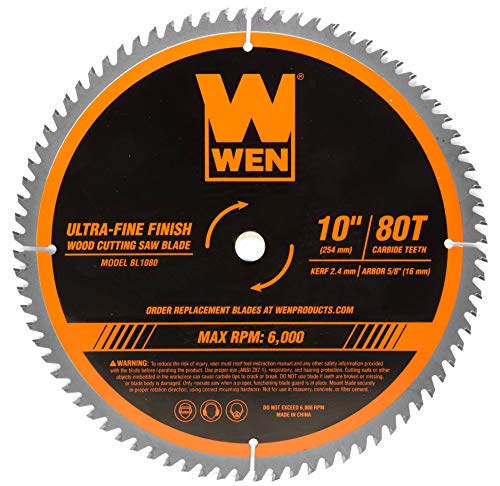 WEN BL1080 10-Inch 80-Tooth Carbide-Tipped Ultra-Fine Finish Professional10 inches10 x 10 x 0 Inches1.6 PoundsCheck on Amazon


The blade specifications that matter
Start with the diameter and arbor size required by your saw. Most 10-inch miter saws use a 5/8-inch arbor, and most 12-inch saws use a 1-inch arbor, but verify both in the saw manual. The blade must also be rated for the saw’s maximum RPM.
| Blade feature | Best choice for laminate | Why it matters |
|---|---|---|
| Diameter | Same as the saw specification | Maintains correct cutting depth and guard clearance |
| Tooth count | 80T for a 10-inch saw; 80T to 100T for a 12-inch saw | Produces a smoother cut with less breakout |
| Grind | TCG, or fine ATB | TCG resists chipping and handles abrasive HDF well |
| Hook angle | 0° to mildly negative, if approved for the saw | Reduces aggressive grabbing in thin flooring |
| Kerf | Full kerf for durability; thin kerf for a lower-powered saw | Changes feed effort, waste, and blade stiffness |
For most homeowners, an 80-tooth 10-inch TCG miter saw blade is the safest purchase. TCG teeth use a flat-topped tooth paired with a chamfered tooth. That geometry removes material without placing a sharp corner directly against the brittle melamine layer.
TCG versus ATB blades
A fine ATB blade is often cheaper and can leave a very clean edge. Its alternating angled teeth slice the surface, which is useful for crosscutting laminate planks. The drawback is that the sharp tips can wear or chip sooner when cutting many boards, particularly when grit gets embedded in the HDF core.
TCG is the better pick for a large flooring job or premium laminate. It usually leaves fewer white chips along the cut line and holds its edge better against abrasive material. It may cut slightly slower, and the edge can look less polished than an excellent ATB blade on softwood, but that difference is rarely important on flooring cuts hidden by baseboard.
An 80-tooth 12-inch composite-cutting blade makes sense for a 12-inch saw. Do not assume that a 100-tooth blade is automatically better. Excessive tooth count can rub instead of cut, especially if you push the saw too slowly. That creates heat, burns the edge, and can soften or smear the laminate surface.
How to get a chip-free cut
Blade choice is only half the result. First, support the plank close to the cut. A piece of scrap flooring or a flat auxiliary fence prevents vibration, which is a common cause of chipped corners. Clamp long boards when practical, but keep clamps clear of the blade path and the saw’s sliding travel.
On a typical miter saw, place the decorative face upward because the blade enters that surface first. The entry side generally receives the cleanest cut. Make a steady, controlled plunge rather than dropping the blade quickly. Cutting too fast tears the wear layer; cutting so slowly that the blade squeals creates heat.
For especially visible cuts, apply painter’s tape over the cut line and mark the line on the tape. Use a fresh, sharp blade and let the blade reach full speed before entering the plank. Tape is not a substitute for the correct grind, but it can reduce small edge splinters.
Make sure the board is fully supported on both sides of the cut. An unsupported offcut can break away at the final few teeth, taking a chunk from the locking edge. If the cut end will be covered by trim, put that end at the wall. Reserve your cleanest cuts for exposed transitions and door jambs.
Full-kerf or thin-kerf?
A full-kerf blade is typically around 2.4 to 3.2 mm wide and has more carbide behind each tooth. It stays rigid and is a good choice for a strong 15-amp miter saw. It also removes more material and requires slightly more effort from the motor.
A thin-kerf blade, often around 1.8 to 2.4 mm, is useful on a compact or lower-powered saw. It produces less dust and wastes less material, but thin blades can deflect if the plank is not supported. Deflection may show up as a cut that is square at the top and slightly angled at the bottom.
Do not use a blade marketed only for ripping wood. Laminate flooring is primarily crosscut on a miter saw, and a ripping blade’s low tooth count can leave a rough, badly chipped edge. A fine-finish laminate flooring blade is the more appropriate category.
When a cheaper blade is good enough
If you are installing one small room and most cuts will disappear under baseboard, a reasonably made 80-tooth ATB blade is usually sufficient. There is no practical benefit in buying an expensive specialty blade for 20 concealed crosscuts. Spend the difference on accurate layout and a replacement blade if the first one becomes dull.
For several rooms, dark or glossy flooring, stair nosings, or visible transition cuts, choose TCG and inspect the teeth before starting. Replace the blade when it requires noticeably more force, leaves repeated chips despite good support, or produces burning. Forcing a dull blade is more likely to damage the flooring and the saw than buying a new blade.
Finally, keep a sharp utility knife nearby for trimming underlayment and use a jigsaw or oscillating tool for irregular notches. A miter saw blade is excellent for square crosscuts, but no tooth count will make it the right tool for curved cuts or detailed cuts around pipes.