What's inside
As an Amazon Associate I earn from qualifying purchases. This post may contain affiliate links at no extra cost to you.
Our Top Picks


The best bit type for MDF and particleboard
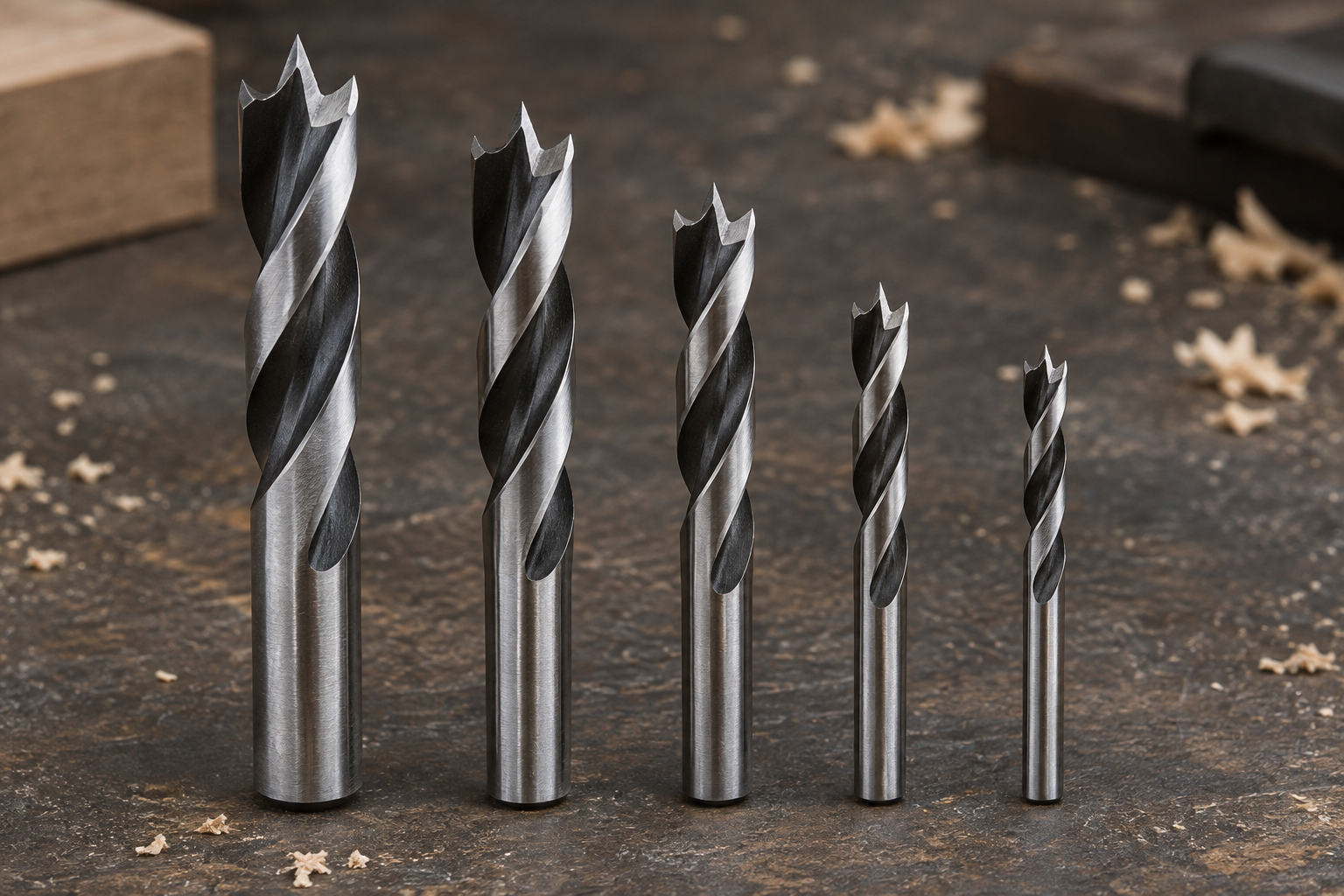
For clean holes in MDF and particleboard, a brad-point wood bit set is the best general choice. Its center point keeps the bit from wandering, while the outer spurs score the hole’s edge before the cutting edges remove material. That matters in engineered sheet goods, where the surface can chip or crumble easily.
A basic brad-point wood drill bit set covering roughly 1/8 to 1/2 inch handles most cabinet hardware, shelf-pin, hinge, and assembly work. Look for bits with clearly formed spurs and a center point that extends slightly beyond the cutting edges. Blunt or poorly ground spurs are usually the first sign of a cheap set that will leave ragged exits.
As an Amazon Associate we earn from qualifying purchases at no extra cost to you.


For holes larger than 1/2 inch, a Forstner bit is usually cleaner than an oversized twist bit. Forstner bits cut with a rim and a flat bottom, making them useful for concealed hinges and cable pass-throughs. They require more drilling force, however, and inexpensive sets can overheat quickly in MDF.
What to look for in a set
Choose a set with 1/4-inch hex shanks if you regularly use an impact driver, but use the driver’s low-speed setting and disable hammer action. A standard round shank works well in a drill and is often held more accurately by a conventional chuck. Do not assume an impact-rated shank makes the cutting portion stronger; it mainly improves compatibility and resistance to chuck or collet slippage.
Size coverage is more important than a large piece count. A useful everyday range includes 1/8, 3/16, 1/4, 5/16, 3/8, 7/16, and 1/2 inch. Metric sets covering approximately 3 to 13 mm are equally practical. Sets padded with duplicate sizes, countersinks, or unrelated twist bits may look like better value but do not necessarily drill better holes.
High-speed steel is adequate for occasional MDF and particleboard work. Black oxide or titanium-colored coatings are not a substitute for a sharp cutting profile. If you drill many holes, a set with replaceable or carbide-tipped cutters can last longer, but it costs more and is less forgiving if the bit is twisted, dropped, or used in a nail-embedded board.
Brad-point, Forstner, and twist bits compared
| Bit type | Best use | Edge quality | Main drawback |
|---|---|---|---|
| Brad-point | General holes from 1/8 to 1/2 inch | Clean entry and good alignment | Spurs dull if forced or used in abrasive material |
| Forstner | Large, flat-bottomed holes and hinge cups | Very clean with proper support | Needs more power and runs hotter |
| Standard twist | Occasional work or mixed materials | Acceptable entry; rougher exits | Wanders and tears out more easily |
| Self-feed or hole saw | Very large through-holes | Depends heavily on backing support | Overkill for small hardware holes |
How to drill without breakout
Mark the hole accurately, then clamp the workpiece to a sacrificial board. The backing board is the most effective way to prevent blowout when the bit exits. MDF and particleboard often look fine on the entry side but erupt around the exit in a cone-shaped chip. A backing board supports the fibers and gives the bit somewhere to cut into.
Use a moderate speed rather than maximum drill speed. For a 1/4-inch brad-point bit, roughly 1,500 to 2,500 rpm is a sensible starting range in MDF. A 1/2-inch bit should generally run slower, around 700 to 1,200 rpm. These are starting points, not fixed requirements: if the bit squeals, smokes, or leaves a dark ring, reduce speed or pressure and clear the chips.
Feed steadily. Pressing too lightly can rub the cutting edges and generate heat; forcing the bit can bend the shank, stall a cordless drill, or tear the surface. When the center point is about to break through, stop and finish from the opposite side, using the small pilot opening as your guide. This produces the cleanest exit when you cannot clamp a backing board.
For a through-hole, you can also apply masking tape over the exit area. Tape helps hold loose surface fibers together, but it is not as reliable as a sacrificial board. On veneered or melamine-faced panels, score the hole location with a sharp knife or use a brad-point bit with intact outer spurs. Dull spurs can lift the decorative layer before the cutting edges reach it.
MDF versus particleboard
MDF is dense and uniform, so it usually produces a more predictable hole. It is also abrasive and creates fine dust that can wear inexpensive bits. Particleboard is less consistent: the outer face may be dense while the core contains coarse chips and voids. A bit can cut cleanly through the surface and then grab in the core, especially near an edge.
Keep holes at least twice the bit diameter from an unsupported edge whenever the design allows. A 1/4-inch hole should ideally be at least 1/2 inch from an edge, and more distance is better in low-density particleboard. Near-edge drilling is a common cause of chipped corners and broken sections, regardless of bit quality.
Which set makes sense for your work
For occasional furniture assembly, flat-pack repairs, and cabinet hardware, buy a mid-priced high-speed steel brad-point bit set with common fractional sizes. The cheaper option is fine when you will drill only a few dozen holes and can support the work properly. A premium set will not compensate for drilling at full speed into unsupported board.
If you are installing many hinges, shelf pins, or drawer components, choose a better-ground set or a dedicated Forstner bit set for larger holes. Consistent diameters and sharper spurs save time when every hole must line up. For production work, carbide-tipped bits may justify their price, especially when MDF is the main material.
Keep the bits in a case, wipe off dust after use, and never drill through a hidden screw or nail. If a bit suddenly stops cutting, inspect the board before applying more force. One embedded fastener can damage a budget bit instantly and can throw the drill sideways. For most home projects, a sharp brad-point set, a backing board, and controlled speed matter more than an expensive accessory kit.