What's inside
- Miller stick welders compared
- 1. Miller Maxstar 210 STR: the best all-around portable option
- 2. Miller CST 280: the shop and maintenance specialist
- 3. Miller Thunderbolt XL 225 AC/DC: the traditional workshop choice
- Decision matrix by job and user
- Electrode size, input power, and real-world output
- Ownership realities: what wears first
- Final buying recommendation
- Related Guides
As an Amazon Associate I earn from qualifying purchases. This post may contain affiliate links at no extra cost to you.
The best Miller MMA welder for most mobile repair work is the Maxstar 210 STR, while the CST 280 is the stronger choice for high-duty-cycle fabrication and the Thunderbolt XL 225 AC/DC is the practical pick when you need a traditional transformer machine and reliable AC output.
Miller uses “stick” or SMAW more often than “MMA,” but the process is the same: a flux-coated electrode supplies the filler metal and shielding. The right model depends less on the maximum amperage printed on the front and more on input power, duty cycle, electrode size, portability, and the kind of arc control you need.
As an Amazon Associate we earn from qualifying purchases at no extra cost to you.


Our Top Picks
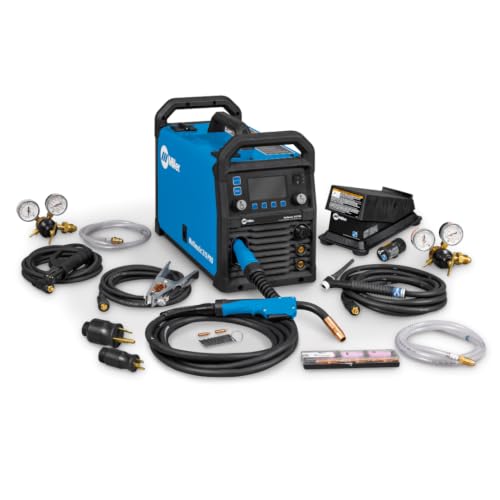


Miller stick welders compared
| Model | Output range | Input power | Approx. weight | Practical electrode range | Best use |
|---|---|---|---|---|---|
| Miller Maxstar 210 STR | 5–210 A | 120 or 240 V, single phase | About 24 lb | 3/32–5/32 in routinely; smaller electrodes at low amperage | Mobile maintenance, fabrication, generators, field repairs |
| Miller CST 280 | 5–280 A | 208–575 V, three phase | About 38 lb | 1/8–3/16 in routinely; larger electrodes where duty cycle permits | Production shops and plant maintenance |
| Miller Thunderbolt XL 225 AC/DC | 40–225 A | 230 V, single phase | About 100 lb | 1/8–3/16 in for general work | Fixed workshop use, farm repair, AC stick welding |
Specifications can vary by package, regional version, and production revision. Check the rating plate and the current Miller manual before selecting a breaker, extension cord, or generator. The electrode ranges above describe sensible working ranges rather than a guarantee that every rod size will run well at every duty cycle.
1. Miller Maxstar 210 STR: the best all-around portable option
The Maxstar 210 STR is the most versatile choice when one welder must move between a workshop, service truck, and jobsite. It is an inverter machine with a 5–210 amp range and dual-voltage input, so it can operate from a suitable 120 V supply for lighter work or 240 V for full output.
Its low weight is a major advantage. At roughly 24 lb, one person can carry it up a ladder, across a site, or into a confined repair area. The machine is suited to 6010, 6011, 6013, and 7018 electrodes, although the available input power determines whether a large rod can be run continuously.
Arc performance is more refined than a basic transformer welder. Adjustable arc-force behavior helps reduce sticking when the arc length becomes short, while hot-start assistance makes ignition easier. That matters when repairing dirty steel, restarting a bead, or welding in an awkward position. It does not eliminate the need to remove heavy rust, paint, oil, and scale.
Choose the Maxstar 210 STR if:
- You regularly weld away from a permanent 240 V outlet.
- Portability is more important than maximum production output.
- Your normal work uses 1/8 in or 5/32 in electrodes.
- You need an inverter that is easier to transport and more efficient than a large transformer machine.
The limitation is capacity. It is not the ideal production machine for long runs with large-diameter electrodes or thick structural sections. Its price is also normally higher than a basic transformer welder, although lower electricity use and easier transport can offset some ownership cost.
2. Miller CST 280: the shop and maintenance specialist
The CST 280 is the better Miller MMA welder for facilities with three-phase power and a need for sustained stick output. Its 5–280 amp range gives it more headroom than the Maxstar 210 STR, and its broad 208–575 V input range makes it suitable for many industrial electrical systems.
The extra amperage is useful when running 3/16 in electrodes, welding thicker sections, or maintaining a stable arc through long repair passes. Compared with a compact field inverter, the CST 280 is aimed more at a work cell, maintenance department, or fabrication area than at occasional homeowner use.
Its arc characteristics are designed for stick work rather than maximum process versatility. A maintenance welder can select an electrode appropriate to the steel and position, then use the machine’s arc-control settings to make starts and short-arc operation more manageable. As with any inverter, a long, undersized extension cord can cause voltage drop and poor arc behavior.
Choose the CST 280 if:
- Your building has compatible three-phase input power.
- The welder will run frequently rather than sit unused for months.
- You need more output reserve for 5/32 in and 3/16 in electrodes.
- Portability matters, but a 38 lb machine is acceptable.
The CST 280 is a poor fit for a garage with only ordinary household circuits. It may also be excessive for occasional brackets, gates, and small repairs. Before buying, confirm that the electrical service, disconnect, receptacle, and duty-cycle requirements match the installation.
3. Miller Thunderbolt XL 225 AC/DC: the traditional workshop choice
The Thunderbolt XL 225 AC/DC remains attractive when simplicity, low purchase cost, and AC capability matter more than portability. Its transformer design is much heavier than the Maxstar and CST, but it does not depend on the same type of electronic inverter architecture.
AC output can be useful for certain electrodes and for work where arc blow becomes troublesome. The machine is straightforward to operate and well suited to a fixed bench, farm workshop, or repair bay with a dedicated 230 V circuit. Its approximately 100 lb weight makes it a two-person move or a permanent-installation machine.
The trade-off is less refined control. Compared with the Maxstar 210 STR, it is less convenient for field work, typically consumes more input power for comparable welding, and offers less electronic adjustment. Its 40 amp minimum output is also less suitable for very small electrodes and thin sheet metal.
Choose the Thunderbolt XL 225 AC/DC if:
- The machine will remain in one workshop.
- You want AC and DC stick capability without advanced setup menus.
- Your work commonly involves 1/8 in to 3/16 in electrodes.
- Purchase budget matters more than low weight and transport efficiency.
Decision matrix by job and user
| Your situation | Recommended choice | Why |
|---|---|---|
| Occasional homeowner, limited storage, 120/240 V available | Maxstar 210 STR | Small footprint, low weight, flexible input |
| Mobile repair technician or farm-service user | Maxstar 210 STR | Easier to carry and practical with generator power |
| Experienced maintenance welder, three-phase shop | CST 280 | Higher output and broader industrial input range |
| Fixed workshop on a tighter equipment budget | Thunderbolt XL 225 AC/DC | Simple controls and useful AC output |
| Frequent long welds with 3/16 in electrodes | CST 280 | More output reserve and better industrial suitability |
| Thin material and occasional 6013 work | Maxstar 210 STR | Lower minimum amperage and finer inverter control |
Electrode size, input power, and real-world output
As a working starting point, a 1/8 in 6013 or 7018 electrode commonly runs around 90–140 A, while a 5/32 in rod often needs approximately 130–190 A. A 3/16 in electrode may require roughly 170–250 A depending on the electrode type, position, joint, and manufacturer instructions.
That means a machine rated at 210 A can handle much general repair work, but it may not sustain a large electrode at full duty cycle. Conversely, buying a 280 A welder does not help if the building cannot provide the required three-phase input.
For example, suppose a 5/32 in electrode is used at 170 A and 25 V. Welding power is approximately:
170 A × 25 V = 4,250 watts of arc power.
After allowing for inverter or transformer losses, the electrical supply must provide substantially more than 4.25 kW. This is why a 240 V circuit, proper breaker, and correctly sized conductors are important even when the welder’s front-panel setting appears moderate.
Ownership realities: what wears first
Consumables usually cause more downtime than the welding power source. Expect to replace electrode holders, work clamps, cable lugs, liners or connectors where fitted, and damaged welding leads before the main transformer or inverter fails. Keep the electrode holder jaws clean and tight; poor contact creates heat and unstable arc starts.
Dust is especially important with inverter welders. Store the machine off the floor, keep ventilation openings clear, and use dry compressed air only according to the manufacturer’s cleaning guidance. Do not operate with blocked fans or wrap a hot machine immediately after a long pass.
Common mistakes include using an extension cord that is too long or too small, welding with a loose work clamp, selecting an electrode that requires more amperage than the circuit can supply, and assuming a high-duty-cycle rating applies at every output. Inspect leads before each job and let the thermal protection work rather than repeatedly resetting an overheated machine.
Final buying recommendation
For most people searching for a Miller MMA welder in 2026, the Maxstar 210 STR is the strongest general recommendation because it combines 120/240 V flexibility, low weight, useful arc control, and enough output for common repair electrodes. Choose the CST 280 when the machine belongs in a three-phase shop and will see frequent, heavier work. Choose the Thunderbolt XL 225 AC/DC when a fixed workshop values conventional operation and AC capability more than mobility.