What's inside
As an Amazon Associate I earn from qualifying purchases. This post may contain affiliate links at no extra cost to you.
Flush cutting with a reciprocating saw means cutting as close as possible to a fixed surface, such as trimming a pipe against a wall, cutting off protruding nails, or removing a door jamb without damaging nearby material. Blade length matters, but the longest blade is rarely the best choice. The right length gives you enough working travel without leaving excess blade flexing, bouncing, or striking something behind the cut.
The basic rule for choosing blade length
Choose a blade that extends about 1 to 2 inches beyond the material at the deepest point of the cut. That extra length keeps the teeth engaged during the stroke, even if the saw angle changes slightly. More than that is usually unnecessary for flush work.
For example, if you are cutting through a 2-inch pipe, a 4-inch blade may work, but a 6-inch blade is generally easier to control. A 9- or 12-inch blade can make the job worse because the unused section bends and the teeth may slap the surface behind the pipe.
The blade’s advertised length is not always its usable cutting length. The portion that enters the saw’s shoe and clamp is unavailable, and some blades have a rounded or blunt section near the shank. Allow for roughly 1 inch of lost length, then add the clearance you need beyond the workpiece.
Blade length by flush-cutting job
| Typical job | Material thickness | Useful blade length | Why |
|---|---|---|---|
| Cutting protruding nails or screws | Up to 1 inch | 4 to 6 inches | Short, stiff blades give better control against the surface. |
| Cutting plastic or copper pipe | 1 to 3 inches | 6 to 8 inches | Provides enough reach without excessive flex. |
| Cutting steel pipe or angle iron | Up to 3 inches | 6 to 9 inches | Extra reach helps clear the saw body while staying manageable. |
| Removing a door jamb or framing member | 2 to 4 inches | 8 to 12 inches | Longer blades can reach through thick wood and embedded fasteners. |
| Flush-cutting from an awkward angle | Varies | 6 to 9 inches | Moderate length balances reach, flexibility, and control. |
When a short blade is the better choice
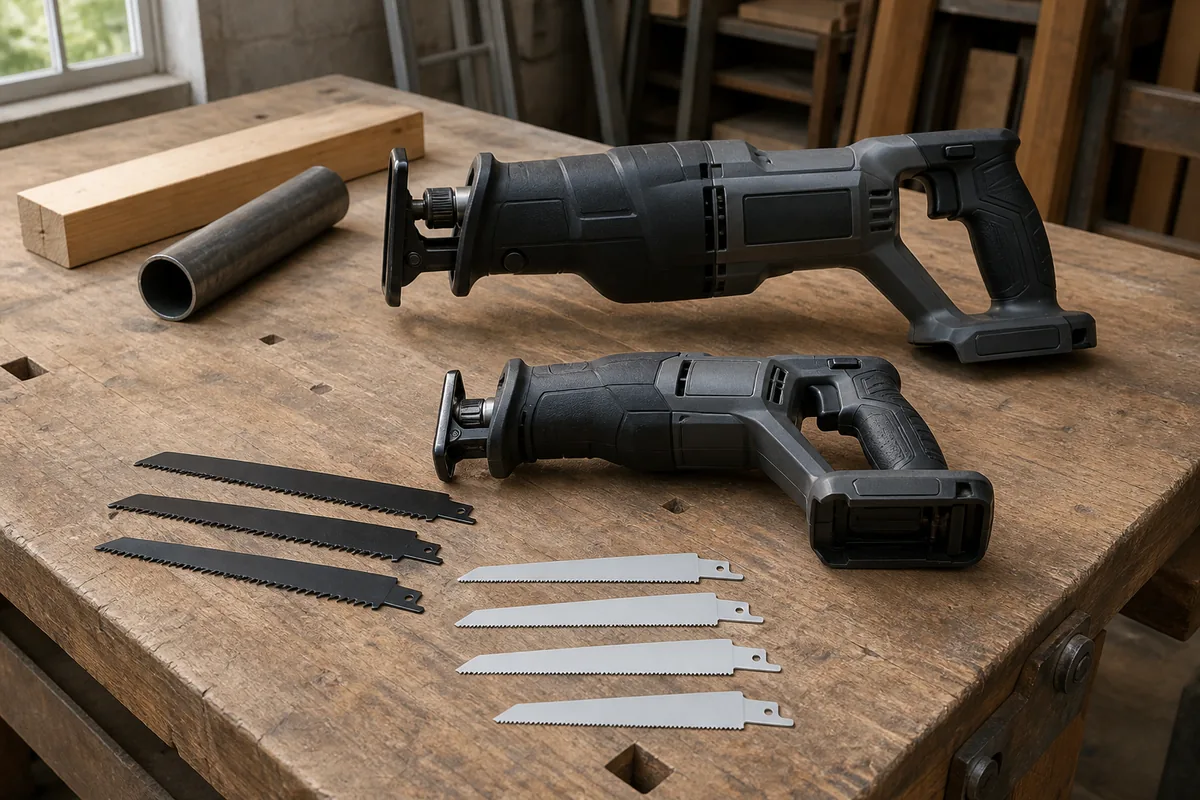
Short reciprocating saw blades, usually 4 to 6 inches long, are best for shallow flush cuts and delicate work. They are stiffer than long blades, so they tend to track straighter when you hold the blade nearly flat against a wall or floor. This reduces chatter and makes it easier to keep the teeth from digging into the surface you are trying to protect.
A short blade is particularly useful for cutting exposed nails, screws, staples, and small pipes. It also reduces the chance of hitting hidden plumbing, wiring, or framing behind the target. The limitation is reach. If the blade cannot pass fully through the material, the saw may stall, bend the blade, or leave an incomplete cut.
A short reciprocating saw blade set is often the sensible low-cost purchase for occasional nail and trim work. You do not need premium blades if you are cutting a few ordinary construction nails. A basic bi-metal set is usually sufficient.
When a longer blade earns its place
Use a longer blade when the workpiece is thick, recessed, or difficult to approach squarely. A 9- or 12-inch blade can reach through a timber, cut behind a pipe, or let you stand clear of a wall while the blade reaches the target.
Long blades are more flexible, which is useful for cutting flush against an uneven surface, but that flexibility creates problems. Pressing too hard can bow the blade and cause it to cut in an arc rather than a straight line. The tip may also whip into the surrounding surface. If the blade is flexing visibly, reduce pressure, change your angle, or switch to a shorter blade.
Do not choose a long blade simply because it cuts faster on paper. A longer blade also creates more vibration and can expose more teeth to accidental contact. For most homeowner flush cuts, 6 to 9 inches is the useful middle ground.
Match the blade to the material
Length cannot compensate for the wrong tooth pattern. Use a wood blade with coarse teeth for clean, fast cuts in lumber. For wood containing nails, choose a bi-metal demolition blade with variable or medium tooth spacing. It will cut more slowly than an aggressive wood-only blade but is less likely to lose teeth when it hits metal.
For steel, choose a fine-tooth bi-metal blade. Around 14 to 18 teeth per inch works for many thin-wall pipes and sheet metal; thicker steel may need a coarser pattern. For copper and plastic pipe, a medium-tooth blade generally works well. Carbide-grit blades are useful for abrasive materials, cast iron, cement board, and some stainless steel, but they cost more and are unnecessary for ordinary wood and nail cutting.
Browse bi-metal reciprocating saw blades for wood and metal if you need one set for mixed demolition. Expect a compromise: combination blades are convenient, but dedicated blades usually cut faster and last longer in one material.
How to make the cut flush
Set the saw’s adjustable shoe against the nearby surface before starting. The shoe stabilizes the tool and limits how much blade is exposed. If your saw has an adjustable shoe, move it forward for a shallow cut, provided there is still enough blade travel to clear the material.
Start at a moderate speed with light pressure. Let the teeth establish the cut before increasing speed. Keep the shoe firmly planted and use the shortest blade that reaches through the work. When cutting against a finished surface, place a thin piece of scrap metal or a purpose-made flush-cutting guard between the blade and the surface. Do not rely on the blade’s side to slide harmlessly across paint, tile, or drywall; it can scratch or gouge them quickly.
For a pipe, support the pipe if possible so it does not vibrate. Vibration makes the blade chatter, increases heat, and can produce a rougher cut. For nails, approach with the blade nearly parallel to the board and use a short blade with fine or medium teeth. Stop as soon as the fastener is flush; continuing can enlarge the cut in the surrounding wood.
Common blade-length mistakes
The most common mistake is using a 12-inch demolition blade for a 1-inch nail. The excess blade flexes, the cut wanders, and the tip can damage hidden material. The opposite mistake is using a 4-inch blade on a thick timber. If fewer than several teeth remain engaged through the stroke, the blade can snag and bend.
Also check clearance behind the work before choosing length. A blade may pass through a pipe and strike a wall stud, cabinet, or cable. When the space is uncertain, a shorter blade, a slower speed, and a shallower shoe setting are safer. If you regularly make controlled flush cuts rather than demolition cuts, a compact reciprocating saw can be easier to control than a full-size demolition saw.