What's inside
As an Amazon Associate I earn from qualifying purchases. This post may contain affiliate links at no extra cost to you.
Choosing between a flat file and a pillar file comes down to the shape of the surface, the clearance around it, and how much control you need near an accurate edge. Both are hand tools for removing metal, but they are not interchangeable. The wrong profile can round a shoulder, widen a slot, or make a part fit loosely after only a few strokes.
For general fitting work, a flat file is the better first purchase. A pillar file earns its place when you regularly fit narrow slots, keyways, grooves, or small precision parts where a slim, parallel tool gives better access and control.
What the files are
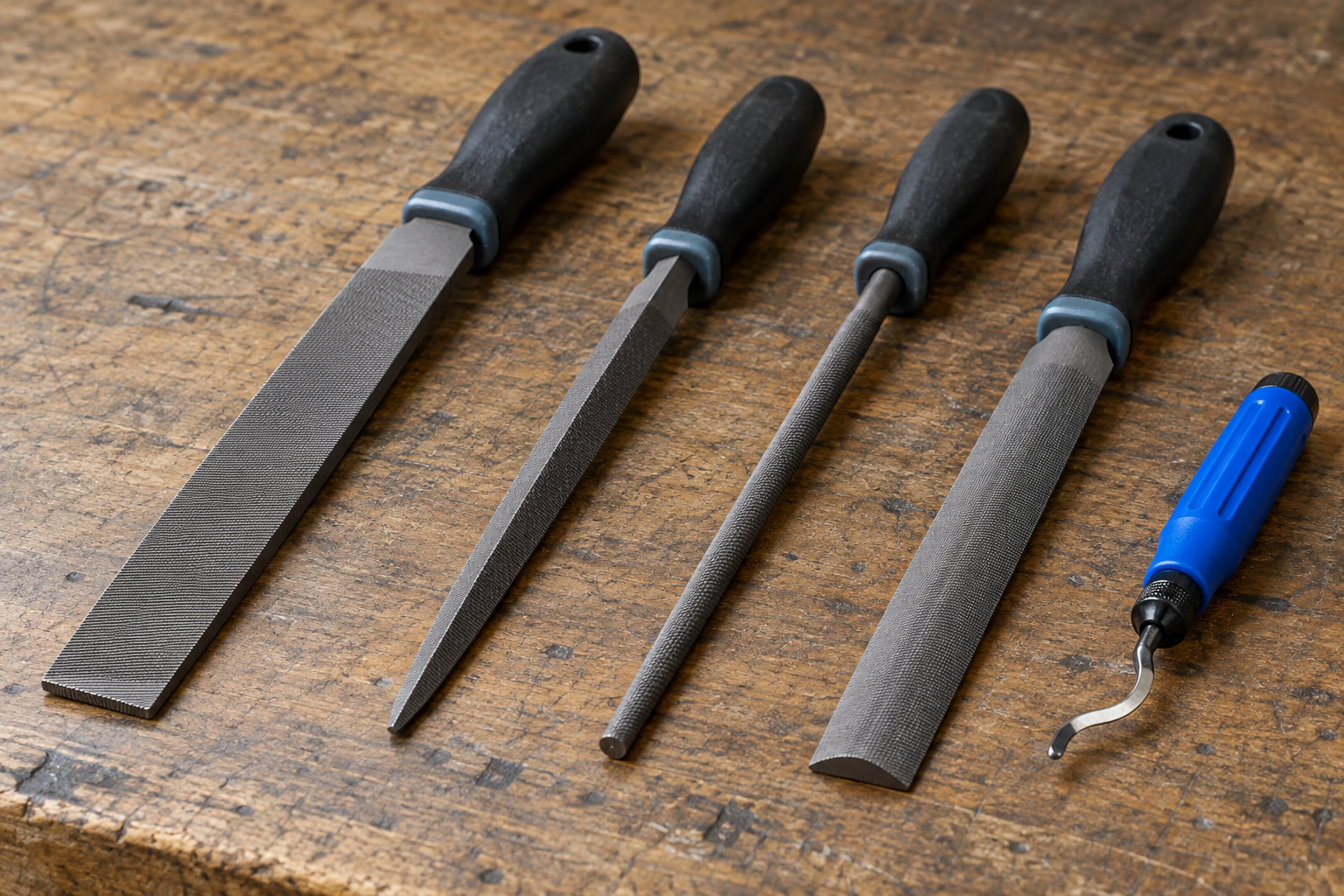
A flat file has a broad, flat working face and is usually rectangular in cross-section. The faces may be double-cut for faster stock removal, while the edges can be safe, single-cut, or toothed depending on the design. It is suited to flat surfaces, outside shoulders, edges, and broad areas that need leveling.
A pillar file is a narrower rectangular file, commonly parallel-sided and relatively thick for its width. Its working faces are generally single-cut or fine-cut on quality precision versions. That tooth pattern removes metal more slowly than a coarse flat file, but it leaves a smoother surface and gives better feedback when fitting a part to a close tolerance.
“Pillar” describes the file’s slim, stiff shape more than one universal tooth specification. Product dimensions vary, so check the width, thickness, length, and cut before buying. A file advertised as a pillar file may still be too thick for a small slot.
Flat file vs. pillar file
| Feature | Flat file | Pillar file |
|---|---|---|
| Best use | Broad faces, outside edges, general fitting | Narrow slots, grooves, keyways, precision fitting |
| Stock removal | Usually faster, especially in coarse cuts | Slower and more controlled |
| Access | Needs more surrounding clearance | Reaches tighter openings and shoulders |
| Surface finish | Depends heavily on cut; coarse files leave visible marks | Typically smoother with a fine or single cut |
| Main failure mode | Rounding edges or making a surface hollow | Flexing, clogging, or taking too long on heavy stock |
| Best first purchase | Yes, for most general metal fitting | Only if narrow precision work is routine |
When a flat file is the better choice
Buy a flat file when you need to remove a visible amount of material from a flat face or outside edge. It is useful for fitting brackets, cleaning weld spatter, adjusting tabs, deburring cut steel, and bringing two mating faces closer together. Its wide face can also help keep a surface flat, provided you use even pressure and do not rock the tool.
For a basic kit, a medium or second-cut flat file around 8 to 10 inches long is a practical starting size. Shorter files are easier to control on small parts, while longer files bridge uneven areas more effectively. A coarse bastard-cut file is useful when several tenths of a millimeter must come off; switch to a second-cut or smooth file for the final fitting strokes.
A flat file is also the cheaper option in many cases, and it is fine for occasional work. If the part has generous clearance and the fit does not depend on a narrow internal shoulder, there is little benefit in buying a specialized pillar file. A decent second-cut flat metal file will handle a wide range of jobs.
When a pillar file earns its place
Choose a pillar file for a slot or recess where a flat file is too wide, or where its edge would contact surfaces that must remain untouched. The parallel sides are particularly useful when fitting a key into a keyway or adjusting a narrow rectangular opening. You can work one wall at a time instead of scraping both walls unpredictably.
It is valuable when the final fit matters more than speed. With a fine pillar file, one or two controlled strokes can remove a small high spot without aggressively enlarging the entire opening. This is easier to judge than using a coarse file that can remove 0.1 mm or more surprisingly quickly on soft aluminum.
Look for a precision pillar file set if you work on different slot widths. A set is more useful than one unusually narrow file because forcing a file into a slot causes rubbing, clogging, and rounded walls. For very small work, needle files may be more appropriate, but they remove material slowly and can flex under pressure.
How to file a precision fit
Start by measuring the part and marking the high area with layout dye or a permanent marker. Secure the work firmly, with the area being filed close to the vise jaws. A part that vibrates produces a rough surface and encourages you to press harder.
Use a push stroke with moderate pressure on the forward movement and lift the file on the return. Do not drag it backward under pressure; that dulls teeth and can tear soft metal. Keep the file level, and use the full useful length rather than repeatedly working one short section. On an outside edge, slightly angle the file only when you deliberately want to break the corner.
For a slot, make a few strokes, clean the part, and test the fit. Aim to remove roughly 0.02 to 0.05 mm per checking cycle when approaching a close fit. Do not force the mating part into place. If it sticks, note where the contact occurs, apply marker, and remove only that high spot. A snug fit should assemble with steady hand pressure, not hammer blows.
Finish with a fine file or abrasive paper only after the geometry is correct. Filing a surface with 400-grit paper may improve appearance, but it will not correct a tapered slot or a rounded shoulder.
Common mistakes and maintenance
The most damaging mistake is using a file that is too coarse for the final operation. Coarse teeth can dig into aluminum and leave deep valleys that make a nominally accurate surface misleading. Another is allowing the file to rock. On a flat face, rocking creates a hollow center; on a shoulder, it rounds the corner.
Clean the teeth with a file card cleaning brush before chips pack into them. Chalk can reduce clogging on aluminum, brass, and other gummy metals, but it is not a substitute for cleaning. Store files separately so their teeth do not strike one another, and always use a properly fitted handle. A tang without a handle can puncture your palm when the file catches.
If you can buy only one file, choose a medium-size second-cut flat file with a comfortable handle. Add a pillar file when your work repeatedly involves narrow internal features or when a general-purpose file is damaging the surfaces you need to protect.