What's inside
As an Amazon Associate I earn from qualifying purchases. This post may contain affiliate links at no extra cost to you.
Our Top Picks
 Crescent Nicholson 12" Half Round Bastard Cut WoodOne Size12 x 1.1 x 1.25 inches0.85 poundsCheck on Amazon



What Makes a Good Wood Rasp for Curves?
Shaping a curved furniture component is a different job from flattening a board. Chair legs, cabriole legs, armrests, bow-front parts, and carved brackets change direction constantly. The best wood rasp removes material quickly without leaving deep, widely spaced grooves that take hours to sand out.
For most furniture work, a medium or fine half-round hand-stitched wood rasp is the most useful choice. Its flat face handles convex surfaces and its rounded face reaches inside curves. A coarse rasp is valuable for roughing out a blank, but it can tear at reversing grain and is less forgiving on narrow edges.
As an Amazon Associate we earn from qualifying purchases at no extra cost to you.


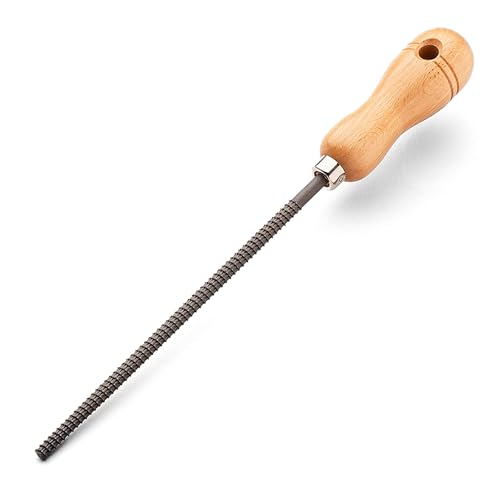
Look for a rasp with a useful cutting length of roughly 8 to 10 inches. Shorter tools are easier to control in tight areas, while longer tools produce a straighter, more even sweep. For a chair arm or leg, a 10-inch rasp gives enough reach without becoming awkward. The handle should be comfortable and securely fitted; rasp tangs are sharp and should never be used without one.
Rasp Types Compared
| Rasp type | Best use | Strength | Main drawback |
|---|---|---|---|
| Hand-stitched half-round | General furniture curves | Fast, controllable cutting on convex and concave surfaces | Costs more than machine-cut rasps |
| Hand-stitched cabinet rasp | Fine shaping and blending | Leaves a relatively clean, even surface | Too slow for removing large amounts of stock |
| Machine-cut half-round | General shop work and rough shaping | Affordable and widely available | More likely to chatter, clog, or leave deep tracks |
| Rotary rasp or burr | Power-tool roughing in open areas | Removes material very quickly | Easy to gouge the work; poor control near finished edges |
| Surform-style tool | Softwood, foam, and fast stock removal | Cheap replacement blades and aggressive cutting | Usually leaves a rough surface and does not follow tight concave curves well |
Best Overall: A Medium Half-Round Hand Rasp
A medium half-round rasp is the best single tool for shaping curved furniture components. Use the rounded side in inside curves such as the hollow under a chair arm. Turn it over for outside curves, shoulders, and transitions between a leg and foot. The tapered profile also lets you work into narrower areas without switching tools.
Hand-stitched rasps have individually formed teeth rather than a simple repeating pattern punched into the steel. The irregular tooth layout reduces chatter and tends to cut more smoothly across changing grain. It also makes the tool less likely to create a conspicuous series of parallel grooves. They are not magic: pushing too hard, working against brittle grain, or using a very coarse grade can still cause tear-out.
For a first purchase, choose a 10-inch half-round rasp in a medium grade. Add a fine cabinet rasp if you regularly make visible furniture parts. Search for 10-inch medium half-round wood rasps and check the cutting length, not just the overall length. A nominal 10-inch tool may include the handle and have only 6 inches of teeth.
When a Cheaper Rasp Is Enough
A machine-cut rasp is a sensible choice for roughing construction-grade pine, poplar, or a part that will be heavily carved and later covered with upholstery. It can remove 1/16 inch or more per pass when used with firm, even pressure. For occasional use, spending less is reasonable.
The trade-off appears on figured hardwood, end grain, and visible transitions. Machine-cut teeth often leave deeper ridges, and those ridges have to be removed with a file, scraper, or coarse abrasive. If a curved rail takes 20 minutes to rasp, an inexpensive tool may add another 15 to 30 minutes of cleanup. That is still acceptable for one project, but it becomes expensive in time across a set of eight chair legs.
Surform-style tools are even cheaper and can be excellent for fast shaping of softwood. They are less suitable for refined furniture work because the blade can catch at an edge and leave a sudden gouge. Keep one for rough blanks, not as your only finishing rasp.
How to Rasp Curves Without Gouging
Mark the finished profile with a pencil or flexible curve, then draw several crosswise reference lines every 1 to 2 inches. These lines tell you where material remains and prevent you from making one section too thin. Stop when the lines are nearly gone rather than trying to reach the final shape in one pass.
Hold the rasp with two hands: one on the handle and one near the nose. Use the front hand to guide direction and the rear hand to provide pressure. On an outside curve, follow the length of the component with overlapping strokes. On an inside curve, use shorter strokes and rotate the rasp gradually so one corner does not cut a trench.
Rasp with the grain when possible, especially near thin edges and end grain. If the rasp catches, reduce pressure and take shorter strokes. A useful working sequence is coarse shaping, medium blending, then a fine rasp or cabinet scraper. Do not use sandpaper to correct a badly uneven profile; it will round high spots and preserve low ones.
Useful Additions to the Rasp
A flat cabinet rasp complements a half-round tool when you need to clean a shoulder or flatten a small transition. A fine half-round file is useful after rasping, but a file is not a substitute for a rasp when more than about 1/32 inch of wood must be removed. Files cut slowly and clog quickly in softwood.
For large sculptural parts, a wood carving rasp set can be worthwhile because different lengths and profiles reduce the temptation to force one tool into every job. If you use a drill or rotary tool, choose a rotary wood rasp burr set only for open, easy-to-control areas. Keep the speed moderate, make shallow passes, and leave at least 1/16 inch for hand-tool cleanup.
Care, Cleaning, and Safety
Brush a rasp with a stiff file card after use, brushing along the tooth direction rather than across it. Do not strike the rasp against steel or use a screwdriver to clear packed fibers. Resinous wood can clog teeth; a solvent-safe nylon brush helps, but dry the tool immediately and apply a light rust preventative to bare steel.
Clamp the work firmly and keep both hands on the tool. Never rasp toward an unsupported edge or toward your body. Replace a loose handle at once. A quality medium half-round rasp, used with reference marks and light finishing passes, gives the best balance of speed, control, and surface quality for most curved furniture parts.