What's inside
As an Amazon Associate I earn from qualifying purchases. This post may contain affiliate links at no extra cost to you.
Our Top Picks


Choosing the Right Deburring Tool
For small metal parts, a hand file and a rotary tool can both remove sharp edges, but they behave very differently. A file gives you control and feedback. A rotary tool removes material quickly, reaches awkward spots, and can produce a cleaner-looking edge when used carefully. It can also ruin a part in seconds.
The cheaper option is usually fine when you have a few parts, the edges are accessible, and dimensional accuracy matters more than speed. A rotary tool earns its place when you are deburring dozens of parts, working inside holes and slots, or removing heavier burrs left by sawing, drilling, milling, or laser cutting.
As an Amazon Associate we earn from qualifying purchases at no extra cost to you.


Hand File vs. Rotary Tool
| Factor | Hand file | Rotary tool |
|---|---|---|
| Best use | Controlled edge breaking and fitting | Fast removal and awkward access |
| Material removal | Slow to moderate | Moderate to very fast |
| Risk of overcutting | Low | High, especially on thin parts |
| Surface control | Excellent with practice | Good only with the right bit and light pressure |
| Noise and mess | Quiet, little dust | Noisy, throws chips and abrasive dust |
| Typical cost | About $10–$30 for a useful set | About $30–$100 before specialized accessories |
When a Hand File Is Better
A hand file is the safer choice for small brackets, tabs, threaded parts, and edges that must stay square. It removes material gradually, so you can check the fit after every few strokes. That matters when a part has a tight slot or a mating surface that cannot lose more than a few thousandths of an inch.
For general steel and aluminum work, start with a medium-cut 6- or 8-inch mill file. A fine file is useful for the final pass, while a small triangular, round, or half-round file handles corners, grooves, and drilled holes. A metal hand file set is usually a better first purchase than a single unusual file.
Use a file with its handle installed and push it forward rather than scrubbing it back and forth. Two or three light passes are easier to control than one forceful pass. On aluminum, clean the teeth frequently with a file card or stiff nylon brush because clogged teeth can skid across the edge and leave scratches.
Hand filing has limits. A large burr on ten identical parts becomes tedious, and a file may not reach the bottom of a narrow hole. Files also tend to follow the existing edge. If the burr is uneven, you may need careful filing from both sides to avoid making one side noticeably larger.
When a Rotary Tool Is Better
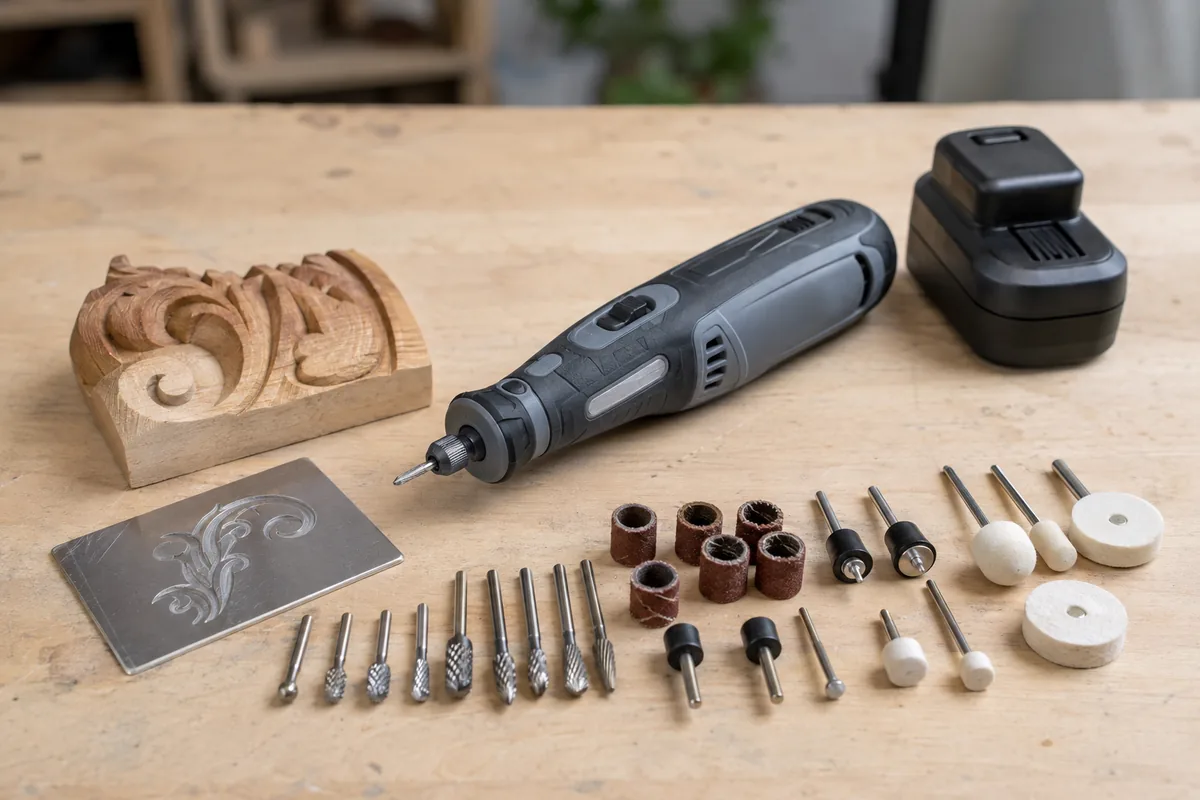
A rotary tool is useful when speed and access outweigh maximum control. A small abrasive wheel can knock down a heavy saw burr, a cylindrical stone can clean the inside of a hole, and a small carbide burr can reach a slot or irregular casting. For occasional workshop use, a variable-speed rotary tool kit gives more flexibility than a fixed-speed unit.
Speed control is important. Start around 5,000 to 10,000 rpm for a small abrasive stone or sanding drum, then increase only if the tool is cutting poorly. Small carbide burrs can run faster, but the exact limit depends on the bit diameter and manufacturer’s instructions. A 1/8-inch burr at high speed can grab an edge and pull itself into the work before you react.
Use the smallest accessory that does the job. A sanding drum is forgiving for smoothing a broad edge, but it can round corners quickly. A small diamond point works on hardened steel and fine features, though it removes material slowly. Carbide burrs cut aggressively and are best reserved for stock removal, not a final cosmetic pass.
Hold the tool with two hands when possible, support the part firmly, and keep the accessory moving. Dwelling in one spot creates low areas, heat discoloration, and uneven chamfers. A common failure mode is tipping the tool at the end of a pass; the bit catches the edge and gouges the face of the part.
Match the Tool to the Metal
Aluminum is soft but prone to loading abrasive accessories. Use sharp files, light pressure, and accessories labeled for aluminum when available. Avoid letting a loaded sanding drum polish instead of cut. Mild steel is more predictable and works well with a file, abrasive wheel, or carbide burr.
Stainless steel generates heat quickly and can work-harden if you rub it without cutting. Use a sharp file or a suitable carbide accessory with firm, controlled passes. For hardened steel, ordinary files may skate across the surface; a diamond-coated point or carbide burr may be necessary, but neither should be forced.
Thin sheet metal needs special care. Clamp it against a solid backing block, file from the burr side with short strokes, and avoid a rotary tool unless the edge is accessible and the part is well supported. High-speed tools can flex the sheet, catch the edge, and leave a scalloped profile.
A Practical Deburring Process
First, inspect the part under good light and identify whether the burr is on one side or both. Secure the work without crushing it. Remove the bulk of a large burr with a file or coarse abrasive, then switch to a fine file, abrasive pad, or fine abrasive point.
For a drilled hole, lightly chamfer the entrance rather than plunging straight into it. A hand countersink or a manual deburring tool often gives better control than a rotary tool for this job. Turn it by hand until the sharp lip disappears; a chamfer of roughly 0.25 to 0.5 mm is enough for many general-purpose parts.
After deburring, wipe the part clean and run a fingertip carefully along the edge, away from the cutting direction. Check that holes still accept the intended fastener and that mating faces remain flat. If appearance matters, finish with fine abrasive cloth rather than trying to make the rotary tool do every step.
Safety and Buying Advice
Wear safety glasses for either method. A rotary tool also calls for hearing protection and a dust mask or respirator appropriate to the material. Do not use compressed air to blow metal dust around your workspace. Clamp small parts instead of holding them in your fingers, and keep loose clothing away from spinning accessories.
Buy the hand file if you deburr fewer than about 20 parts at a time, need precise edges, or work mostly on flat and accessible surfaces. Choose the rotary tool if repetitive work is slowing you down or the parts contain internal features. In many shops, the best setup is both: use the rotary tool for bulk removal and the file for the final, controlled pass.