What's inside
As an Amazon Associate I earn from qualifying purchases. This post may contain affiliate links at no extra cost to you.
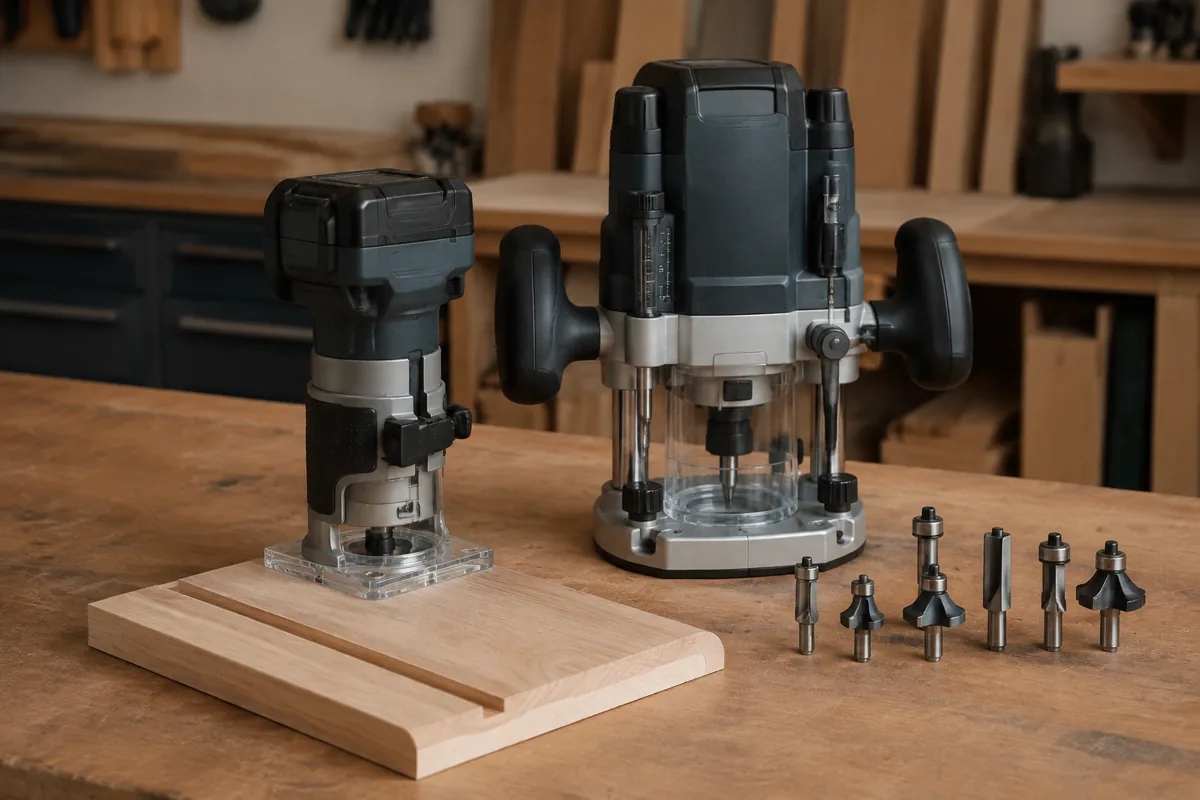
For sign making, both the Festool OF 1010 and Bosch Colt occupy the useful middle ground between a trim router and a full-size plunge router. They can cut lettering, bevels, edge profiles, and shallow pockets without the bulk of a 2¼-hp machine. The difference is that the Festool is a precision router built for repeated, controlled work, while the Colt is a compact, inexpensive router that makes sense for lighter jobs and occasional use.
The right choice depends less on maximum cutting depth than on how you hold the router, guide it, and control the dust. Sign work exposes weaknesses quickly: a small amount of slop can ruin lettering, a dull bit can burn hardwood, and a base that tips near an edge can turn a clean outline into a gouge.
As an Amazon Associate we earn from qualifying purchases at no extra cost to you.



Our Top Picks

Quick comparison
| Feature | Festool OF 1010 | Bosch Colt |
|---|---|---|
| Typical motor class | About 1.25 hp | About 1 hp |
| Collet size | Commonly supplied for 8 mm and/or 1/4-inch tooling, depending on kit and market | 1/4-inch |
| Plunge capability | Built-in plunge router | Primarily a fixed-base compact router; plunge-base availability depends on version and accessory package |
| Depth adjustment | Fine, repeatable adjustment with a turret stop | Coarse fixed-base adjustment with less refined repeatability |
| Best use | Detailed signs, templates, repeated production work | Small lettering, edge work, and occasional signs |
| Cost | Premium | Budget to midrange |
Routing performance for signs
The OF 1010 has the advantage when a sign requires controlled plunge cuts. Its plunge mechanism lets you start inside a letter or pocket rather than entering from an edge. That matters for enclosed shapes such as O, A, R, and B, where starting from the outside can damage the finished outline. The depth turret also makes it practical to take two or three shallow passes at a consistent depth.
The Bosch Colt is capable of clean work, but it is more naturally suited to shallow cuts and edge treatments. It works well for V-groove lettering with a template, small round-overs, chamfers, and cleanup passes. Its roughly 1-hp motor is enough for pine, cedar, poplar, and similar woods when you remove about 1/16 to 1/8 inch per pass. In hardwood, deep pockets, or wide lettering, it reaches its limits sooner.
Neither tool should be treated like a production CNC spindle. A 1/4-inch straight bit buried 1/2 inch deep in oak can overload either router, especially in a pocket with poor chip evacuation. For sign work, use a shallow first pass, clear the chips, and let the bit cut rather than forcing the feed rate.
Control and accuracy
The Festool is easier to control around small lettering because its plunge action is smooth and its base remains stable while the bit enters the work. The handles give a more deliberate grip than the small cylindrical body of the Colt. That extra control is valuable when following a template or cleaning up a hand-drawn layout.
The Colt is compact and easy to see around, which is a genuine benefit on narrow letters. However, its fixed base encourages edge entry or a drilled starter hole. It can also feel top-heavy when the base is only partly supported, such as when routing near the edge of a small plaque. A larger auxiliary base improves stability and is often more important than buying a stronger motor.
For freehand sign carving, neither router is ideal without a wide base. A narrow factory base can rock as the router crosses a thin section or approaches a corner. A clear, flat auxiliary base made from acrylic or plywood gives more support and makes the tool easier to steer. If you want to build one, leave enough clearance around the collet and use screws that cannot protrude into the router body.
Bits, collets, and depth
The Bosch Colt uses 1/4-inch router bits, which are widely available and generally less expensive. That keeps the cost of a basic sign setup low. A starter set should include a 60-degree or 90-degree V-bit, a 1/4-inch straight bit, and a small round-over or chamfer bit. Avoid very large-diameter bits in a compact router unless the manufacturer specifically rates the tool for them.
The OF 1010’s available collet options vary by market and package, so check the exact kit before ordering. The ability to use 8 mm tooling can be useful because some sign-carving and template bits are stiffer in that shank size. It does not automatically make the router cut better; bit sharpness, runout, and feed control still determine the result.
For lettering, a 1/4-inch straight bit is practical for flat-bottomed pockets, while a V-bit produces a traditional carved look. A V-bit leaves a wider line as depth increases, so a nominal 1/8-inch-deep cut can look substantially bolder than a shallow engraving. Make a test cut in scrap from the same species before committing to the sign.
Dust collection and workflow
Dust collection is one of the clearest differences in daily use. The OF 1010 is designed as part of a dust-extraction system, and its enclosed base and compatible accessories can capture a large share of chips from template work. You still need a vacuum and a dust hood positioned correctly, but the setup is more integrated.
The Colt can be connected to a shop vacuum with the appropriate base or adapter, though capture is less consistent around open lettering and edge cuts. Fine dust from MDF is particularly troublesome. Use a vacuum rated for fine dust, wear eye protection, and avoid routing MDF without effective extraction.
Before cutting, secure the blank with clamps or double-sided sign-making tape. Mark the grain direction, set the depth stop, and make a test pass. A common failure mode is moving the router too slowly with a dull bit: the cut burns, the motor pitch drops, and the bit may leave a dark, fuzzy edge. A second is taking too much depth in one pass, which causes the router to pull sideways when it meets end grain.
Which one should you buy?
Choose the Festool OF 1010 if sign making is a regular part of your work, you need plunge routing, or you depend on repeatable depth settings. It is also the better choice for detailed hardwood signs, template routing, and jobs where reduced dust and better handling justify the price. Pair it with a quality router template guide bushing set if your sign designs rely on lettering templates.
Choose the Bosch Colt if you make a few signs per year, already own a larger router for deep work, or mainly need a compact tool for shallow engraving and edge profiles. The cheaper option is perfectly reasonable for pine, cedar, plywood, and occasional hardwood signs when you work in multiple shallow passes. Put part of the savings toward a 1/4-inch V-bit set for sign carving and a stable auxiliary base.
For either router, buy sharp bits individually rather than relying on a large bargain assortment. Add a compact router dust-collection adapter if your current setup leaves chips across the bench. The OF 1010 is the more complete sign-making machine, but the Colt remains the better value when the work is shallow, infrequent, and carefully supported.