What's inside
As an Amazon Associate I earn from qualifying purchases. This post may contain affiliate links at no extra cost to you.
Our Top Picks
 Milwaukee 2415-20 M12 12-Volt Lithium-Ion Cordless Right AngleMedium0 x 0 x 0 inches2.23 poundsCheck on Amazon


What the tool needs to do
Installing structural screws, ledger fasteners or blocking hardware inside a framed wall is a clearance problem first and a torque problem second. A standard impact driver may have plenty of power but be too long to fit between studs or reach past a pipe. A right-angle impact driver puts the bit at 90 degrees to the motor, so the tool can work in a narrow bay without your hand and battery needing the same line of access as the fastener.
For this work, compare the head’s reach and height, the tool’s overall bulk, trigger control and fastener capacity—not just the advertised torque. “Right-angle impact driver” is also a narrower category than right-angle drill. Drills can be useful in framing, but they do not deliver the same impact action for driving screws. If you need a driver, check the product specification rather than assuming every compact right-angle tool is an impact driver.
As an Amazon Associate we earn from qualifying purchases at no extra cost to you.


What to compare before buying
| Feature | Why it matters in framing | What to check |
|---|---|---|
| Head profile | The housing must clear the stud, sheathing and nearby services. | Compare published head height and width; then measure your actual bay. |
| Reach | A low-profile head is not useful if the bit holder cannot reach the screw. | Check the distance from the head’s outside edge to the bit tip. |
| Control | Impact action can sink a fastener quickly, including too far. | Look for a variable-speed trigger and useful low-speed settings. |
| Fastener range | Short screws and long structural screws demand different effort. | Follow the manufacturer’s limits for screw size and material. |
| Battery and balance | A bulky battery can make an otherwise compact head awkward in a bay. | Handle a tool with the battery you plan to use, if possible. |
Measurements matter more than a “compact” label. A typical stud bay is nominally 14½ inches wide, but plumbing, wiring, blocking and existing fasteners can reduce the usable space. Measure the tightest access point and allow room to hold the tool square. A shallow angle may help a bit reach the screw, but it also raises the chance of cam-out or a damaged screw head.
The right choice for confined bays
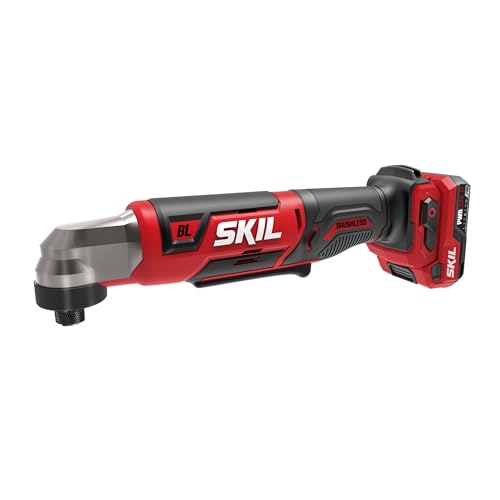
For repeated fastening where a regular impact driver cannot fit, a purpose-built right-angle impact driver is the best starting point. Look for a compact head, a secure bit holder and a trigger you can feather. A selector with lower-speed or fastening modes is useful when driving into framing near an edge, where a fastener can split wood or pull the work together abruptly.
Before buying, confirm the tool accepts the bits you use. Many impact drivers take ¼-inch hex bits, but the holder design and access around it affect how easily you can change bits in a cramped opening. A short bit may fit better than a long one; a long bit may be necessary to clear a flange or reach past an obstruction. Keep both options available rather than assuming one length solves every bay.
Compare current right-angle impact drivers by dimensions, compatible battery platform and included modes. If you already own batteries in a tool system, staying on that platform can save money and reduce the number of chargers on site. A bare tool is only a bargain if you have a compatible battery and charger.
When a cheaper right-angle drill is enough
If the job is mostly drilling pilot holes, driving smaller screws, or making only a few fasteners in an awkward spot, a right-angle drill may be the better-value purchase. It usually offers steadier control for drilling and avoids the sharp bursts of an impact mechanism. It may also be easier to use gently in soft wood or close to a board edge.
The trade-off is speed and capability on demanding screws. A drill can stall, twist in your hand or overheat when asked to drive long fasteners through dense material. Pre-drilling helps reduce splitting and effort, but do not treat a right-angle drill as a substitute for a high-load driver when the fastener manufacturer specifies an impact driver or a particular installation method. Compare right-angle drills if your workload is light or drilling-led.
Bits, extensions and setup
A right-angle attachment for a standard impact driver can cost less than a dedicated tool, and it is reasonable for occasional access work. But it adds length, can reduce clearance at the head and may have a lower torque rating than the driver itself. Check the attachment’s stated impact compatibility and load limits. A drill-only attachment should not be used with an impact driver unless its manufacturer explicitly allows it.
Use impact-rated bits and extensions with an impact driver. A standard bit can snap under repeated hammering, especially when it is long or poorly supported. Keep the bit aligned with the screw and brace the tool against the framing where practical. Start slowly, then increase speed once the screw has bitten. Stop when the head seats; continuing to hammer can strip the recess, break the screw or bury the head below the surface.
For large structural fasteners, follow the fastener maker’s instructions for pilot holes, embedment and installation tools. A right-angle driver may physically fit but still be a poor choice if the screw exceeds the tool’s capacity or needs controlled tightening. Do not substitute a generic torque figure for the fastener’s installation requirements.
A practical buying decision
Buy a dedicated right-angle impact driver if you regularly install substantial fasteners where a straight tool cannot line up, and verify the head dimensions against your tightest access point before committing. Choose a right-angle drill if your work is occasional and mostly involves holes or modest screws. For a one-off job, a compatible impact-rated attachment can be the economical option—provided its size fits and its rating covers the task.
Whichever route you take, test the setup on scrap framing with the same screw and bit. That reveals whether the tool can reach, whether the bit holds the screw securely and how quickly the fastener seats. This short test is cheaper than finding out inside a finished wall that the head is too tall or the driver has stripped the first screw.