
What's inside
As an Amazon Associate I earn from qualifying purchases. This post may contain affiliate links at no extra cost to you.
Our Top Picks


Quick verdict
The Festool OF 1400 and Bosch 1617EVS can both handle cabinet joinery, template work and general routing. The main difference is how they’re set up: the Festool is a purpose-built plunge router with a 1400 W motor and a metric-friendly 12 mm collet, while the Bosch is a 2.25 hp router commonly sold with both fixed and plunge bases. Bosch’s 1617EVS has a 1/4-inch and 1/2-inch collet, making it easier to use common North American bits.
Choose the OF 1400 if you expect to plunge often, value its integrated dust collection and want a broad plunge depth range. Choose the 1617EVS if you want a capable router at a lower price, especially if the included bases suit your work. For occasional mortises, stopped grooves or hinge recesses, the Bosch is not a compromise by default.
As an Amazon Associate we earn from qualifying purchases at no extra cost to you.
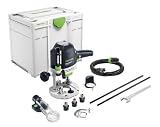


Specifications that matter for joinery
| Feature | Festool OF 1400 | Bosch 1617EVS |
|---|---|---|
| Motor rating | 1400 W | 2.25 hp |
| Collet sizes | 8 mm and 12 mm | 1/4 inch and 1/2 inch |
| Base arrangement | Plunge base | Typically sold as a combo with fixed and plunge bases; verify the package |
| Plunge depth | Approx. 70 mm | Approx. 2-3/8 inches |
| Speed control | Variable speed | Variable speed |
| Dust collection | Integrated hood at the base | Collection depends on base and accessory setup |
Package contents and regional versions can change, so check which bases and collets are included before ordering. The Bosch figure is a horsepower rating rather than a direct watt-for-watt comparison with Festool’s input rating. Neither number, by itself, tells you how cleanly a router will cut a particular joint.
Plunge control and repeatable cuts
The OF 1400’s plunge mechanism is well suited to jobs where you lower the cutter into a workpiece and need a controlled stop: mortises, hinge pockets, inlay recesses and stopped grooves. Its roughly 70 mm of plunge travel gives more room for deep setups than the Bosch’s approximately 2-3/8-inch travel. That extra movement is useful when a jig, guide bushing or thick template takes up some of the available reach. It does not mean you should cut a deep mortise in one pass.
The 1617EVS plunge base is capable of the same basic work, and its turret stop allows staged depth settings. For a mortise 1/2 inch deep, for example, make two or three passes rather than forcing the bit down at full depth. That reduces strain and helps avoid burning, chatter and torn fibers. Check your actual base’s plunge range and stop arrangement; the fixed base included in a combo package cannot plunge.
Bits, collets and regional fit
For many US buyers, the Bosch’s 1/2-inch collet is a practical advantage. Half-inch-shank bits are widely available and generally offer a stiffer shank than the same cutter in 1/4-inch form. That matters with larger diameter cutters and long-reach bits, though it does not make an unsafe cut safe. Keep the exposed cutter length as short as the job allows, and make sure the shank is fully seated without bottoming out in the collet.
The OF 1400’s 12 mm collet accepts a common European shank size, but 12 mm and 1/2 inch are not interchangeable. Use the correct collet for the bit. The included 8 mm collet adds flexibility, yet buyers who already own a large collection of imperial bits may need additional collets or different bits. Check the exact collet package for your market before counting on a particular size.
Dust collection and visibility
Festool’s integrated dust hood is a strong point when routing inside a template or making plunge cuts. Better extraction keeps chips from piling around a layout line and reduces the amount of cleanup, especially when the router is connected to a suitable extractor. It is not dust-free: edge cuts, awkward joints and some open-base setups still throw chips.
The Bosch can also be connected to dust collection, but performance depends more on the base, collection attachment and setup. If you mostly use the router at a bench for short cuts, a shop vacuum and a simple cleanup may be enough. If you cut many mortises indoors, the Festool’s more integrated arrangement is worth considering; compare the cost of the router and any required extractor rather than treating dust collection as a free upgrade.
Setup, adjustment and workflow
For joinery, the best router is often the one that holds a setting and fits your jig. Test plunge lock, depth stop and edge-guide adjustments before committing to a production batch. Make a test cut in scrap of the same thickness, then check the fit with the actual mating part. A tiny depth error can leave a proud tenon shoulder or a mortise too shallow for the joint to close.
The Bosch combo format is useful if you want to leave one base installed in a router table and keep the other for handheld work. The trade-off is that changing bases takes time, and package contents vary. The OF 1400 keeps the focus on handheld plunge routing, with a broad set of compatible guides and accessories, but its system accessories can add substantially to the initial cost.
Which one should you buy?
Buy the OF 1400 if plunge work is central to your shop, you need its extra travel for a particular jig, or integrated extraction and the Festool guide system will save time on repeated work. It is a premium choice, not an automatic route to better joinery. A loose jig, dull bit or rushed depth setup will still produce a poor mortise.
Buy the Bosch 1617EVS if you want a versatile router with a 1/2-inch collet and the fixed/plunge-base arrangement fits your workflow. It is a sensible option for furniture makers who need occasional plunge cuts and do not need Festool’s particular accessories. Before buying, compare the exact package and confirm that it includes the base you need.
If you are choosing your first router mainly for cabinet joinery, compare current Bosch 1617EVS router packages with Festool OF 1400 packages, checking collets, bases and guide accessories rather than comparing the bare tool price alone. If you already own imperial bits, the Bosch’s included 1/2-inch option can keep the changeover simple. If a template’s depth or dust setup is the deciding factor, verify the router’s actual reach and compatible attachments before purchasing.