What's inside
As an Amazon Associate I earn from qualifying purchases. This post may contain affiliate links at no extra cost to you.
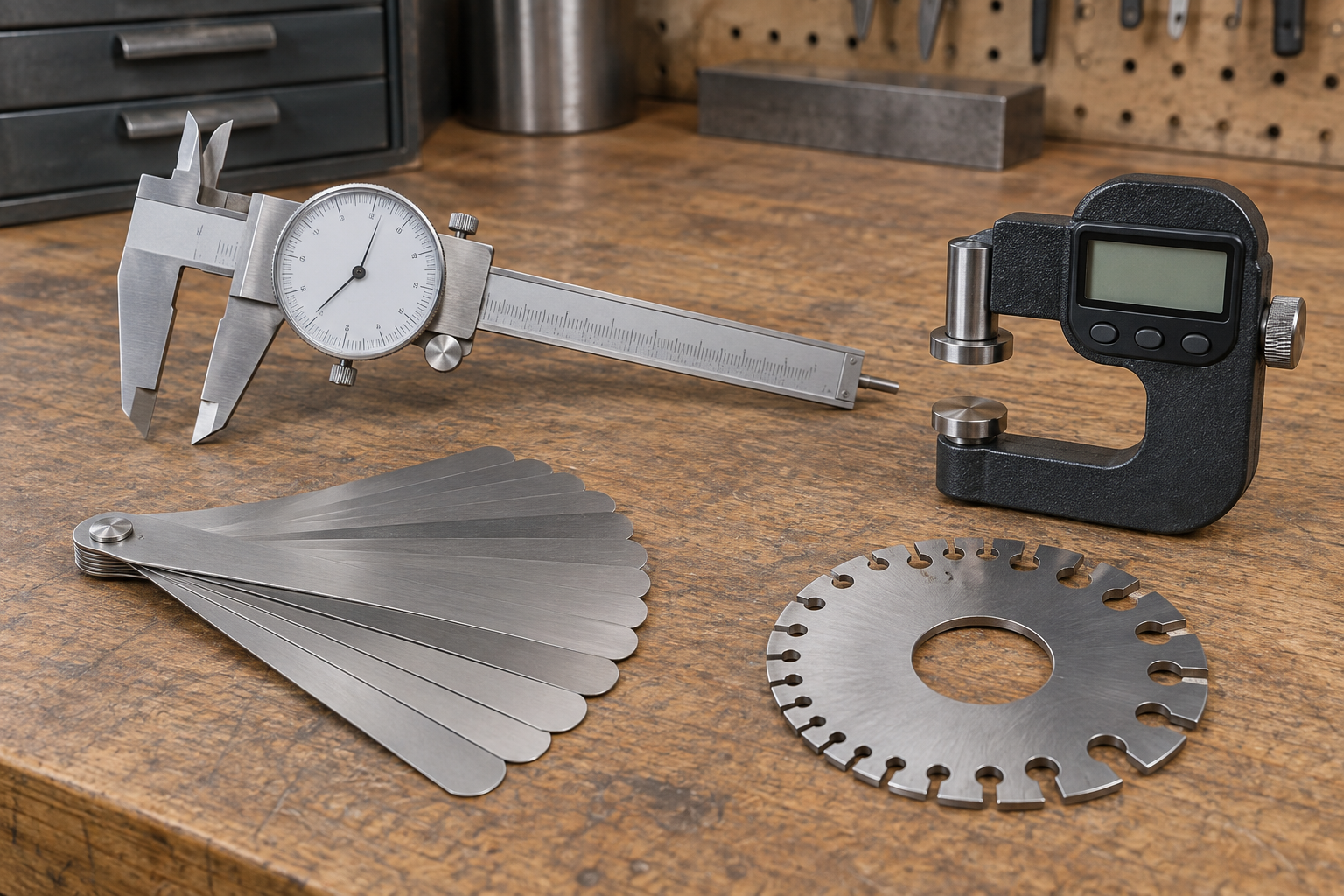
A feeler gauge and a digital thickness gauge can both help check a small gap, but they do it in different ways. A feeler gauge tests whether a blade of known thickness fits; a digital gauge measures an object placed between its anvils. For checking a valve clearance or a spark-plug gap, the feeler gauge is usually the more reliable tool. For measuring sheet material or comparing thicknesses quickly, a digital gauge is easier to read—but its displayed precision can exceed its practical accuracy.
As an Amazon Associate we earn from qualifying purchases at no extra cost to you.


Our Top Picks

What the tools actually measure
A feeler gauge is a set of thin metal leaves, each stamped with a thickness. You slide a leaf into a gap and judge the fit. A blade that enters with slight drag is a common target; one that slides freely may be too thin, while one that needs force may be too thick. Sets commonly include blades from roughly 0.0015 to 0.035 inch, though the range and increments vary.
A digital thickness gauge has two measuring faces, or anvils, that close on a part. The screen reports the distance between them, often in inches or millimeters. Depending on the tool, the resolution may be 0.0005 inch or 0.01 millimeter. Resolution is the smallest displayed increment, not a guarantee that the measurement is accurate to that amount.
Feeler gauge vs. digital thickness gauge
| Factor | Feeler gauge | Digital thickness gauge |
|---|---|---|
| Best suited to | Clearances and gaps | Thickness of accessible parts |
| Reading method | Blade fit and stamped value | Digital display |
| Power required | None | Usually a battery |
| Common sources of error | Wrong blade angle, force, dirt, worn blades | Jaw pressure, zero error, part shape, dirt |
| Practical advantage | Directly tests a gap under working conditions | Fast numeric readings and easy comparisons |
For small gaps, fit beats a screen
On a valve train, bearing clearance, or machine setup, the question is usually whether a specified blade fits with the intended drag—not what number a caliper-like display produces. A feeler gauge is designed for that task. It can reach into a narrow opening, and its blade tests the actual clearance along the contact path.
For example, if a service specification calls for 0.006 inch, start with that blade, not a random stack. Keep it flat and aligned with the gap. A blade inserted at an angle can bind and feel too thick. Dirt, burrs, oil films, and uneven surfaces also change the feel. If the 0.006-inch blade will not enter without force, do not force it; check the setup and try the next thinner blade. For an adjustable clearance, confirm the result by repeating the test after tightening the fastener, since tightening can shift the setting.
A thickness gauge can be awkward or useless when the gap is recessed, angled, or blocked by surrounding parts. Its anvils need access to both sides of the material, and many gauges cannot reach into the space where a feeler blade can slide. A digital number is not an advantage if the tool cannot contact the surfaces properly.
For parts, a digital gauge is faster
When checking gasket stock, leather, plastic film, shim material, or sheet metal, a thickness gauge gives a direct reading without interpreting blade drag. It is useful for comparing several spots or sorting mixed material. A basic digital thickness gauge is a sensible choice when measurements are frequent and the part is flat enough to sit between its anvils.
Pressure is a major limitation. Soft gasket material, foam, rubber, and fabric compress as the anvils close, so the reading depends on how hard the tool presses. A gauge with a controlled spring force is better for repeatable measurements of compressible stock, but it still measures under that force—not necessarily the part’s unloaded thickness. For sheet metal, a burr or a small dent can also produce a misleading result. Take readings in several places and avoid edges unless edge thickness is what you need.
For rigid stock, a digital thickness gauge can be quicker than trying combinations of feeler blades. If you only need occasional checks and already own a decent digital caliper, that may be enough for flat, rigid parts that fit between its jaws. A dedicated gauge is more convenient for repeated thickness checks, especially when its contact faces and force suit the material.
Accuracy depends on handling and condition
Neither tool is automatically reliable just because it has a fine scale. Before using a digital gauge, close the anvils gently, check that they read zero, and clean both contact faces and the workpiece. If zero drifts, the reading is suspect; reset it only if the tool allows that and the faces are clean. Avoid squeezing the part harder to make the number settle. Replace the battery if the display becomes erratic, and use a known reference if the measurement matters.
Feeler blades also wear. A blade that is bent, nicked, rusty, or polished thin from repeated use may no longer match its stamped value. Keep the leaves clean, wipe off moisture, and use light oil for storage if the set is likely to rust. Do not pry with a blade or force it through a tight gap. A damaged blade can give a confident but wrong result.
Which one should you buy?
Buy a feeler gauge if your work involves valve lash, spark-plug gaps, small mechanical clearances, or checking fit in a slot. A feeler gauge set is inexpensive, needs no battery, and remains useful even if its case is basic. Check that its range and increments match the measurements in your service manual. A set that skips the target thickness is less useful than one with a suitable range.
Choose a digital thickness gauge if you regularly measure flat material and need quick, repeatable numeric readings. Look for a range that covers your stock, a display you can read in your working position, and contact faces appropriate to the material. If you measure soft or compressible material, prioritize controlled measuring force over extra display digits.
For a workshop that does both jobs, these tools are not true substitutes. Use the feeler gauge to test clearance and the thickness gauge to measure stock. If small-gap checks are only occasional and the target is an ordinary mechanical clearance, the cheaper feeler gauge is usually enough—and often the better tool for the job.