What's inside
As an Amazon Associate I earn from qualifying purchases. This post may contain affiliate links at no extra cost to you.
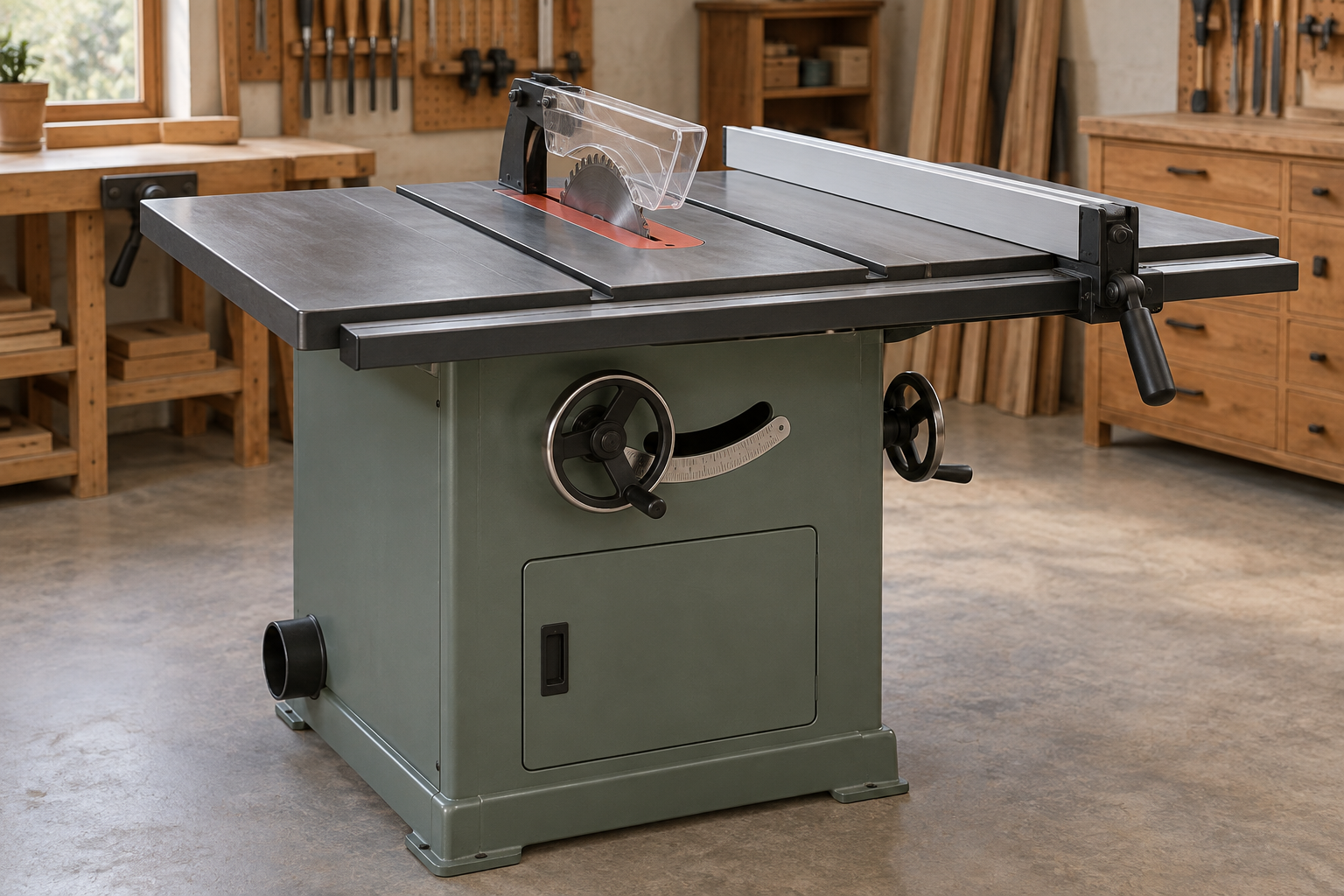
In a one-car garage, a table saw has to do more than cut sheet goods. It must also share floor space with a vehicle, workbench, dust collector, and walking paths. That makes the cabinet table saw versus hybrid table saw decision less about maximum horsepower and more about what you can realistically power, move, and maintain.
A cabinet saw is the better production machine. A hybrid saw is usually the better garage-shop compromise. Either can produce accurate cuts, but they differ in electrical requirements, dust collection, mobility, vibration, and price.
Our Top Picks


Cabinet saw vs. hybrid saw at a glance
| Factor | Cabinet table saw | Hybrid table saw |
|---|---|---|
| Typical motor | 3 to 5 hp, commonly wired for 240 volts | 1.5 to 2 hp, often convertible between 120 and 240 volts |
| Cutting capacity | Handles thick stock and repeated ripping with less strain | Handles furniture, cabinets, trim, and occasional thick stock |
| Dust collection | Generally better-sealed cabinet and stronger port arrangement | Usable, but often leaks more around the blade and cabinet |
| Mobility | Heavy; usually needs a mobile base | Still heavy, but easier to move and position |
| Typical footprint | About 30 by 50 inches before outfeed space | About 27 by 45 inches before outfeed space |
| Best fit | Frequent production work and thick hardwood ripping | Mixed hobby work in a shared or limited shop |
What a cabinet saw does better
The main advantage is reserve power. A cabinet saw keeps the blade speed more consistent when ripping 8/4 hardwood, resawing narrow boards, or cutting a full sheet of plywood. It is less likely to bog down, trip a breaker, or leave a rough, burned edge. A 3-hp motor is not automatically faster on every cut, but it gives you more margin when the wood is dense, damp, bowed, or improperly fed.
Cabinet saws also tend to have heavier trunnions, cast-iron tables, and more rigid fences. That mass reduces vibration and helps the blade stay aligned after setup. A good cabinet saw can hold a rip fence parallel within a few thousandths of an inch, provided the fence is adjusted correctly and the blade is aligned to the miter slot.
Dust collection is another meaningful advantage. A mostly enclosed cabinet with a 4-inch dust port can capture a large share of the chips, especially with a collector producing roughly 800 to 1,200 CFM at the machine. It will not eliminate airborne fine dust, but it is usually easier to control than an open-bottom saw.
The drawbacks are substantial in a garage. Many cabinet saws need a dedicated 240-volt circuit, and a 3-hp motor can require a 20-amp circuit depending on the manufacturer. The saw may weigh 450 to 600 pounds. A mobile base helps, but rolling that mass over a garage threshold or expansion joint is still work. You also need room for a full-size outfeed table; a 4-by-8-foot plywood sheet requires roughly 8 feet of support in front of the blade and several feet on the left or right.
Where a hybrid saw makes sense
A hybrid saw uses a cabinet-style enclosure and cast-iron table, but its motor is usually smaller and mounted differently. Many run on a standard 120-volt circuit, although 240 volts may be available as an option. That matters if your garage has only one suitable circuit or if adding a new circuit would cost more than the saw upgrade.
For a typical home shop, a hybrid saw has enough power for 3/4-inch plywood, construction lumber, hardwood boards up to about 1-1/2 inches thick, and normal cabinetmaking. It may need a slower feed rate in maple, oak, or beech. That is not a problem unless you regularly break down heavy stock or run the saw for hours at a time.
The cheaper option is fine when your work consists of occasional furniture projects, shelving, picture frames, and cabinet parts. A hybrid saw with a dependable fence, a flat table, a riving knife, and a working dust port is more useful than a poorly set-up cabinet saw.
Hybrid saws are not lightweight benchtop tools. Many weigh 250 to 350 pounds, so you still need a table saw mobile base. Check that the base locks firmly. A saw that shifts during a rip cut can ruin an edge and create a kickback risk.
One-car garage space and power
Measure the actual working area, not just the empty floor. With the saw centered in a garage, a 24-inch rip fence capacity and a 4-by-8-foot sheet can quickly consume the available width. Plan for at least 36 inches of clearance around the active sides of the machine, and leave a safe route to the electrical panel and garage door.
For a shared garage, a folding or removable outfeed table is often more valuable than a larger motor. Use a torsion-box table, folding legs, or a compact outfeed cart that can double as an assembly surface. Keep the outfeed surface level with the saw table; even a 1/16-inch height difference can catch plywood.
Before buying, inspect your circuit. A 120-volt hybrid saw sharing a circuit with a shop vacuum may trip a 15-amp breaker during startup. A 240-volt cabinet saw avoids that particular problem but requires appropriate wiring and a compatible plug. Have electrical work done to local code rather than using an extension cord as a permanent solution.
Accuracy, safety, and dust control
Do not judge either category by horsepower alone. The fence should lock without moving, the miter slot should be straight, and the blade should remain parallel to the slot through the full height adjustment. A poorly aligned saw can burn wood, pinch the blade, and push stock toward the operator.
A riving knife is essential. It helps keep the kerf open behind the blade and reduces the chance of kickback. Use the blade guard whenever the cut allows it, and use a push stick for narrow rips. Neither a cabinet saw nor a hybrid saw makes unsafe feeding safe.
Connect the saw to a properly sized shop vacuum and dust separator for light work, or to a dedicated collector with a 4-inch hose for regular use. A separator prevents the sawdust from filling the vacuum filter, but it does not replace adequate airflow. Wear a respirator when cutting dusty hardwoods, MDF, or plywood, even with collection running.
Which one should you buy?
Choose a cabinet saw if you routinely rip thick hardwood, build furniture every week, have room for a permanent machine, and can provide a suitable 240-volt circuit. Its rigidity, dust containment, and power become worthwhile when the saw is used heavily.
Choose a hybrid saw if the garage must remain usable for a car, your projects are intermittent, or electrical and budget limits matter. Spend the savings on a quality table saw fence and outfeed setup. In a one-car shop, reliable alignment, safe support, and easy storage usually improve results more than an extra 1 or 2 horsepower.