What's inside
As an Amazon Associate I earn from qualifying purchases. This post may contain affiliate links at no extra cost to you.
Cabinet rasps and spokeshaves both refine carved wood, but they remove material in very different ways. A rasp abrades the surface with hundreds of cutting points. A spokeshave slices off a continuous shaving with a knife-like blade. That difference determines how quickly you work, what shapes you can reach, and how much cleanup the surface needs afterward.
For hollow carvings, tight transitions, and rough or figured wood, a rasp is usually the safer first purchase. For convex surfaces that are accessible from both sides, a sharp spokeshave can leave a cleaner surface much faster. Neither tool replaces the other completely, and the better choice depends more on the carving’s geometry than on the price tag.
As an Amazon Associate we earn from qualifying purchases at no extra cost to you.



Our Top Picks
How the tools cut
A cabinet rasp has a toothed face, often with a coarse cut on one side and a finer cut on the other. It cuts in both directions, although pushing it forward usually gives better control. The tool removes small chips and dust rather than producing a long shaving. Good rasps are remarkably controllable: light pressure makes a small change, while firm pressure removes stock quickly.
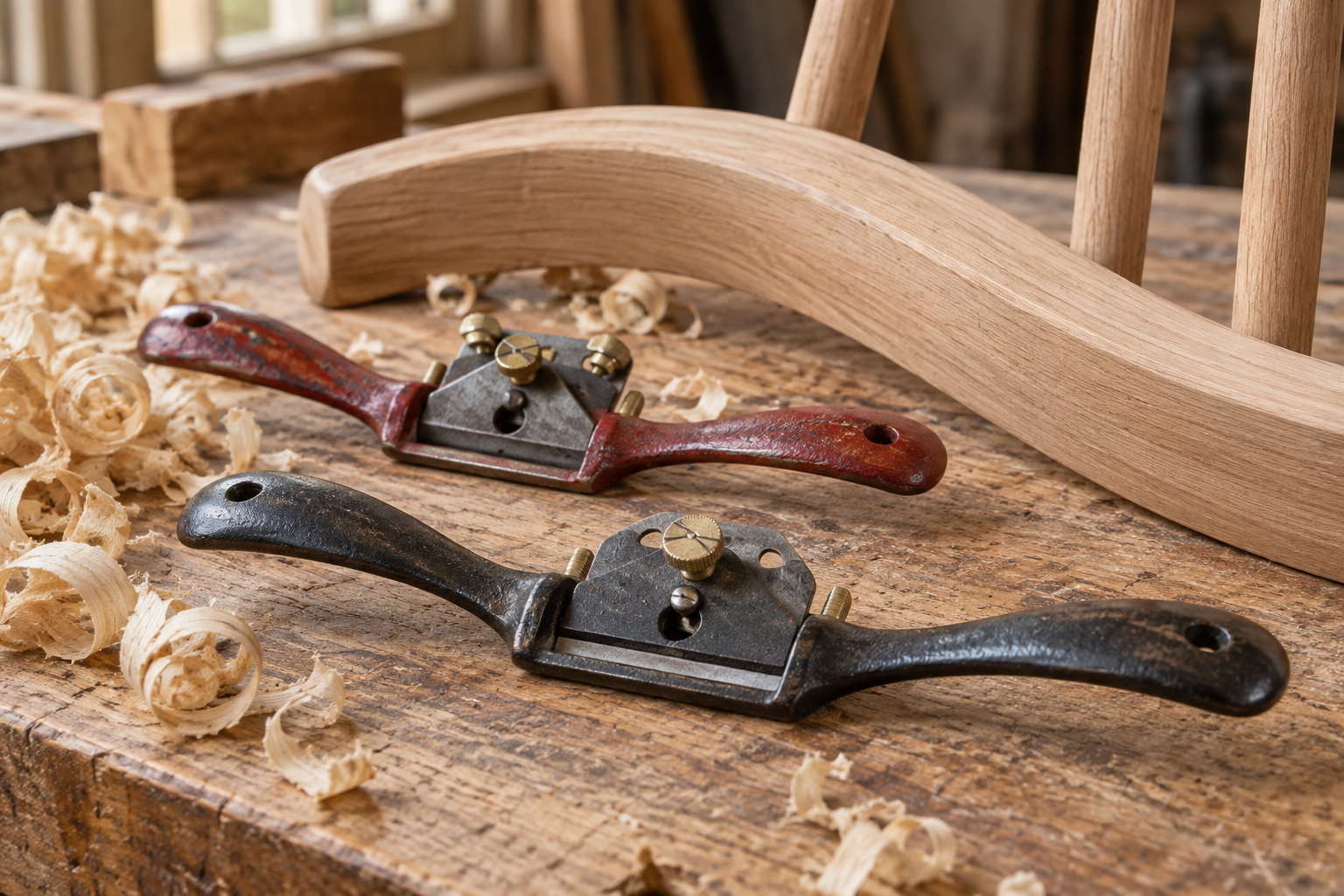
A spokeshave holds a short plane iron between two handles. You push or pull it across the work, adjusting the blade to take a shallow shaving. The sole bridges low spots, so the tool naturally favors convex and gently curved surfaces. It cuts cleanly only when the blade is sharp, correctly set, and moving with the grain.
That last point matters. A spokeshave can suddenly dig in when the grain reverses, the blade projection is too aggressive, or the work is not supported securely. A rasp is slower to create a catastrophic gouge, though its teeth can leave deep scratches that take time to remove.
Cabinet rasp vs spokeshave
| Factor | Cabinet rasp | Spokeshave |
|---|---|---|
| Best surface | Concave, convex, irregular, and carved details | Accessible convex curves and broad transitions |
| Material removal | Fast, controlled abrasion | Fast with a properly set blade; slower when constantly adjusted |
| Surface left behind | Toothed scratches and a slightly faceted texture | Usually smooth shavings; can tear out badly |
| Learning curve | Low to moderate | Moderate to high |
| Grain sensitivity | Low | High |
| Maintenance | Clean teeth; protect the rasp from impact | Sharpen and hone the iron; keep the sole and mouth clean |
| Typical limitation | Leaves more finishing work | Cannot easily reach tight hollows or abrupt concave details |
When a cabinet rasp is the better choice
Choose a rasp when the carved surface includes hollows, inside corners, narrow valleys, or changing curves. Its cutting face can follow the shape instead of bridging across it. This makes it useful for relief carving, sculptural furniture parts, chair seats, and free-form work where a flat sole would rock or catch.
A rasp is also the more forgiving option in difficult grain. On figured maple, interlocked grain, and pieces assembled from several directions, a spokeshave may tear out even when it is sharp. Rasping does not eliminate the need to read the grain, but it reduces the risk of lifting a large section of wood.
Use a fine or cabinet-grade rasp for the final shaping rather than leaning on a coarse body rasp. A coarse rasp can remove 1/16 inch (about 1.5 mm) in a few passes, but its grooves may require 80- or 100-grit abrasive to erase. A finer rasp takes longer but can often be followed by 120- or 150-grit paper.
If you are buying one, compare fine cabinet rasps by tooth cut, length, and handle comfort. Avoid pressing down hard. Let the teeth cut, and use short strokes near delicate edges so you do not flatten a ridge accidentally.
When a spokeshave earns its place
A spokeshave is excellent on broad convex surfaces: the outside of a bowl, a rounded armrest, a chair leg transition, or a carved hump that has enough room for the sole to sit flat. Once tuned, it removes a consistent layer and can bring a rough surface close to finish-ready far quicker than a rasp.
It is especially effective when you can work with the grain in a known direction. On a 12-inch-long curved part, a spokeshave may establish a smooth surface in minutes, while a rasp leaves a texture that still needs sanding. It also produces visible shavings, making it easier to judge how much material you are removing.
Buy a quality adjustable spokeshave if you want to tune the cut for roughing and finishing. A useful blade projection is often only 0.002 to 0.010 inch (0.05 to 0.25 mm). If the tool chatters, digs in, or refuses to start a shaving, do not simply push harder: check blade sharpness, mouth opening, sole flatness, and grain direction.
A practical workflow for carved surfaces
For most carvings, the efficient answer is both tools in sequence. Remove waste with a gouge, bandsaw, or coarse rasp, then use a cabinet rasp to establish the curves and reach concave areas. Switch to a spokeshave on broad convex sections where its sole has continuous support. Finish the stubborn transitions with the rasp.
Keep the final rasp strokes aligned with the shape rather than scrubbing randomly. Afterward, use a scraper or abrasive only as needed. Sanding from 120 to 180 grit is often enough before finish; jumping directly from deep rasp marks to 220 grit wastes time and can leave valleys that still show under oil or satin varnish.
Which one should you buy first?
Buy a cabinet rasp first if your projects are genuinely carved, include concave details, or use unpredictable grain. It is easier to control, works on more shapes, and remains useful even after you add a spokeshave.
Buy a spokeshave first if you mainly shape broad convex parts and are willing to sharpen. The tool may be cheaper than a premium rasp, but the purchase price is not the whole cost: budget spokeshaves often need flattening, blade grinding, and careful adjustment before they cut well.
If your work is occasional and the surface will be painted, a moderately priced rasp is usually sufficient. If the wood will receive a clear finish and you regularly make rounded components, spending more on a better rasp or a well-made spokeshave can save substantially more time in sanding and tear-out repair.