What's inside
As an Amazon Associate I earn from qualifying purchases. This post may contain affiliate links at no extra cost to you.
Our Top Picks
 Crescent Nicholson 12" Half Round Bastard Cut WoodOne Size12 x 1.1 x 1.25 inches0.85 poundsCheck on Amazon
Rasp vs Cabinet File for Shaping a Hardwood Door Edge
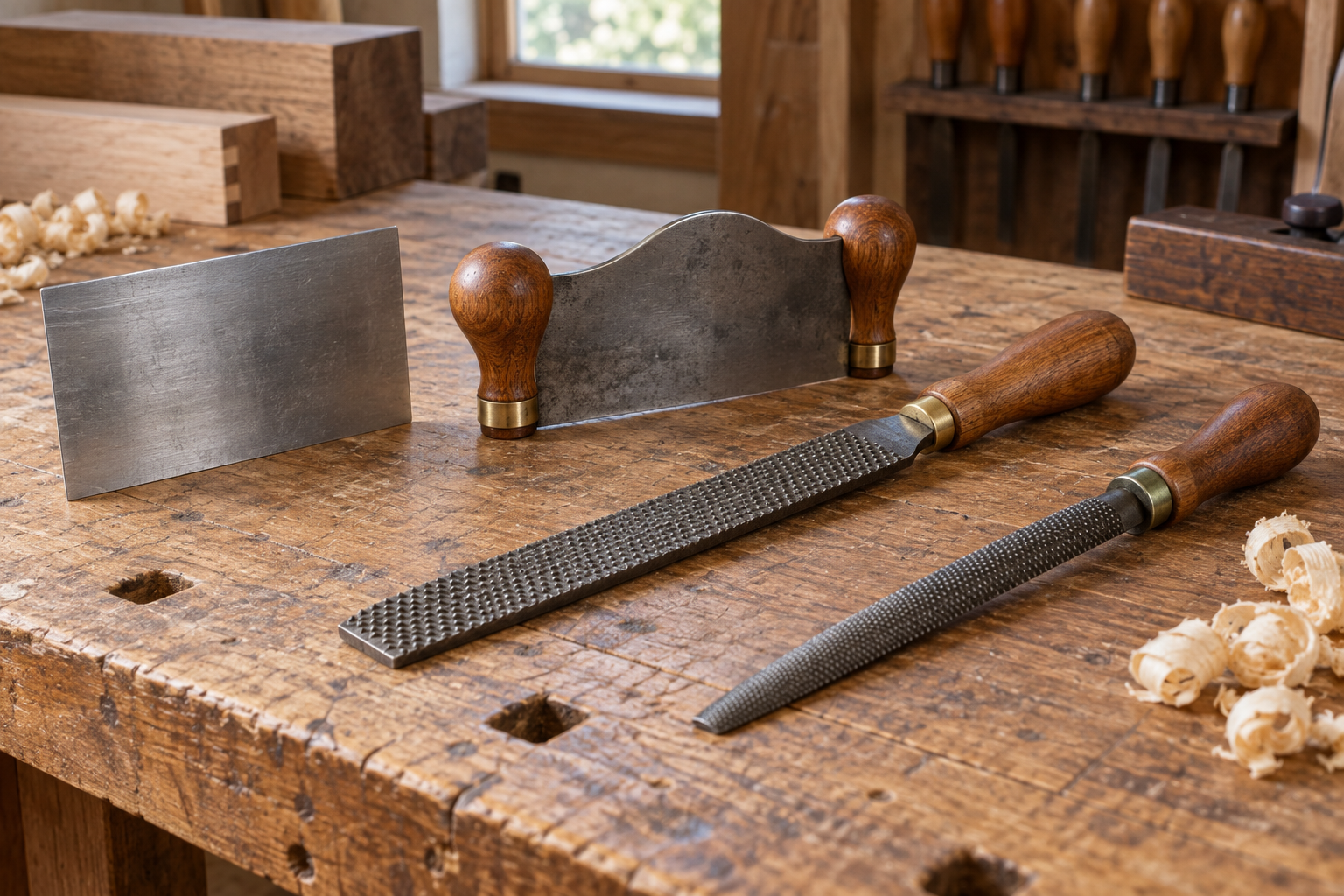
When a hardwood door edge needs reshaping, a rasp and a cabinet file can both remove material, but they are not interchangeable. A rasp is the faster, rougher tool. A cabinet file is slower and more controlled, with a much better chance of leaving an edge that needs only light sanding.
For most door work, the practical choice is to use both: a rasp for significant material removal, followed by a cabinet file for straightening and refining the edge. If the edge is already close to the correct size, skip the rasp and use the file.
As an Amazon Associate we earn from qualifying purchases at no extra cost to you.




What each tool is designed to do
A rasp has individually raised teeth that behave like many small cutters. It removes wood quickly, especially across end grain and on curved or irregular areas. Coarse rasps can take off 1/16 inch or more in a short time, but they leave deep ridges and can tear the fibers at the exit end of a stroke.
A cabinet file has parallel teeth cut into a relatively flat surface. The teeth are much finer and more uniform than a rasp’s. A good file removes less material per stroke, but it produces a flatter, more predictable surface. It is well suited to fitting a door edge to a jamb, easing a tight spot, or correcting a high area without changing the whole profile.
For hardwood such as oak, maple, ash, or beech, choose a purpose-made coarse wood rasp set if you need to remove noticeable material. A cheap, dull rasp is frustrating: it skates, requires excessive force, and is more likely to gouge the edge.
Direct comparison
| Feature | Rasp | Cabinet file |
|---|---|---|
| Material removal | Fast; best for substantial reshaping | Slow to moderate; best for small corrections |
| Surface left behind | Rough, ridged, and sometimes torn | Relatively smooth and even |
| Control | Good with practice, but aggressive | Excellent for fitting and truing |
| Risk of removing too much | High, particularly on corners | Lower, because each stroke removes less |
| Best use on a door | Taking down a swollen or badly oversized edge | Final fitting, straightening, and easing an edge |
| Typical follow-up | Cabinet file, sanding block, or hand plane | Fine sanding or finish application |
Which tool should you buy?
Buy a rasp when the door is more than about 1/32 to 1/16 inch too large in a localized area, or when you must reshape a rounded transition. A half-round rasp is particularly useful if one face of the edge needs a flat surface and the other needs a slight curve. A flat rasp is easier to control when correcting a straight edge.
Buy a cabinet file when the door is nearly fitting and you need to remove a controlled amount along a marked section. A 10- or 12-inch file is a useful general size for door work. Longer files help bridge small irregularities, while short files are easier to control in tight areas. A 10-inch mill or bastard file is a sensible general-purpose choice, although a true cabinet file with a finer, more consistent cut is preferable for visible hardwood.
If you can buy only one tool, choose based on the amount of wood to remove. For a door that is already close, the file is the safer purchase. For a door that will not enter the jamb by 1/8 inch or more, a rasp saves time, provided you finish with a finer tool.
How to shape the edge without ruining it
Remove the door and support it securely at a comfortable working height. Mark the high area with pencil, then transfer the mark across the edge with a square. If the door is rubbing at the top corner, do not automatically remove material from the entire edge. Mark only the contact area and add a short transition into the surrounding wood.
Start with a rasp only when necessary. Hold it with two hands, keep it flat against the intended surface, and use moderate strokes. On a straight door edge, work diagonally for the first few strokes, then switch to strokes running with the edge to even the surface. Stop after every 5 to 10 strokes and check the fit. It is easy to remove another 1/32 inch; putting that wood back requires a repair.
Work from both ends toward the center rather than rasping off the end of the door. This reduces the chance of breaking out fibers at the corner. If you must work toward an end, make the last few strokes very light and support the exit area with your free hand.
Once the door is close, change to the cabinet file. Chalk or pencil on the edge shows where the file is making contact. Use long, even strokes and keep the file face flat. Clean the teeth regularly with a file card brush; packed hardwood dust makes a file slide instead of cut.
Common failure modes
The most common mistake is using a rasp for the entire job. Its coarse teeth can leave valleys that remain visible after paint, and they are difficult to flatten if the edge has a bevel. Another mistake is pushing too hard. Pressure does not make a rasp or file cut better; it increases chatter, clogging, and accidental digging.
Do not use a file with oil on it for ordinary hardwood work. Oil attracts dust and can interfere with later glue or finish. A clean, dry file is easier to maintain. Also avoid filing across a crisp door corner unless you intend to ease it. Even two or three careless strokes can create a rounded spot that catches the light.
The most reliable workflow
For a badly tight door, use a coarse rasp to remove most of the excess, leaving roughly 1/32 inch for correction. Follow with a medium cabinet file, then a fine abrasive on a hard sanding block. For a door that is only slightly tight, go straight to the cabinet file and test the fit often.
A hard sanding block with 180- or 220-grit abrasive is the final step, not a substitute for correcting a high spot. Sanding alone tends to round the edge and takes much longer. The rasp is the economical choice for rough shaping; the cabinet file earns its place when accuracy, surface quality, and control matter more than speed.