What's inside
As an Amazon Associate I earn from qualifying purchases. This post may contain affiliate links at no extra cost to you.
Removing bark from green wood is one of the jobs a drawknife does better than almost any other hand tool. It takes long, controlled shavings instead of the short bites produced by a knife or hatchet, and it lets you follow the grain without removing more wood than necessary. The best choice is usually a sharp, moderately sized drawknife with a comfortable handle layout—not the biggest blade you can find.
As an Amazon Associate we earn from qualifying purchases at no extra cost to you.



Our Top Picks


What Makes a Good Bark Drawknife
For green logs, look for a blade roughly 8 to 10 inches long and 1 1/4 to 2 inches wide. That size gives enough cutting edge for productive passes while remaining manageable around knots and changes in grain. A 12-inch blade can remove bark faster from straight, large-diameter logs, but it takes more effort to control and is awkward on small branches or irregular wood.
A bevel-down drawknife is generally the most forgiving arrangement for bark removal. With the bevel facing the wood, the flat back rides against the surface and helps prevent the edge from diving deeply. A bevel-up design can work well for controlled shaping, but it is easier to take an unexpectedly thick shaving when the angle changes.
Handles should be large enough to grip with both hands while wearing work gloves, but not so oversized that they force your wrists into an awkward position. Straight handles are simple and durable. Offset or upswept handles can improve clearance over the log, especially when working close to the surface, though they add cost and can make the tool less compact.
Drawknife Types Compared
| Type | Best use | Main advantage | Main drawback |
|---|---|---|---|
| Standard 8–10 inch drawknife | General bark removal and green woodworking | Best balance of control, speed, and sharpening effort | Slower on very large, straight logs |
| Long 10–12 inch drawknife | Large logs and long straight pulls | Removes a wide strip per pass | Less nimble around knots and branches |
| Small 5–7 inch drawknife | Branches, chair parts, and detailed work | Easy to control in tight areas | More passes and less efficient on log-sized material |
| Heavy, thick-bladed drawknife | Rough stock removal and stubborn bark | Resists flexing and tolerates force | Heavier, slower to sharpen, and tiring over time |
Best Overall: A Standard 8–10 Inch Drawknife
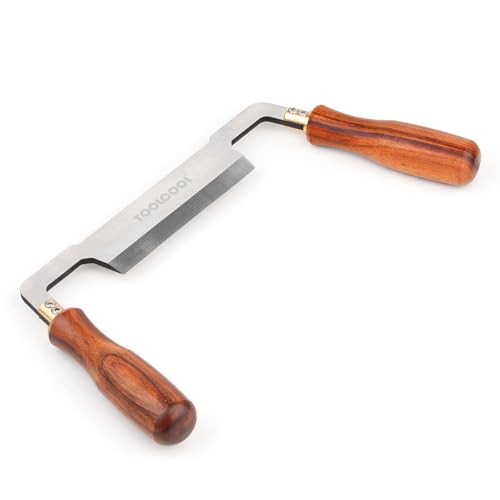
For most people, the best buy is a conventional drawknife with an 8- to 10-inch hardened steel blade, wooden handles, and a modest cutting bevel. It is long enough to strip a section of green ash, oak, birch, or maple efficiently, but short enough to steer around knots. A blade in this range also fits common sharpening stones and files without special equipment.
Choose a standard 8-inch drawknife with wooden handles if you want the safest general-purpose option. The cheaper tools in this category can be perfectly adequate. A low-cost drawknife is worth considering when you are removing bark from a few garden branches, making rustic stakes, or learning the technique. Check that the handles are firmly attached, the blade is straight, and the edge has no deep chips.
Price alone does not determine performance. An inexpensive tool with a properly ground edge will outperform a costly tool that arrives dull or has a poorly shaped bevel. The difference with better tools is usually more consistent heat treatment, smoother handle fitting, and less time spent correcting the edge.
When a Heavy Drawknife Is Worth It
A thick, heavy drawknife makes sense when you regularly work with logs 8 inches or more in diameter or remove rough, corky bark from species such as oak and black locust. The extra mass helps the blade stay stable when you apply firm pressure, and a thicker blade is less likely to flex into an uneven cut.
The trade-off is fatigue. A heavy drawknife can weigh twice as much as a light greenwood tool, and the difference becomes obvious after 20 or 30 minutes of repeated pulls. It also encourages users to force the cut instead of improving the cutting direction. Buy one if you need durability and production, not simply because it looks more substantial. A heavy-duty 10-inch drawknife is a sensible category for this work.
Blade Edge and Sharpening
Green wood does not require a razor edge polished to mirror brightness. A keen, durable edge with a small secondary bevel is more practical. Start around 25 to 30 degrees per side, depending on the blade and how aggressively you work. A very thin edge may shave beautifully for ten minutes, then roll when it hits embedded grit or a knot.
Before the first cut, remove loose dirt and grit from the bark with a stiff brush. Grit is a major cause of premature dulling. Keep a medium sharpening stone nearby and touch up the edge as soon as it starts skating over the surface. If the blade needs heavy repair, a drawknife sharpening stone with a narrow edge is easier to control than a large flat bench stone.
Do not use a file as the regular sharpening method unless the blade is badly damaged. A file removes metal quickly and can leave a coarse, uneven bevel. It is useful for restoring a chipped edge, followed by stones to refine it.
Safe Bark Removal Technique
Secure the log at waist height or slightly below. Sawhorses, a shaving horse, or a simple wooden stop can prevent the log from rolling. Stand to one side rather than directly in line with the blade. Pull the drawknife toward your body, but stop before it reaches your torso and keep both hands behind the cutting edge.
Begin with light passes at a shallow angle. On fresh green wood, bark often lifts in strips 1/16 to 1/8 inch thick. If the blade dives deeper than about 1/4 inch, reduce pressure, lower the handle slightly, or reverse direction to work with the grain. Do not pry under stubborn bark with the edge; that can chip the blade. Instead, score a short line, remove the section from another direction, or leave bark around a knot and clean it up later.
For occasional projects, a standard 8- to 10-inch drawknife is the right balance. Spend the extra money on a straight blade, secure handles, and a usable edge—not on excessive length or weight.