What's inside
As an Amazon Associate I earn from qualifying purchases. This post may contain affiliate links at no extra cost to you.
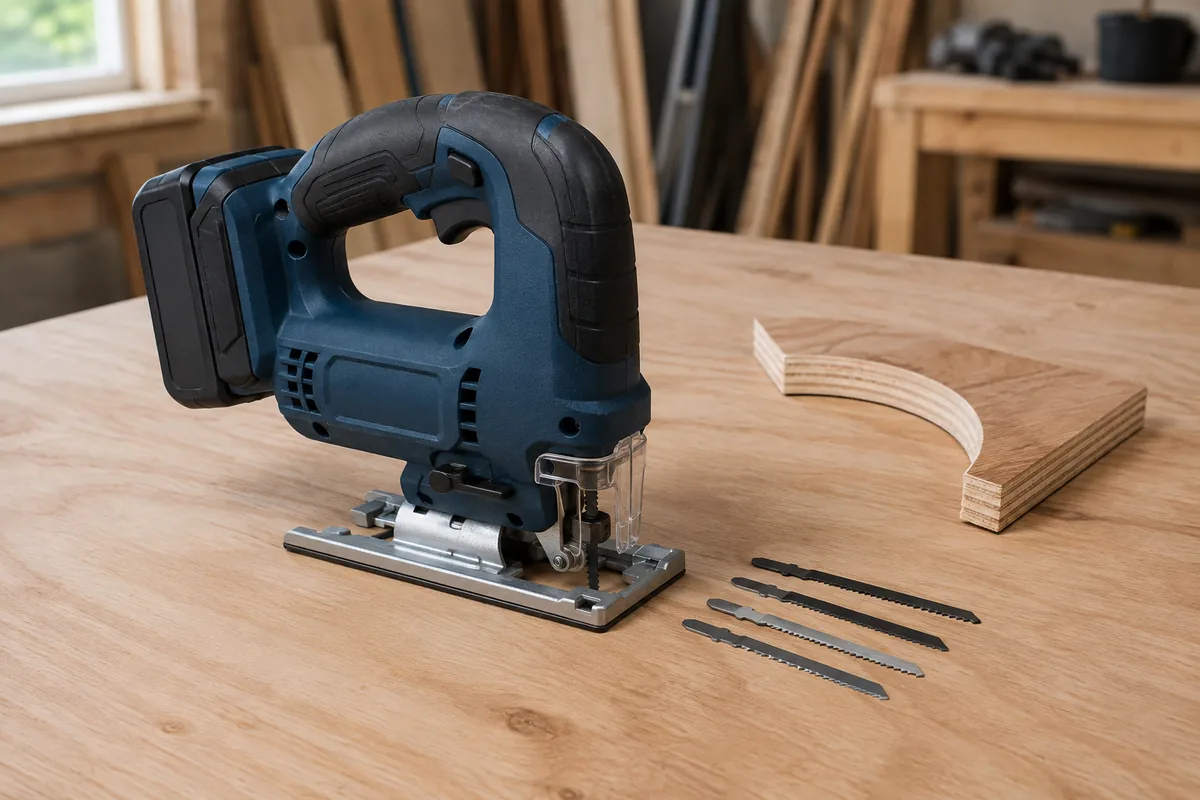
Choosing a jigsaw blade for thick hardwood is a balance between cut speed, control and the chance of bending the blade. Tooth count matters, but so do blade length, tooth geometry, material and the saw’s orbital setting. For most rough cuts in solid hardwood, start with a long, coarse blade around 6–10 teeth per inch (TPI), then adjust for the cut quality you need.
Why tooth count matters
Jigsaw blades cut on the upstroke. Teeth need space to clear sawdust from the kerf, especially in thick stock. A coarse blade has larger gullets, so it tends to clear chips and cut faster. A fine blade makes smaller, less ragged cuts, but its tighter gullets can pack with dust and heat up in thick wood.
Too many teeth can make a blade crawl, burn the wood or wander as you push harder to keep it moving. Too few can leave a rough edge and catch aggressively, particularly where grain changes direction. In thick hardwood, a blade that is too short is a separate problem: if its teeth stop clearing the bottom of the cut, the blade can bind and deflect.
Tooth-count comparison
| Blade range | Best fit | Main trade-off |
|---|---|---|
| 6–8 TPI | Fast, rough cuts in thick hardwood | Rougher edge; can grab on tight curves |
| 10–12 TPI | General-purpose cuts where a cleaner edge matters | Slower; more prone to heat and dust packing in very thick stock |
| 14+ TPI | Thin material and cleaner cuts where speed is secondary | Usually a poor choice for thick hardwood; slow cutting and increased heat risk |
These are practical ranges, not guarantees. Tooth spacing and shape vary between brands, and a blade marked for hardwood may cut differently from a general-purpose blade with the same TPI. Check the blade’s stated material and thickness range as well as the number of teeth.
Pick blade length and type
For a board 2 inches thick, use a blade long enough that its teeth extend below the workpiece throughout the stroke. A blade only a little longer than the stock may technically reach, but it leaves little margin for the blade’s up-and-down motion or for the saw’s shoe position. For stock around 2 inches thick, a blade in the 4- to 5-inch overall-length range is often a sensible place to look; confirm the manufacturer’s stated cutting capacity for your saw and blade.
Long blades are more likely to bend if you steer them hard. For a straight cut, guide the saw without forcing it and use a fence or straightedge when practical. For curves, use a narrower blade designed for curve cutting. A wide blade resists twisting better on straight lines but takes a wider radius to turn.
High-carbon-steel blades are inexpensive and can be fine for occasional work in wood. Bimetal blades generally hold up better to heat and wear, a useful upgrade if you cut hardwood regularly. A long 6–8 TPI jigsaw blade for hardwood is a reasonable starting category for rough cuts in thick boards. If you want longer service life, compare it with coarse bimetal jigsaw blades.
Match the blade to the cut
For a hidden cut, such as trimming a shelf to fit, a coarse blade is often the better choice even if it leaves a rough edge. For a visible edge that will be sanded, 10–12 TPI can give a cleaner starting surface in moderately thick stock, provided the blade clears chips and cuts without bogging down. If the edge must be especially clean, consider cutting slightly proud of the line and sanding or routing to the final dimension rather than asking a jigsaw to make a finish-quality edge.
To reduce splintering on the top face, keep in mind that the teeth cut on the upstroke, so tear-out is often worse on the top. A reverse-tooth blade can improve the top edge, but it changes the way the saw behaves and may require more pressure to keep the shoe seated. It is not automatically a better choice for thick hardwood. A zero-clearance support, painter’s tape or cutting with the better face down can also help, depending on the workpiece and saw setup.
Set up and test before the full cut
Start with a sharp blade and a firm workpiece. Set the saw’s shoe flat on the surface, and use a low or moderate orbital action for a cleaner cut or tight control. More orbital action can speed a rough straight cut, but it makes the blade’s motion more aggressive and tends to worsen tear-out and accuracy. If the saw offers variable speed, begin around the middle of its range and adjust if the blade burns, chatters or struggles.
Make a test cut in scrap of the same thickness and species. If the saw slows sharply, the blade gets hot, or the kerf shows dark burn marks, ease off the feed pressure and check for packed sawdust or a dull blade. If the cut wanders, do not twist the saw back toward the line while the blade is trapped in the kerf. Stop, back out carefully if possible, and restart with less pressure or a blade better suited to the curve.
A practical buying decision
If you will make only a few rough cuts, an inexpensive coarse wood blade is usually enough; a premium blade cannot compensate for forcing the saw or using a blade that is too short. For repeated cuts in dense hardwood, buying a small assortment is more useful than relying on one fine blade: include coarse blades for fast cuts and a medium-tooth option for cleaner edges. A long-blade hardwood assortment lets you test tooth counts on scrap before committing to a visible cut.
As a simple rule, choose 6–8 TPI for speed and chip clearance in thick stock, 10–12 TPI when a cleaner edge is worth slower progress, and avoid fine blades for thick hardwood unless the blade maker specifically rates them for that thickness. Confirm length and capacity, let the blade do the cutting, and replace it when it starts requiring noticeably more force.