What's inside
As an Amazon Associate I earn from qualifying purchases. This post may contain affiliate links at no extra cost to you.
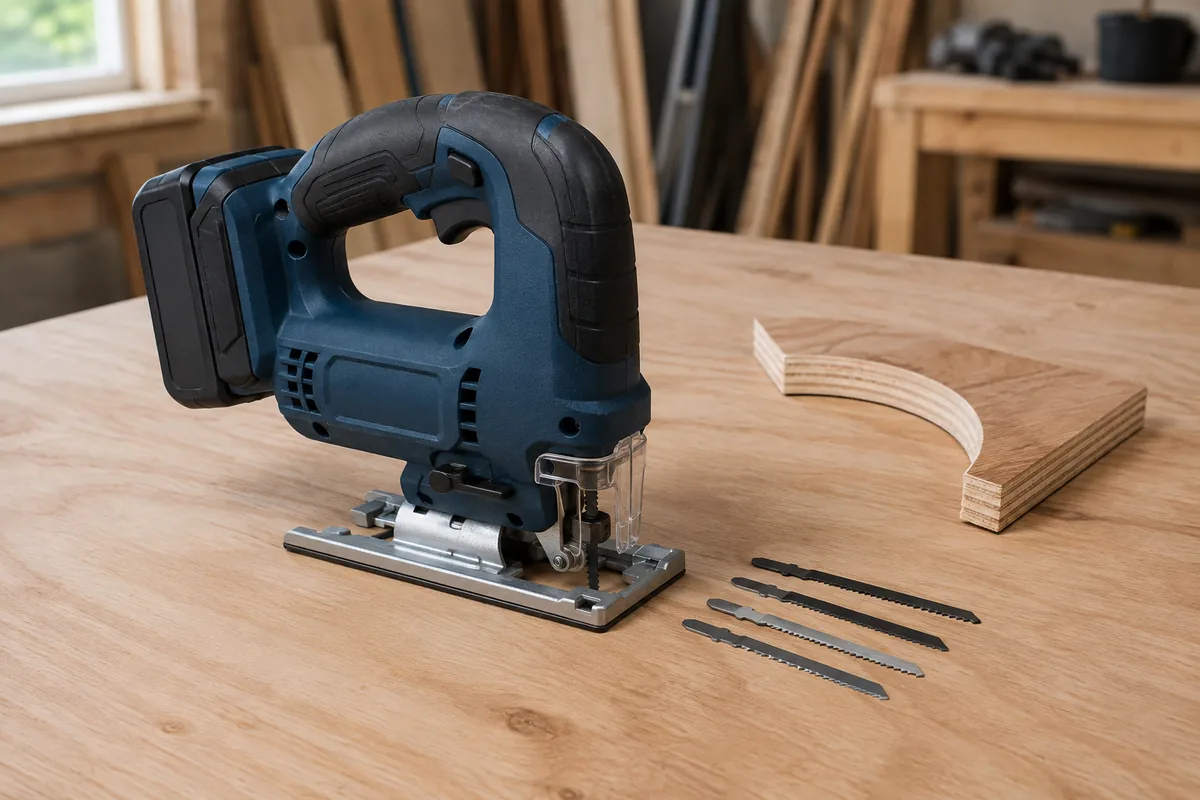
A jigsaw’s pendulum setting—also called orbital action—changes how the blade moves. With it off, the blade travels mostly straight up and down. With it on, the blade also swings forward on the upstroke and back on the downstroke. That can speed a rough cut, but it is not a free upgrade in cut quality.
For clean curves, straight-stroke action is usually the better starting point. Pendulum action is useful when speed matters more than a smooth edge, especially on thicker wood. The blade, material, curve radius and feed rate matter too; switching the setting cannot compensate for a blade that is too coarse or a turn that is too tight.
As an Amazon Associate we earn from qualifying purchases at no extra cost to you.



Our Top Picks


What the settings change
On a straight-stroke jigsaw, the teeth cut as the blade rises, while the downward stroke clears the kerf. This gives you a more controlled cut and reduces the blade’s tendency to pull itself forward. It is easier to follow a line through a curve without the saw surging ahead.
Pendulum action adds a forward-and-back motion. The teeth take a more aggressive bite, so the saw can cut faster through wood. The trade-off is more vibration and a rougher edge. The extra push can also encourage the blade to wander, particularly when you steer it hard around a curve.
Most jigsaws offer several pendulum settings as well as off. Higher settings are generally more aggressive, but the exact movement varies by tool. Try a short test cut on scrap rather than assuming a particular numbered setting will suit every material.
Which cuts curves cleaner?
For a tight or visible curve, use straight-stroke action first. It gives you more time to steer and reduces the chance that the saw will lunge forward at the start of each cut. Pair it with a narrow, fine-tooth blade rated for the material. Narrow blades turn more readily than wide blades, though they can flex if you force them.
For broad curves in thick stock, a low pendulum setting may work well if the edge will be sanded or hidden. It can remove material faster and reduce the temptation to push too hard. High pendulum action is usually a poor choice for a small-radius curve: the blade can bind, bow or cut beyond the line before you can correct it.
There is no universal minimum curve radius. Blade width and thickness, stock thickness, and the direction of the teeth all affect how sharply the blade can turn. If the blade starts to twist or the saw becomes difficult to guide, stop and make relief cuts into the waste area. Those short cuts let the waste fall away instead of trapping the blade around the curve.
Settings by job
| Job | Starting setting | Main trade-off |
|---|---|---|
| Tight curves in thin plywood | Straight stroke; fine, narrow blade | Slower, but easier to steer and leave a clean edge |
| Broad curves in thick construction lumber | Low pendulum; coarse wood blade | Faster, with more tear-out and cleanup |
| Curves in laminate or veneered panels | Straight stroke; fine-tooth blade | Less chipping, but feed slowly and support the panel |
| Curves in metal | Straight stroke; suitable metal blade | Slow cutting; pendulum action can make control worse |
These are starting points, not guarantees. A clean-side-up cut may still chip on the top face because many jigsaw blades cut on the upstroke. Check the blade’s tooth direction and the manufacturer’s guidance. If the visible face must stay pristine, use a reverse-tooth or down-cut blade if your saw accepts one, or make a test cut and orient the panel accordingly.
Blade and technique matter as much as the setting
Pick the blade for the curve and material, not just for the saw. A coarse blade clears chips quickly in thick wood but leaves a rougher edge. A fine blade cuts more slowly and can heat up if you force it. For a beginner making decorative curves, a jigsaw scroll-blade set for wood can be useful, provided the blades match the saw’s shank type.
Keep the base plate flat on the work and let the blade do the cutting. On a curve, advance steadily and rotate the saw gradually; do not twist the handle sharply while the blade is buried in the cut. If the blade begins cutting at an angle, ease off, back out only when it is safe, and correct the approach rather than forcing it back to the line. Forcing a flexed blade can leave a bevelled edge or break the blade.
Mark the waste side clearly and leave a small margin—around 1 to 2 mm—for sanding when the edge must fit precisely. On tight curves, drill a starter hole if the cut begins inside the panel, and add relief cuts that stop short of the finished line. Clamp the work securely, but leave enough room for the base plate and blade to move through the whole curve.
What to buy—and when to use the cheaper option
If you mostly cut gentle curves in framing lumber or make rough cuts that will be covered, a basic jigsaw with adjustable pendulum action is enough. You do not need an expensive saw simply to get a clean curve; a suitable blade and patient feed rate often make a bigger difference. A corded jigsaw with adjustable orbital action is a practical choice for long sessions where battery runtime is not important.
Pay more for a saw with a stable base, low vibration and good blade guidance if you routinely cut visible curves, thick stock or materials where a small deviation is costly. Better blade support can reduce wandering, but it does not make a wide blade turn like a scroll blade. Before buying, check that replacement blades are easy to find and that the saw’s base can be adjusted securely for bevel cuts—though bevel cutting is a different task from cutting a curve.
For the cleanest curve, start with pendulum action off, choose a narrow fine-tooth blade, and test on scrap of the same thickness. Add a low pendulum setting only if the cut is too slow and the edge does not need to be finished straight from the saw. Speed is useful; on a curve, control is usually what keeps the blade on the line.