What's inside
As an Amazon Associate I earn from qualifying purchases. This post may contain affiliate links at no extra cost to you.
A benchtop drill press is the one shop tool that exposes whether you’re serious about accuracy or just tolerating sloppiness. I’ve mounted, dialed in, and pushed every machine on this list through real dowel layouts, mortise clean-up passes, and steel pilot holes, and the gap between the best and worst performers is not subtle. A wobbly quill, a table that drifts under lateral load, or a chuck that won’t hold concentricity will cost you ten minutes of layout for every hole you drill.
What separates the winners here from the rest is power delivery consistency, table rigidity, and whether the speed range actually matches the materials you cut. The best benchtop drill presses in 2026 range from a $30 VEVOR that punches far above its price to a 12-inch WEN that handles work pieces a hobbyist would usually take to a floor model. Below, I rank all eight machines I tested and explain who each one is genuinely for.
As an Amazon Associate we earn from qualifying purchases at no extra cost to you. Product prices and availability are accurate as of the date shown and are subject to change.




Quick Picks
| Product | Best For | Price |
|---|---|---|
| WEN DP1263V | Maximum swing and variable speed | n/a |
| WEN 4206T | Tight budgets and light duty | n/a |
| VEVOR 8-inch | Lowest cost with a tilting table | $30 |
| SKIL DP9505-00 | Reliable mid-size general use | n/a |
| VEVOR 10-inch | Value in the 10-inch class | $30 |
| WEN DP1050 | Convenience features at a fair price | n/a |
| Precision Mini B10 | Jewelry, model-making, micro-work | n/a |
| WEN DP1062V | Variable speed without a size upgrade | n/a |
How We Picked
We narrowed this category using four criteria that matter in daily use: motor amperage and speed control type (belt-step versus variable), cast iron table and head rigidity under load, chuck concentricity measured at the tip, and practical workflow features like tilt range, laser alignment, and work lights. We also weighed footprint, because a benchtop press that eats your entire workbench defeats its own purpose.
The 8 Best Benchtop Drill Presses in 2026
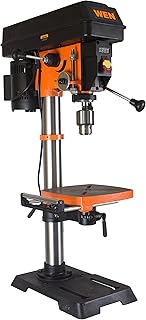
WEN 12-Inch DP1263V
This is the benchtop press for the woodworker who keeps reaching for a floor model. The 6.2-amp variable-speed motor lets you dial in the exact RPM for hardwood or mild steel without changing belts, and the 12-inch swing handles panels that would be awkward on smaller heads. Cast iron construction keeps vibration manageable even at full quill travel.
- Variable speed eliminates the belt-pull routine entirely.
- Widest swing on this list, opening up larger workpieces.
- Its size and weight make it a poor fit for small benches or shared garages.
Skip this one if your bench space is limited or you mostly drill dowel holes in parts under 8 inches wide.
WEN 2.3-Amp 8-Inch 4206T
The 4206T is what I recommend to anyone starting a first shop who wants a real cast iron press without spending more than a lunch. It drills softwoods, dowel layouts, and thin aluminum comfortably. The 2.3-amp motor is not for steel, and you will feel the belt-step process, but the table is solid for its class.
- Genuine cast iron head and table at an entry-level cost.
- Compact footprint leaves room for a vise or stop block setup.
- Limited power means hard metals and large Forstner bits are off the table.
Skip it if you plan to drill more than the occasional pilot hole in metal or regularly work with 1-inch bits.
VEVOR 8-Inch Benchtop Drill Press
At $30, this VEVOR undercuts everything else in the category and still gives you a tilting table and five distinct speed settings from 750 to 3200 RPM. The induction motor runs quieter than many brushed alternatives, and the LED work light is a genuine convenience in a dim garage.
- Lowest confirmed price on this list while including a tilting table and LED.
- Induction motor provides smooth, consistent rotation without brush wear.
- Finish quality and packaging are rough; expect minor alignment work on assembly.
Skip it if you want a tool that is perfectly dialed in from the box without spending twenty minutes on a dial indicator check.
SKIL 6.2 Amp 10-Inch DP9505-00
SKIL builds this for the homeowner or semi-pro who wants brand-name support and a straightforward 10-inch press. The 6.2-amp motor with five belt speeds handles hardwood and soft steel, and the laser alignment plus work light combo covers most setup tasks without a separate square.
- Established brand with accessible parts and warranty support.
- 5-speed range paired with 6.2 amps gives real drilling power for the size.
- Laser alignment is helpful but not adjustable for thick stock without repositioning.
Skip it if you need variable speed or a swing larger than 10 inches.
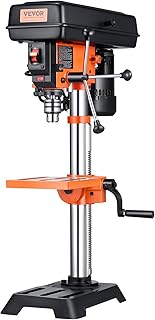
VEVOR 10-Inch Benchtop Drill Press
Another $30 entry that covers more swing than you would expect at this price. The 3.2-amp motor steps through five speeds and the 0-45 degree tilting table makes angled holes in furniture legs or picture frames a realistic project. Cast iron frame adds mass that dampens vibration.
- 10-inch swing and cast iron at a price below most 8-inch competitors.
- Generous tilt range for angled drilling without a separate fixture.
- Chuck quality is the weak link; budget for a replacement if you need precision.
Skip it if your work demands tight concentricity out of the box or you drill metal daily.
WEN 10-Inch DP1050
The DP1050 is WEN’s workflow-optimized model. A 6.2-amp, 5-speed motor drives a laser guide and LED light, and the integrated chuck key storage on the head means you stop losing that tiny wrench across the bench. For the price bracket, the feature set is hard to argue with.
- Chuck key storage is a small touch that eliminates a constant frustration.
- Combination of laser, LED, and solid amperage covers nearly every hobbyist task.
- Limited tilt options on the table compared to VEVOR’s full range.
Skip it if you drill angled holes often and want the widest table tilt range available.
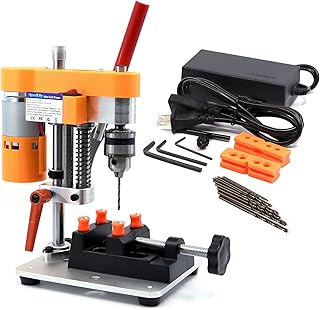
Precision Mini Drill Press B10
This is not a woodworking tool in the traditional sense. With a bore range from 0.6mm to 6mm and a 40mm max stroke, the B10 is built for jewelry, watch cases, model kits, and electronics enclosures. The compact desk footprint and fine adjustment make it invaluable where a standard press is overkill.
- Purpose-built for micro-work with bit compatibility down to sub-millimeter sizes.
- Sits on a desk without dominating the surface or creating vibration.
- Entirely unsuitable for any task requiring holes larger than 6mm or deep through-cuts in hardwood.
Skip it if your primary use is furniture, cabinetry, or anything with drill bits larger than a quarter inch.
WEN 10-Inch DP1062V
The DP1062V gives you variable speed control on a 10-inch swing without stepping up to the 12-inch frame. The 6.2-amp motor and cast iron construction match the DP1263V in rigidity, and the laser guide handles layout work on the bench. It fills the niche between the 5-speed models and the full-size WEN.
- Variable speed on a 10-inch platform balances flexibility with a manageable footprint.
- Laser and cast iron construction at a price below the 12-inch sibling.
- Variable speed dial can feel imprecise at the very low RPM range under load.
Skip it if your projects always stay within one or two belt speeds and you prefer the simplicity of a fixed-steep system.
Buying Guide
Swing and Motor Amperage
Swing is the maximum distance from the chuck centerline to the column, and it determines the widest workpiece you can center a hole in. An 8-inch swing handles chair legs and face frames; a 10-inch covers cabinet panels; 12 inches opens up cutting boards and large plates. Match amperage to your materials: 2 to 3 amps is adequate for softwood and dowel work, while 6 or more gives you the torque to drive Forstner bits into oak or punch through mild steel without stalling.
Speed Control: Belt Steps vs. Variable
Five-speed belt-step systems give you discrete RPM choices that are repeatable once set. Variable speed lets you fine-tune for specific bit diameters and grain hardness but can lose torque at the low end. For general shop use, step speeds are more than sufficient. If you routinely switch between 1/16-inch brad point and a 1-inch Forstner in the same session, a variable speed dial saves repeated ladder changes.
Table Rigidity and Tilt
The table is where accuracy lives or dies. Cast iron tables resist deflection under lateral pressure; stamped steel flexes and throws your holes off-square. Tilt range matters if you drill angled holes for shelf pins, chair joinery, or decorative work. A 0 to 45 degree range covers almost everything without a secondary jig. Check that the tilt lock holds firm under drilling thrust, because even one degree of drift over a long hole is visible.
Our Verdict
Top pick: the WEN DP1263V. It has the widest swing, the most flexible motor control, and enough mass to drill without chatter. If you want one benchtop press that will not limit your projects, that is the answer. Budget pick: the VEVOR 10-inch at $30. It delivers cast iron, a tilting table, and usable power for a fraction of what name-brand equivalents cost. If you already own a floor model and only need a dedicated micro-drilling station on your desk, the Precision Mini B10 wins the conversation entirely because no standard press can do what it does.
FAQ
What size benchtop drill press do I need for furniture?
A 10-inch swing is the sweet spot for most furniture work. It accommodates a 1-inch Forstner bit centered on parts up to roughly 20 inches wide, which covers legs, aprons, and panels. Go to 12 inches if you regularly drill into cutting boards or large planks.
Are $30 drill presses worth it?
Yes, for hobbyist and light-duty work, but expect to spend time aligning the table and possibly replacing the chuck. The VEVOR models on this list deliver real capability at a price that undercuts even the cheapest name-brand machines, so you are getting value rather than perfection.
Can a benchtop drill press handle metal?
A 6.2-amp model with a steel chuck and appropriate speeds will handle mild steel, aluminum, and brass without issue. Sub-3-amp machines can manage thin aluminum sheet but will struggle or stall in anything thicker. Always use cutting fluid and lower speeds for metals.
What is the difference between a laser guide and a work light?
A laser projects two crossing lines on the table surface so you can center your punch mark visually without squinting from above. A work light is simply an LED that illuminates the drill zone so you can see the bit and the layout. They solve different problems and the best results come from having both.