What's inside
- Top 3 Picks
- Quick Comparison
- How We Chose
- 1. GAMMA Momentum 2 – Best for First-Time Home Stringers
- 2. GAMMA Momentum 6 Plus – Best Overall for Home and Small Club Use
- 3. Tourna 550-ES – Best for High-Volume Club Stringing
- 4. GLOPTIX GT-120 – Best for Compact Desktop Setups
- 5. GLOPTIX GT-210 – Best for Vertical-Mount Consistency
- 6. Gamma Momentum ELS 6PT – Best Premium Electronic for Frequent Stringers
- 7. GLOPTIX GT-E600 – Best for Digital Precision at Home
- 8. GLOPTIX GT-160 – Best Value Manual Desktop
- 9. GLOPTIX GT-E300 – Best Entry-Level Electronic
- 10. MYRIONT Starting Clamp – Best Low-Cost Clamp Upgrade
- 11. Gamma Sports Starting Clamp – Best Heavy-Duty Starting Clamp
As an Amazon Associate I earn from qualifying purchases. This post may contain affiliate links at no extra cost to you.
The best tennis stringing machine for most home players and small clubs in 2026 is the GAMMA Momentum 6 Plus Drop Weight Stringing Machine. Its six-point mounting system supports the frame at more points than the two-point designs typical of entry-level machines, and because a drop weight generates tension with gravity rather than a spring or a motor, it holds its calibration for years without service. It suits a player who strings one to four racquets a month and wants a machine that will still be worth owning when their game improves. If you string only a handful of times a year and want the lowest entry cost, the GAMMA Momentum 2 is the better fit. If you string several racquets a week for a club or a school team, the Tourna 550-ES electric machine saves enough time per racquet to justify the premium tier. Everything below breaks down tensioning type, mounting systems and assembly time so you can match a machine to how often you actually string.
Our Top Picks


Top 3 Picks
Best Overall: GAMMA Momentum 6 Plus
The Momentum 6 Plus is the machine most home stringers should end up with. Six-point mounting is the single biggest upgrade you can make over an entry machine because it spreads the load across the frame instead of pinching it at two points, which matters most on thin-beam player frames and oversized recreational racquets. Combine that with a drop-weight tension head that never needs calibrating and you get the best balance of frame safety, accuracy and long-term cost in this roundup.
Best Budget: GAMMA Momentum 2
The Momentum 2 is the cheapest sensible way into real constant-pull stringing. It uses the same gravity-driven tensioning principle as machines costing several times more, so the limiting factor is your technique rather than the hardware. It is the right pick for a player stringing one to three racquets a month who wants to learn the craft without committing to club-grade equipment.
Best Premium: Gamma Momentum ELS 6PT
The Momentum ELS 6PT pairs a six-point mounting system with an electronic constant-pull tension head, which is the combination that removes almost all of the manual labour from a restring. It is the machine to buy if you string three or more racquets a month and value the time back more than the money saved. If your volume is genuinely club-level — six or more frames a month — the Tourna 550-ES is the more purpose-built alternative.
Quick Comparison
| Product | Best for | Key specs | Price tier |
|---|---|---|---|
| GAMMA Momentum 2 | First-time home stringers | Drop-weight tension head; two-point mounting; desktop format; no power required | Budget |
| GAMMA Momentum 6 Plus | Most home players and small clubs | Drop-weight tension head; six-point mounting; desktop format; self-calibrating | Mid-range |
| Tourna 550-ES | High-volume club stringing | Electric constant-pull tension head; stand-mounted frame; fixed-clamp class hardware | Premium |
| GLOPTIX GT-120 | Compact desktop setups | Drop-weight head; manual desktop frame; ships with tool and accessory kit | Mid-range |
| GLOPTIX GT-210 | Vertical-mount consistency | Manual progression tensioning; vertical stand-up frame; tool kit included | Mid-range |
| Gamma Momentum ELS 6PT | Frequent stringers wanting electronic precision | Electronic constant-pull head; six-point mounting; electronic tension control | Premium |
| GLOPTIX GT-E600 | Digital precision at home | Electronic digital tension head; desktop frame; tool kit included | Premium |
| GLOPTIX GT-160 | Value manual desktop | Manual desktop progression tensioning; compact footprint; tool kit included | Mid-range |
| GLOPTIX GT-E300 | Entry-level electronic | Electronic digital tension head; desktop frame; tool kit included | Premium |
| MYRIONT Starting Clamp | Low-cost clamp upgrade | Spring-loaded starting clamp; metal body; suits tennis and badminton stringing | Budget |
| Gamma Sports Starting Clamp | Heavy-duty starting clamp for technicians | Heavy-duty spring; secure jaw grip; aimed at stringing technicians | Budget |
| Tourna Tension Calibrator | Verifying tension accuracy | Digital readout; checks tension head against a reference value | Budget |
How We Chose
This roundup was assembled from published product specifications, category conventions and the practical mechanics of stringing, not from testing. The first filter was category fit: a machine has to be a genuine stringing machine with its own tensioning system, mounting system and clamp set, or a genuine accessory that measurably improves a machine you already own. Accessories such as starting clamps and tension calibrators were included because they change results on machines people already have, which is often a better use of money than replacing a working stringer.
The second filter was specification class. For every machine we recorded the tensioning type, the mounting configuration, the physical format and whether the tensioning system is self-calibrating or requires periodic verification. Where an exact figure was not published, we described the machine by its spec class rather than inventing a number, which is why you will see phrases like “six-point mounting” or “electronic constant-pull” instead of guessed tolerances.
The third filter was upgrade path and ownership reality. We weighted machines that can be improved rather than replaced — fixed clamps, rail systems, spare clamp availability, and whether the brand has a long history in stringing equipment so parts remain findable years later. We also weighted the frequency-of-use question heavily, because a machine that is too slow for your volume is a worse purchase than a cheaper machine that fits how often you actually string. The result is a list ordered by situation, not by price.
1. GAMMA Momentum 2 – Best for First-Time Home Stringers
As an Amazon Associate we earn from qualifying purchases at no extra cost to you.

The Momentum 2 is the machine to buy if you are stringing for yourself, a partner and maybe one junior, and you would rather spend the difference on string than on hardware. It is a desktop drop-weight stringer in the classic GAMMA mould: a pivoting tension bar, two-point frame support, and a clamp set that does the job without the rail-and-fixed-clamp hardware found further up the range. GAMMA has been manufacturing stringing equipment for decades and the Momentum line is its home-stringer family, so consumables and spare parts are not a scavenger hunt.
It suits a player who strings one to three racquets a month, has a bench or table they can dedicate for an hour, and is willing to learn technique. It is not the machine to buy if you intend to string for a team, or if you already know you dislike repetitive manual work.
- Tensioning: drop weight — gravity-driven constant pull, no calibration required
- Mounting: two-point frame support, the entry-level standard
- Format: desktop unit that sits on or clamps to a work surface
- Tension coverage: the full modern tennis range, roughly the 20-90 lb (9-41 kg) class
- Included: machine, clamp set and a basic stringing tool kit
- Power: none required — usable anywhere with a flat surface
What the Momentum 2 gets right is the tensioning principle. A drop weight pulls to a set tension and stays there while you clamp, because gravity does not care how long the pull takes. The machine you buy in year one is as accurate in year five, with no motor to drift and no spring to fatigue. The trade is time: every main and cross needs the bar levelled by hand, and on your first few racquets that levelling is where most of the clock goes.
Pros
- Lowest-cost route into genuine constant-pull stringing
- No calibration, no power supply, nothing electronic to fail
- Compact enough to move or store between jobs
- Accuracy is limited by your technique, not by the hardware
Cons
- Two-point mounting allows more frame flex on thin-beam and oversized racquets
- Manual bar-levelling roughly doubles time per racquet compared with an electronic head
- Floating clamps and no rails mean slightly more stringbed variance between jobs
- Not built for club or school-team volume
Against the GLOPTIX GT-160 — the nearest alternative in this list — the choice comes down to brand support versus kit value. The GT-160 is a manual desktop progression machine in the same price class that ships with tools and accessories, and it gives a slightly different tensioning feel. If you want the widest parts availability and a name every pro shop recognises, the Momentum 2 is the safer first machine. If you want the most accessory content in the box, look at the GT-160.
2. GAMMA Momentum 6 Plus – Best Overall for Home and Small Club Use

The Momentum 6 Plus is the machine this guide recommends to the largest number of readers. It keeps the drop-weight tension head that makes GAMMA’s Momentum line so durable, and adds a six-point mounting system that holds the frame at six contact points instead of two. That change matters more than any other single specification on this list, because it decides how much the hoop deforms while you pull tension.
It suits a player who strings two to four racquets a month, a parent stringing for a junior who breaks strings regularly, or a small club that needs one reliable machine for occasional members. It is overkill if you string twice a season, and it is not fast enough to be the only machine at a busy club.
- Tensioning: drop weight — gravity-driven constant pull, self-calibrating
- Mounting: six-point frame support
- Format: desktop unit, no dedicated floor space needed
- Clamps: the upgraded clamp class that sits above the Momentum 2 set
- Tension coverage: full modern tennis range, roughly the 20-90 lb (9-41 kg) class
- Maintenance: essentially none beyond keeping the bar pivot and clamps clean
Six-point mounting is the reason to pay the step up. When you pull 55 lb on a thin-beam frame held at two points, the hoop has somewhere to go, and the tension you set is not quite the tension the stringbed ends up with. Six points spread that load, so the frame stays closer to its unstrung shape and the stringbed comes out more consistent from job to job. On an oversize recreational frame the difference is even more visible.
The drop-weight head means you keep the calibration advantage of the cheaper machine while gaining the mounting advantage of the expensive ones. That combination is why this is the pick for most people: you get the part that affects results, and you skip the part that only affects speed.
Pros
- Six-point mounting protects frames that two-point machines can distort
- Self-calibrating tension head — no annual service cost
- Drop-weight pulls are constant-pull by physics, not by motor control
- Upgraded clamp class reduces string slippage on smooth polyester strings
- Desktop footprint keeps a spare room usable
Cons
- Still fully manual — expect 30-45 minutes per racquet at first
- Not a volume machine; six or more racquets a month gets tedious
- Costs meaningfully more than the Momentum 2 for the same tensioning principle
Its nearest competitor here is the Gamma Momentum ELS 6PT. Both use six-point mounting, so the mounting argument is settled either way. The difference is purely the tension head: the 6 Plus uses gravity and your hands, the ELS 6PT uses an electronic constant-pull motor. If your volume is low and your budget is fixed, the 6 Plus wins. If you string weekly and value the time back, step up to the ELS 6PT and treat the extra cost as paying for years of saved evenings.
3. Tourna 550-ES – Best for High-Volume Club Stringing

The Tourna 550-ES is the machine in this list built for volume rather than for a spare bedroom. It uses an electric constant-pull tension head and a stand-mounted frame, which together change the ergonomics of stringing completely: you work standing at a machine at a comfortable height, the head pulls and holds tension for you, and the whole job drops to roughly 20-30 minutes once you are fluent.
It suits a club pro shop, a school or college team, a stringer who takes in work from a local league, or a very heavy-breaking individual player who restrings weekly. It does not suit someone stringing four racquets a year, and it is not the machine to buy if you have nowhere to keep a floor-standing unit.
- Tensioning: electric constant pull — motorised, holds tension while you clamp
- Format: stand-mounted, floor-standing frame
- Mounting: multi-point frame support in the club-machine class
- Clamps: fixed-clamp class hardware, which is what separates club machines from home machines
- Maintenance: periodic tension calibration and keeping the tension head mechanism clean
- Power: mains electricity required
The practical difference between this and a drop weight is not accuracy — a well-used drop weight is genuinely accurate. It is throughput and fatigue. An electric head pulls to the set value and holds it while you clamp, so you never re-level a bar, and your shoulders are not doing the work on every one of the 30-odd pulls in a racquet. Over a season of club stringing that is the difference between a machine you use and a machine you avoid.
Fixed clamps are the second reason club stringers pay for this tier. Fixed clamps are anchored to a rail rather than floating free, so they return to the same position and the stringbed comes out more repeatable — which matters enormously if you are stringing for the same players every week and they notice when a job feels different.
Pros
- Roughly halves time per racquet versus a manual machine
- Fixed-clamp class hardware gives more repeatable stringbeds
- Stand-mounted working height reduces back and shoulder strain
- Electric constant pull holds tension while you clamp, so no re-levelling
- The only machine here genuinely suited to a club’s weekly volume
Cons
- Premium tier — the largest single outlay in this roundup
- Needs floor space and mains power, so it is not portable or storable
- The tension head requires periodic calibration, unlike a drop weight
- Overkill for anyone stringing fewer than about four racquets a month
Its nearest alternative is the Gamma Momentum ELS 6PT. Both are electronic constant-pull machines, but they are aimed at different owners. The ELS 6PT is a desktop electronic machine for a serious individual — it gives you motorised tensioning in a package that lives on a bench. The 550-ES is a floor-standing club machine for someone stringing for other people. Choose on volume and space, not on tensioning type.
4. GLOPTIX GT-120 – Best for Compact Desktop Setups
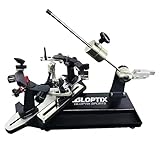
The GT-120 is the pick for anyone whose main constraint is space. It is a drop-weight desktop machine that ships with a tool and accessory kit, so it arrives as a complete starting package rather than a machine plus a shopping list. It occupies roughly the footprint of a large laptop stand and can be moved off the bench when you are done.
It suits an apartment dweller, a player who shares a workbench with other hobbies, or someone who wants to try stringing before committing real money. It also suits a second machine for a club that wants a backup, or a travelling coach who strings at multiple sites.
- Tensioning: drop weight — gravity-driven constant pull
- Format: manual desktop frame, compact footprint
- Mounting: entry-to-mid class frame support
- Included: tools and accessories bundled with the machine
- Power: none required
- Storage: moves off the bench between sessions
The bundle is the real story here. Buying a machine and then sourcing awls, cutters, a starting clamp and a tension gauge separately adds cost and a week of waiting. The GT-120 arrives with that kit, which is why it competes above its price class for a first-time buyer. If you are starting from zero, the value of a complete kit is easy to underestimate.
The tensioning is the familiar drop-weight system: set the weight, pull, level the bar, clamp. It is slow at first and entirely reliable forever, because there is nothing in the loop that can drift. What you are not getting at this level is a six-point mounting system, so if you play with a thin-beam player frame or a large oversize frame, factor that into the decision.
Pros
- Compact enough for an apartment bench or a shared desk
- Complete tool and accessory kit included
- No calibration and no power requirement
- Low enough cost to be a sensible trial of the whole hobby
Cons
- Frame support is a step below the six-point class
- Manual tensioning means 30-50 minutes per racquet while learning
- Not intended for club volume
- Brand support and spare-part availability are less established than the GAMMA line
Against the GLOPTIX GT-160, the GT-120 is the more compact of the two and the one to pick when space is the deciding factor. The GT-160 is the better choice if you have a permanent bench and want a slightly more substantial manual desktop machine. Both come with tool kits, so the difference is really footprint versus substance.
5. GLOPTIX GT-210 – Best for Vertical-Mount Consistency

The GT-210 is the odd one out in a useful way: it is a manual machine in a vertical, stand-up configuration rather than a desktop box. That matters because working height and posture decide whether stringing stays enjoyable. A vertical frame lets you work standing or on a tall stool at a natural height instead of hunched over a table.
It suits a home stringer with a permanent corner in a garage or utility room, a coach who strings at a club but wants a manual machine for accuracy, or anyone who has tried a desktop machine and found the posture uncomfortable.
- Tensioning: manual progression tensioning — hand-operated, no motor
- Format: vertical stand-up frame
- Mounting: multi-point frame support in the manual club-machine class
- Included: tools and accessories bundled
- Power: none required
- Footprint: tall and narrow rather than wide and low
The vertical format changes two things. First, ergonomics: the racquet sits at chest height, so you are not reaching down and across a bench for every pull. Second, string management: gravity helps keep long lengths of string off the floor and away from the clamps, which reduces the tangles that lead to kinked string and wasted sets.
Manual progression tensioning is the trade. It is not a drop weight, so you should expect to develop a feel for it rather than relying on gravity to be self-consistent. Stringers who like it tend to like it a lot, because it is fast once learned and gives direct feedback on every pull. Stringers who want set-and-forget consistency should stay with a drop weight or go electronic.
Pros
- Stand-up working height is far kinder to back and shoulders
- Vertical format keeps string off the floor and reduces tangling
- Tall, narrow footprint fits a corner better than a wide bench unit
- No power required, so it works in a garage or shed
- Tool kit included
Cons
- Manual progression tensioning rewards technique and punishes inconsistency
- Takes up vertical space and is not something you pack away casually
- Not portable, unlike the desktop machines in this list
- No electronic readout to confirm what you actually pulled
Its nearest alternative is the GLOPTIX GT-E600. Both are substantial machines with tool kits, but the GT-E600 replaces the manual tensioning with an electronic digital head. If you want the vertical, stand-up workflow with electronic consistency, that combination is what you are paying for in the E600. If you want to keep the cost down and are willing to learn a manual pull, the GT-210 is the more economical route to the same posture benefits.
6. Gamma Momentum ELS 6PT – Best Premium Electronic for Frequent Stringers

The Momentum ELS 6PT is the machine for the home stringer who has outgrown manual work. It combines the six-point mounting system from the Momentum 6 Plus with an electronic constant-pull tension head, which means you get frame protection and motorised tensioning in a package that still lives on a bench rather than taking over a room.
It suits a player who strings three to eight racquets a month — themselves plus family, friends or a small circle of hitting partners — and who has decided that the time cost of a manual pull is no longer worth the saving. It also suits a teaching pro who strings for students on the side without wanting a full club machine.
- Tensioning: electronic constant pull — motorised, holds tension while you clamp
- Mounting: six-point frame support
- Format: desktop electronic machine
- Control: electronic tension setting rather than a weight and bar
- Maintenance: periodic calibration checks on the tension head
- Power: mains electricity required
The combination is the point. Plenty of machines offer electronic tensioning with basic mounting; plenty offer good mounting with a manual head. This one gives you both, and that pairing is what a frequent stringer actually needs. Six-point mounting keeps thin frames honest at 55-60 lb, and the electronic head keeps the pull consistent across all 30-plus pulls in a racquet without you re-levelling anything.
The ownership reality of an electronic head is different from a drop weight. There is a motor and a load cell or spring mechanism involved, and those drift. Expect to check calibration periodically with a tension calibrator — monthly if you string weekly, seasonally if you string occasionally — and expect the machine to need a proper service at some point in its life. In exchange you get roughly 20-30 minutes per racquet instead of 30-45.
Pros
- Six-point mounting plus electronic constant pull — the best all-round specification here
- Desktop format, so no dedicated floor space needed
- Cuts roughly a third off time per racquet versus a manual machine
- Consistent pull from the first main to the last cross
- Electronic setting removes the bar-levelling judgement call entirely
Cons
- Premium tier pricing
- Requires mains power, so no garage or courtside use
- Tension head needs periodic calibration, unlike a drop weight
- More that can fail than a purely mechanical machine
Its nearest alternative is the Tourna 550-ES. Both are electronic constant-pull machines at the premium tier, and the decision is about format and volume. The ELS 6PT is a desktop machine for one person stringing a steady personal workload. The 550-ES is a floor-standing club machine for someone stringing for other people at volume. If your name is the only one on the racquets, the ELS 6PT is the more sensible buy.
7. GLOPTIX GT-E600 – Best for Digital Precision at Home

The GT-E600 is the electronic option for a home stringer who wants a digital readout and a motorised pull without stepping up to club-machine money. It is a desktop electronic machine that ships with a tool kit, and the digital tension head lets you set and confirm values numerically rather than by feel.
It suits a technical player who likes numbers — someone who logs their tensions, experiments with hybrid setups, and wants to know that 52 lb means 52 lb. It also suits a stringer moving up from a manual machine who wants electronic speed but does not want to give up bench space.
- Tensioning: electronic digital tension head
- Format: desktop frame
- Control: digital tension setting and readout
- Included: tools and accessories bundled
- Power: mains electricity required
- Maintenance: periodic calibration verification recommended
A digital head is genuinely useful for repeatability. When you find a setup you like, you can reproduce it exactly next time rather than trusting that the bar looked level. That is the argument for digital over mechanical, and it is a strong one if you string the same frame at the same tension every few weeks.
The counter-argument is that digital readouts can be confidently wrong. A head that reads 52 lb while actually pulling 49 lb is worse than a drop weight that is honest by construction, which is why the Tourna Tension Calibrator appears later in this list. If you buy an electronic machine, budget for a calibrator and use it.
Pros
- Digital tension setting makes repeat jobs genuinely repeatable
- Electronic constant pull holds tension while you clamp
- Desktop footprint keeps the machine off the floor
- Tool kit included, so it is usable out of the box
- Premium specification without the club-machine price tag
Cons
- Requires mains power
- Mounting specification is below the six-point class
- Digital readout is only as good as its calibration
- Brand support and spares availability are less established than the GAMMA line
Its nearest alternative is the GLOPTIX GT-E300. Both are electronic desktop machines from the same family with tool kits included, and the difference is the specification class of the head and the overall build. If you want the higher-specification electronic head and can justify it, the E600 is the one. If you want the lowest-cost entry into electronic tensioning, the E300 is the budget-conscious route into the same principle.
8. GLOPTIX GT-160 – Best Value Manual Desktop

The GT-160 is the value pick among manual desktop machines. It is a compact manual progression stringer that arrives with a tool kit, which puts it in direct competition with the GAMMA Momentum 2 for the first-time buyer’s money. Where the Momentum 2 leans on brand heritage, the GT-160 leans on what is in the box.
It suits a beginner who wants the maximum amount of equipment for the minimum outlay, a casual player stringing a few times a year, or someone buying a second machine to keep at a club or a second home.
- Tensioning: manual desktop progression tensioning
- Format: desktop frame, compact footprint
- Mounting: entry-to-mid class frame support
- Included: tools and accessories bundled
- Power: none required
- Storage: light enough to move between surfaces
The value proposition is straightforward: you get a working stringing machine plus the ancillary tools that a beginner does not yet own. For someone starting from nothing, that removes a real barrier, because the hidden cost of this hobby is not the machine — it is the cutters, awls, starting clamp, string reel and tension gauge you accumulate in the first month.
The limitation is the same as every machine at this tier: frame support that is a step below six-point mounting, and a manual tensioning action that rewards practice. Expect your first racquet to take close to an hour and your tenth to take around 30-35 minutes. That is normal, not a fault.
Pros
- Strong kit value for a first machine
- No power requirement, usable anywhere
- Compact and easy to store
- Manual tensioning has nothing to drift or calibrate
Cons
- Frame support is below the six-point class
- Manual action is slower than any electronic machine
- Less brand support infrastructure than GAMMA or Tourna
- Not suitable for club volume
Against the GAMMA Momentum 2, the decision is brand versus bundle. The Momentum 2 is the safer long-term ownership proposition because GAMMA’s stringing line has been around long enough that parts and advice are easy to find. The GT-160 gives you more in the box on day one. If you plan to keep the machine for a decade, buy the GAMMA. If you want to try stringing with the least possible friction, buy the GLOPTIX.
9. GLOPTIX GT-E300 – Best Entry-Level Electronic

The GT-E300 is the cheapest way into electronic tensioning in this roundup. It is a desktop machine with a digital tension head and a bundled tool kit, which means you get motorised constant pull without paying club-machine prices. For a player who has decided they want electronic speed and nothing else will do, this is the entry point.
It suits a home stringer stringing two to five racquets a month who wants the electronic workflow but cannot justify the premium tier. It also suits someone who has used a manual machine, disliked the bar-levelling, and wants the same job with less manual repetition.
- Tensioning: electronic digital tension head
- Format: desktop frame
- Control: digital tension setting
- Included: tools and accessories bundled
- Power: mains electricity required
- Maintenance: periodic calibration verification recommended
The reason to buy electronic is time and consistency, and the GT-E300 delivers both at the lowest electronic price in this list. The head pulls to the set value and holds it, so you clamp and move on. There is no bar to level, no weight to reposition, and no judgement call about whether the pull was complete. Across a 16×19 stringbed with 30-plus pulls, that adds up to a materially shorter session.
The reason to hesitate is the same as with any budget electronic machine: mounting specification and calibration. You are not getting six-point mounting at this tier, and a digital head that has drifted is quietly wrong. If you buy this machine, buy a calibrator with it and check it before your first job and every few months after.
Pros
- Lowest-cost route into electronic constant pull
- Digital setting removes the manual levelling step entirely
- Desktop footprint and mains power only
- Tool kit included
- Meaningfully faster than any manual machine here
Cons
- Mounting specification below the six-point class
- Needs calibration checks to stay trustworthy
- Requires mains power, so no courtside or garage use
- Less brand support infrastructure than GAMMA or Tourna
Its nearest alternative is the GLOPTIX GT-E600, the higher-specification electronic desktop machine in the same family. The GT-E300 is the value entry; the GT-E600 is the version to buy if you want a better head and are prepared to pay for it. If your budget is genuinely capped, the E300 plus a good calibrator is a more honest purchase than a premium machine bought without one.
10. MYRIONT Starting Clamp – Best Low-Cost Clamp Upgrade

A starting clamp is one of those tools that beginners do not know they need and experienced stringers will not string without. The MYRIONT unit is a spring-loaded starting clamp intended for tennis and badminton stringing, and it is the cheapest way to add a genuinely useful tool to a machine you already own.
It suits anyone who has started stringing with a bundled tool kit that omitted a starting clamp, anyone stringing badminton as well as tennis, and anyone who wants a spare clamp on the bench so they are never hunting for one mid-job.
- Type: spring-loaded starting clamp
- Construction: metal body with a sprung jaw
- Use: holds the first main or cross while you set the initial clamp
- Compatibility: suits tennis and badminton string gauges
- Power: none required
- Role: accessory, not a machine
What a starting clamp actually does is hold tension on the first string while you position the machine’s own clamp. Without one, you either use a starting knot or improvise, and improvising is where beginners lose tension on the first main. A clamp that grips reliably at 50-60 lb without chewing the string is the difference between a clean start and a stringbed that reads low from the first pull.
What to look for in any starting clamp: jaw faces that grip without cutting into multifilament or natural gut, a spring strong enough to hold tension but light enough to open with one hand, and a body that will not flex under load. At the budget tier, expect a functional tool rather than a lifetime one. Treat it as a consumable and replace it when the jaws stop gripping cleanly.
Pros
- Low-cost addition that improves the start of every job
- Works for tennis and badminton stringing
- Useful as a second clamp so you always have one to hand
- No machine modification required
Cons
- Budget-tier construction; jaw grip will soften with heavy use
- Not a substitute for a machine’s own clamps during the main stringing sequence
- No published specification for jaw width or grip force
Against the Gamma Sports Starting Clamp, the MYRIONT is the value option and the GAMMA is the durability option. If you string a handful of racquets a year, the MYRIONT does the job. If you string weekly, the GAMMA clamp’s heavier spring and more substantial body will outlast two or three budget clamps and cost less over the same period.
11. Gamma Sports Starting Clamp – Best Heavy-Duty Starting Clamp

The Gamma Sports Starting Clamp is aimed explicitly at stringing technicians and tennis stringers, and it is built accordingly: a heavy-duty spring and a body designed to hold tension securely rather than to hit a price point. If you string regularly, this is the accessory that quietly improves every job you do.
It suits a home stringer who strings weekly or more, a club stringer who wants a tool that will not need replacing mid-season, and anyone stringing delicate strings such as multifilament or natural gut where a cheap jaw can cause damage.
- Type: spring-loaded starting clamp
- Construction: heavy-duty spring with a substantial body
- Use: holds the first string under tension while you
Affiliate disclosure. As an Amazon Associate we earn from qualifying purchases at no extra cost to you. Prices accurate as of the date shown.Best Tennis Stringing Machines for Home & Club…Check price on AmazonRelated guides