What's inside
- Top 3 Picks
- Quick Comparison
- How We Chose
- 1. Nattork Kids Roller Skates – Best for Kids Ages 3-12 With Growing Feet
- 2. YYW Roller Skates – Best Budget Adult Beginner Skate
- 3. Roller Derby Roller Star 600 – Best for Adult Everyday Skating
- 4. MammyGol Roller Skates – Best for Toddlers and Little Kids
- 5. Roller Derby Firestar Youth – Best Budget Youth Skate for Rink Beginners
- 6. Nattork Adjustable Checkerboard Skates – Best for Style-Forward Kids and Teens
- 7. SULIFEEL Rainbow Unicorn Kids Roller Skates – Best Premium Kids Skate
- 8. Nattork Kids Roller Skates for Boys (Blue) – Best for Big Kids Ages 7-10
- How to Choose
As an Amazon Associate I earn from qualifying purchases. This post may contain affiliate links at no extra cost to you.
The best roller skates for most adults who want a comfortable, durable pair for regular everyday skating are the Roller Derby Roller Star 600, a women’s high-top quad with a supportive boot and wheels tuned for smooth, rink-like surfaces. It suits someone skating two or three times a week who wants one pair to last several seasons. For children, the best overall pick is the Nattork Kids adjustable quad, because its four-position sizing grows with a child’s foot and its light-up wheels keep beginners motivated. If budget is the deciding factor, the YYW high-top PU leather quad delivers the classic double-row shape and a supportive collar for adult beginners at the lowest tier. The eight models below are sorted by the three things that actually determine whether a skate feels good on your feet: boot support, wheel hardness, and sizing. Get those right and almost any well-built skate will feel stable and controllable within a session or two.
Our Top Picks
 MammyGol Roller Skates for Kids Boys GirlsMedium - Big Kid (13C-2)14.3 x 10.5 x 4.5 Inches4.5 poundsCheck on Amazon



Top 3 Picks
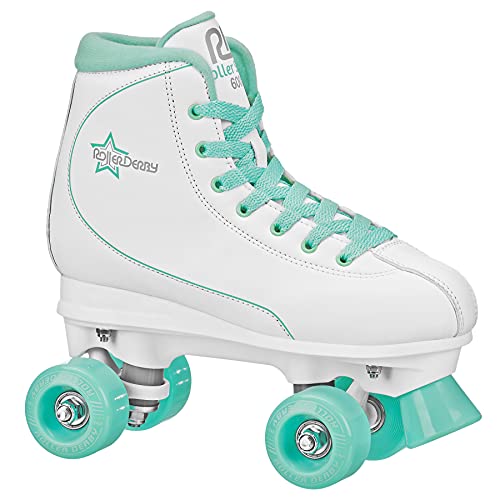
Best overall: Roller Derby Roller Star 600
The Roller Star 600 is the pick for adults who intend to skate often. Its high-top boot with a padded collar holds the ankle far more securely than an entry-level soft boot, which translates directly into control when you are learning to stop, turn and cross over. It ships in women’s sizing with wheels in the harder, rink-friendly class, so it feels fast and predictable on smooth concrete and coated floors.
Best budget: YYW high-top PU leather quad
The YYW gives adult beginners the two features that matter most at the start — a high-top collar and a lace-and-buckle closure — at the entry tier. The PU leather upper wipes clean and holds its shape better than thin vinyl, and the double-row plate is the standard four-wheel layout that every beginner lesson assumes. It is the sensible first pair if you are not yet sure you will stick with the hobby.
Best for kids: Nattork Kids adjustable quad
For families, the Nattork Kids model solves the biggest practical problem in children’s skating, which is outgrowing the boot in a single season. Four adjustable sizes cover a wide range of foot lengths, and the light-up wheels add a reason for a reluctant child to put them on. It is the best “one pair for the whole family” option in this roundup.
Quick Comparison
| Product | Best for | Key specs | Price tier |
|---|---|---|---|
| Nattork Kids Roller Skates for Girls (4 sizes adjustable) | Kids ages 3–12 whose feet are still growing | Four-position adjustable sizing; LED light-up wheels (no batteries); reinforced high-top upper; buckle, strap and lace closure; class-typical 78A–85A wheels roughly 60–64 mm | Mid-range |
| YYW Roller Skates for Women and Men | Adult beginners who want a classic quad at the lowest cost | High-top PU leather boot; double-row (quad) plate; indoor/outdoor urethane wheels; full lace plus buckle closure; unisex adult sizing | Budget |
| Roller Derby Roller Star 600 Women’s | Adults skating regularly on smooth indoor surfaces | High-top boot with padded collar and tongue; cushioned insole; bearings in the ABEC-7 class; rink-friendly urethane wheels; women’s sizing, listed in size 08 | Premium |
| MammyGol Roller Skates for Kids | Toddlers and little kids taking a first pair | Adjustable sizing; light-up wheels; padded high-top collar; simple strap-and-lace closure; lightweight composite plate sized for small riders | Budget |
| Roller Derby Firestar Youth | Youth beginners taking rink lessons | High-top youth boot; star graphic; rink-friendly urethane wheels; youth sizing, listed in size 02; classic double-row plate | Budget |
| Nattork Adjustable Roller Skates (checkerboard) | Kids and teens who want a style-forward adjustable pair | Adjustable sizing; illuminating wheels; checkerboard print upper; reinforced heel and ankle collar; indoor/outdoor wheel class | Mid-range |
| SULIFEEL Rainbow Unicorn Kids Roller Skates | Kids who want the most decorative light-up skate | Adjustable sizing; full light-up wheel set; rainbow unicorn graphics; padded collar; indoor/outdoor wheel class | Premium |
| Nattork Kids Roller Skates for Boys (blue, ages 7–10) | Big kids who need a wider adjustable fit | Adjustable sizing for older children; all light-up wheels; reinforced upper; indoor/outdoor wheel class; sized for roughly ages 7–10 | Mid-range |
How We Chose
This roundup is built from published product information, manufacturer specification sheets, sizing charts and the established engineering norms of quad skating rather than from hands-on sessions. We started by sorting the eight listed models into four use cases — toddler first pair, growing kid, youth rink beginner, and adult everyday skater — because a skate that is right for one of those is usually wrong for the others. From there we compared four things that are visible in a spec sheet and measurable on a skate: boot height and heel-counter stiffness, wheel durometer and diameter, bearing class, and the size range each model actually covers. We weighted adjustable sizing heavily for children’s models, since a boot that stops fitting after one season is a poor value no matter how good it looks. For adult models we weighted plate material and closure systems, because those are the two components that most often fail or loosen first. Finally, we looked at the upgrade path: whether wheels, bearings and toe stops are standard sizes that can be replaced or upgraded later, which determines how long the skate stays useful as a rider improves.
1. Nattork Kids Roller Skates – Best for Kids Ages 3-12 With Growing Feet
As an Amazon Associate we earn from qualifying purchases at no extra cost to you.

This is the family skate in the roundup, and it is designed around the single most expensive problem in children’s skating: feet grow roughly one to two shoe sizes per year between ages three and twelve. Rather than buying a new pair every spring, the Nattork Kids model uses a four-position adjustable shell that expands as the foot grows. The listing describes it as suitable for ages 3–12 across four adjustable sizes, which in practice means a family can buy one pair, set it to the smallest setting, and extend it through several seasons of use.
It suits a household where one or more children will skate on driveways, sidewalks, park paths and the occasional rink visit. It is also a reasonable choice for a grandparent or relative buying a first pair, because the adjustable sizing removes most of the risk of getting the size wrong.
Key specs
- Boot: reinforced high-top upper with a padded collar and tongue; the ankle support is the feature that matters most for a beginner who is still learning balance.
- Closure: a three-point system typical of this class — a buckle or cam-lever at the top, a hook-and-loop strap across the instep, and laces down the front. The strap does most of the work for small hands.
- Wheels: light-up polyurethane in the soft indoor/outdoor class, typically in the 78A–85A durometer range and roughly 60–64 mm in diameter. Soft wheels roll over driveway cracks and sidewalk seams without tripping a light rider.
- Bearings: entry-to-mid class, generally ABEC-5 to ABEC-7.
- Plate: composite (nylon or fiberglass-reinforced) double-row plate, which is light and forgiving for a small rider.
- Lighting: the LED wheels are powered by the rotation of the wheel itself, so there are no batteries to replace.
One thing to understand about light-up wheels: the LED generator inside the hub adds a small amount of rolling resistance compared with a plain wheel of the same hardness. For a five-year-old this is invisible. For a nine-year-old who wants to keep up with friends on a smooth path, it is a mild factor, which is why the boys’ version of this skate and the Roller Derby Firestar are worth a look for older children.
Strengths
The adjustable sizing is the headline feature and it is genuinely useful rather than a gimmick, because it directly reduces the cost per season of skating. The padded high-top collar gives a beginner real ankle support, which is the difference between a child who feels wobbly and one who feels planted. The soft wheel class means the skate works on the surfaces children actually skate on — driveways, sidewalks, playground courts — without the harsh vibration that hard rink wheels produce on rough asphalt. And the self-powered lighting removes the maintenance headache that battery-powered wheels create.
Assembly and adjustment are straightforward: the size mechanism is a push-button or lever on the side of the boot, and the toe stop is a standard bolt-on that can be raised or lowered with a wrench. That matters because a toe stop that is set too low drags and makes a beginner feel like they are tripping.
Pros
- Four adjustable sizes cover several years of growth, so the cost per season is low.
- Reinforced high-top boot with padded collar gives beginners real ankle support.
- Soft indoor/outdoor wheels handle driveways and sidewalks comfortably.
- Self-powered LED wheels need no batteries and no charging.
- Standard bolt-on toe stop and common wheel size make replacement parts easy to source.
Cons
- Light-up hubs add slight rolling resistance compared with plain wheels.
- Composite plate flexes under a heavier or older child; it is not built for aggressive skating.
- Adjustable shells are bulkier than fixed-size boots, so the fit is less precise than a dedicated size.
- The light-up wheels are soft, so they wear faster on rough asphalt than a harder wheel would.
How it compares
Against the MammyGol adjustable skate, this Nattork model is the more grown-up purchase: the boot is stiffer, the closure system is more secure, and the size range extends further into the age bracket. The MammyGol is the better choice for a three- or four-year-old who needs the lightest possible skate and may not stick with it. Against the Nattork boys’ blue model, this version is the better pick for a younger or smaller child, while the blue version is aimed squarely at the seven-to-ten range where the rider is heavier and pushing harder. If your child is at the top of the age range and skating more than once a week, step up to the Roller Derby Firestar or the Roller Star 600 instead.
2. YYW Roller Skates – Best Budget Adult Beginner Skate
The YYW is the entry point for adults, and it is built around the classic quad silhouette that has barely changed in forty years for a good reason: a high-top boot on a four-wheel plate is stable, predictable and easy to learn on. It is sold in unisex women’s and men’s sizing with a PU leather upper, which is a meaningful upgrade over the thin vinyl used on the cheapest skates because it resists creasing at the flex point and wipes clean with a damp cloth.
It suits an adult who wants to try roller skating without committing to a premium price, or who wants a second pair for a partner or friend. It also suits a casual skater who rolls around the neighborhood a few times a month and stores the skates in a closet the rest of the time.
Key specs
- Boot: high-top PU leather with a padded collar and tongue; the collar height is the key beginner feature because it supports the ankle during the learning phase.
- Closure: full lacing plus a buckle or strap at the top of the boot for a locked-in feel.
- Plate: double-row (quad) plate in a composite or entry metal class, carrying four wheels.
- Wheels: urethane in an indoor/outdoor class, generally in the 78A–85A range for grip on mixed surfaces.
- Bearings: entry to mid class, typically ABEC-5 to ABEC-7.
- Toe stop: bolt-on, adjustable, and replaceable.
- Sizing: listed in adult women’s and men’s sizes; skate sizing generally runs close to shoe size.
PU leather is worth explaining, because it is the single biggest difference between this skate and the cheapest alternatives. Polyurethane-coated leather is a fabric-backed material with a synthetic surface layer. It holds its shape better than vinyl, does not crack at the crease as quickly, and wipes clean. It is not as breathable as genuine leather, so a long summer session will leave your feet warmer than a premium boot would.
Strengths
The high-top collar is the reason to choose this over a low-top entry skate. Beginners fall sideways far more often than forwards or backwards, and ankle support is what converts a sideways wobble into a recoverable moment. The PU leather upper also makes the boot look and feel more expensive than its tier suggests.
The double-row plate is the standard configuration that every beginner lesson, every rink rental fleet and every online tutorial assumes. If you are learning from videos or taking a class, this is the geometry you will be taught on, and there is no translation gap. The bolt-on toe stop is adjustable, which matters more than most beginners expect: set correctly, it sits roughly a finger’s width above the floor when you are standing, and it gives you a reliable way to slow down before you learn to stop properly.
Because the wheels and bearings are standard sizes, the upgrade path is real. You can fit harder wheels for rink skating or softer ones for rough pavement, and swap the bearings for a smoother set later. That means the boot, which is the part that fits your foot, can stay with you while the rolling parts are tuned to your surface.
Pros
- High-top PU leather boot gives beginners meaningful ankle support.
- Classic double-row geometry matches what beginner lessons teach.
- Lace plus buckle closure locks the heel down better than laces alone.
- Standard wheel, bearing and toe-stop sizes make upgrades and repairs easy.
- Indoor/outdoor wheel class works on driveways, paths and rink floors.
- Wipes clean and resists creasing better than vinyl at the same tier.
Cons
- Composite or entry-level plate flexes under heavier adult skaters.
- PU leather is less breathable than genuine leather on long summer sessions.
- Stock bearings are serviceable rather than smooth; upgrading is a common first improvement.
- One wheel class for both indoor and outdoor means it is a compromise on both.
- Padding is thinner than on premium boots, so long sessions can rub before break-in.
How it compares
Against the Roller Derby Roller Star 600, the YYW is roughly a tier below in boot construction, plate stiffness and bearing smoothness, but it costs a fraction as much and gets a beginner rolling just as safely for the first year. If you already know you will skate weekly, the Roller Star 600 is the better long-term buy. If you are testing whether you enjoy skating at all, the YYW is the sensible entry. For kids, neither of these applies — the adjustable Nattork and MammyGol models are sized for growing feet and this one is not.
3. Roller Derby Roller Star 600 – Best for Adult Everyday Skating

The Roller Star 600 is the best overall skate in this roundup for adults, and it earns that on boot construction. Roller Derby is one of the oldest names in quad skating and the Roller Star line is its mainstream recreational model, built for people who skate regularly rather than once a summer. The boot is a high-top with a cushioned collar and tongue and a reinforced heel counter, which is the part of a skate that determines whether your heel lifts when you push. A heel counter that holds means your effort goes into the wheels instead of into sliding around inside the boot.
It suits an adult — this is a women’s model, listed here in white and mint — who skates two or three times a week at a rink, on a smooth path, or in a gym, and who wants a pair that will still feel good in three years. It is also the natural upgrade for someone who started on a budget skate and has outgrown the flex in a composite plate.
Key specs
- Boot: high-top with padded collar and tongue, cushioned insole, and a stiffer heel counter than entry-tier boots.
- Closure: full lacing with a top buckle or strap for heel lock.
- Plate: a stiffer plate than entry-level composites, which translates into more direct power transfer and less flex under a full adult weight.
- Wheels: urethane in the rink-friendly class — harder than the soft indoor/outdoor compound used on the budget skates, generally in the 88A–98A range and roughly 57–62 mm in diameter.
- Bearings: ABEC-7 class, which is the norm at this tier and noticeably smoother than entry bearings.
- Toe stop: adjustable bolt-on, replaceable.
- Sizing: women’s sizing; the listing shown here is size 08.
The wheel spec deserves a note, because it is the main reason this skate feels different from the budget models. A harder wheel in the high-80s to high-90s durometer has less rolling resistance and more grip on smooth coated floors, which is exactly what a rink skater wants. On rough asphalt that same wheel transmits every crack straight into your knees. If you plan to skate mostly outdoors on pavement, budget for a second set of soft 78A wheels in the 62–65 mm range, which is a straightforward swap on a standard quad plate.
Strengths
The boot is the strength. A stiff heel counter plus a padded collar plus a cushioned insole adds up to a skate you can wear for a two-hour session without your arches complaining. For an adult learner, that combination also shortens the learning curve, because the skate responds the instant you shift your weight rather than flexing first.
The ABEC-7 bearings and harder wheels make the skate feel faster and more precise than the entry tier, and the whole package is built from standard components. Wheels, bearings, toe stops, cushions and laces are all replaceable, and cushions in particular are worth knowing about: the rubber bushings that sit on the kingpins control how much the plate tilts when you lean. Softer cushions make a skate turn more easily and are a cheap, effective upgrade for a lighter skater; harder cushions stabilize a heavier one. Most skaters never touch them, and most skaters would benefit from experimenting.
Pros
- Stiff heel counter and padded collar deliver the best support in this roundup.
- ABEC-7 class bearings roll noticeably smoother than entry-tier bearings.
- Rink-friendly harder wheels feel fast and grippy on smooth indoor floors.
- Cushioned insole and padded tongue make long sessions comfortable.
- Fully standard components: wheels, bearings, cushions and toe stops are all replaceable.
- Established brand with a long-running model line, so parts and sizing advice are easy to find.
Cons
- Premium tier pricing; the biggest single cost in this roundup.
- Stock wheels are tuned for smooth surfaces and feel harsh on rough asphalt.
- Women’s sizing only in this listing, so it does not serve every skater.
- Stiffer boots take a few sessions to break in around the ankle.
- No light-up wheels, which matters to some younger skaters.
How it compares
Against the YYW, this is a clear step up in every measurable category: stiffer plate, better bearings, harder and faster wheels, more padding. The question is whether you will skate often enough to notice. If you will skate weekly, the difference in comfort and control is obvious within the first session and the extra cost is spread over years. If you will skate a handful of times a year, the YYW gets the job done and leaves money for a helmet and pads. Against the Roller Derby Firestar, which is the youth version of the same idea, the Roller Star 600 is simply the adult-sized, better-equipped sibling — same brand philosophy, different foot size and a stiffer build.
4. MammyGol Roller Skates – Best for Toddlers and Little Kids

The MammyGol is aimed at the youngest skaters in the household: toddlers and little kids taking a first pair. It is an adjustable quad with light-up wheels, padded high-top collar and a simple closure, and its design priority is clearly weight and ease rather than stiffness. For a three- or four-year-old, that is the right trade. A heavy, stiff skate on a small child is discouraging; a light one they can pick up themselves gets worn more often.
It suits families with a toddler or preschooler who will skate on a driveway or a smooth court with an adult nearby, and it suits anyone buying a first pair for a very small child where the priority is low cost and low commitment.
Key specs
- Boot: padded high-top with a soft collar; sized and shaped for small feet.
- Closure: a simple strap-and-lace combination designed for small hands and quick on-and-off.
- Wheels: light-up polyurethane in the soft indoor/outdoor class, typically 78A–85A and around 60 mm; soft enough to roll over driveway texture without rattling a light rider.
- Plate: lightweight composite double-row plate.
- Bearings: entry class, typically ABEC-5 to ABEC-7.
- Adjustability: expands through several sizes as the foot grows.
The lightweight build is the point. A small child’s ability to balance on skates depends heavily on how much mass is strapped to each foot, because every gram has to be lifted and redirected. A lighter skate means faster progress and fewer falls caused by simply not being able to pick the foot up in time.
Strengths
The adjustable sizing makes this a low-risk purchase: if the child loses interest, you have not spent a premium-tier amount on a skate that will be outgrown in a year. The light-up wheels are self-powered by rotation, so there is no battery to change and no charging routine to maintain, and they give a hesitant child a reason to roll forward. The padded collar protects small ankles from the boot edge, which is a common source of rubbing on cheaper skates with hard, unpadded tops.
Because the components are standard sizes, the skate is also serviceable. When the soft wheels develop flat spots — which they will, since soft compounds wear faster on abrasive asphalt — a replacement set in the same class is a modest expense and takes a few minutes with a wrench.
Pros
- Lightweight build suits small, light riders who are still learning balance.
- Adjustable sizing extends usable life across several growth spurts.
- Self-powered light-up wheels need no batteries or charging.
- Padded collar reduces ankle rubbing on a small foot.
- Budget tier keeps the financial risk low for a first pair.
- Standard wheel and bearing sizes make replacements simple.
Cons
- Soft boot and composite plate offer less support than the Nattork kids’ models.
- Light-up wheels wear faster than plain wheels because the compound is soft.
- Size range tops out before the child reaches the heavier, faster-skating years.
- Simple closure is quick but holds the heel less firmly than a three-point system.
- Not suitable for older or heavier children pushing hard on rough pavement.
How it compares
Against the Nattork Kids adjustable skate, the MammyGol is the lighter, cheaper, more forgiving first pair and the Nattork is the more structured one. If your child is three or four and you are not certain they will take to it, the MammyGol is the lower-risk buy. If your child is five or older and will skate regularly, the Nattork’s stiffer boot and broader size range will serve longer. Against the SULIFEEL Rainbow Unicorn, the MammyGol gives up decorative detail and some boot structure in exchange for a lower price and a lighter weight — a fair trade for a toddler, less so for a seven-year-old.
5. Roller Derby Firestar Youth – Best Budget Youth Skate for Rink Beginners

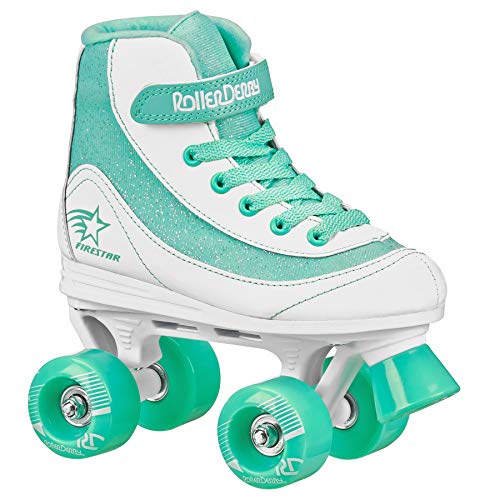
The Firestar is Roller Derby’s youth recreational model, and it is the natural first “serious” skate for a child who has moved past the toddler stage. The listing here is white and mint in youth size 02, with the star graphic the line is known for. Unlike the adjustable kids’ models, this is a fixed-size youth boot built on the same high-top pattern as the adult Roller Star line, which means the geometry and the support philosophy scale down rather than being redesigned.
It suits a child roughly six to twelve who is taking rink lessons, skating with a club, or rolling regularly on a smooth surface and wants a skate that behaves like an adult skate. It also suits a parent who would rather buy one fixed-size pair that fits properly than an adjustable pair that fits approximately.
Key specs
- Boot: high-top youth boot with a padded collar and tongue and a reinforced heel area.
- Closure: full lacing, with the lace path running high enough to lock the ankle.
- Plate: classic double-row plate sized for a youth boot.
- Wheels: urethane in the rink-friendly class, generally in the mid-to-high durometer range and roughly 54–60 mm, tuned for smooth coated floors.
- Bearings: entry to mid class, typically ABEC-5 to ABEC-7.
- Toe stop: adjustable bolt-on.
- Sizing: youth sizing; the listing shown is size 02.
The wheel spec is the defining difference between this skate and the light-up adjustable models. Harder wheels roll faster and grip better on a rink floor, and they do not light up. For a child who is skating on a smooth indoor surface and wants to keep up with a class, that trade is worth making. For a child who skates on a bumpy sidewalk, it is not — hard wheels transmit vibration and feel unstable on rough ground.
Strengths
The Firestar’s biggest advantage is that it is a real skate rather than a toy. The boot is built to the same pattern as Roller Derby’s adult recreational line, so the support, the heel lock and the plate geometry all translate. A child who learns on a Firestar and later moves to a Roller Star 600 will find the transition almost seamless, because the two feel like the same family.
Fixed sizing is also a genuine benefit for a child in the right size window. Adjustable boots achieve their range with a telescoping mechanism that inevitably adds bulk and a little play. A fixed-size boot fits the foot more precisely, which means better control and fewer blisters. The trade-off is obvious: it will be outgrown.
Pros
- Built on the same high-top pattern as adult recreational skates, so support scales properly.
- Rink-friendly wheels roll fast and grip well on smooth indoor floors.
- Fixed youth sizing fits more precisely than an adjustable shell.
- Well-established brand with widely available replacement parts.
- Budget tier pricing despite the brand name.
- Clear upgrade path to the Roller Star 600 as the skater grows.
Cons
- Fixed sizing means it will be outgrown, often within a year or two.
- Harder rink wheels are a poor match for rough outdoor pavement.
- No light-up wheels, which some younger skaters specifically want.
- Youth size range does not cover toddlers or older teens.
- Stock bearings are serviceable rather than smooth.
How it compares
Against the Nattork adjustable kids’ models, the Firestar trades adjustability for a better-fitting, more structured boot and faster wheels. If your child is at a stable size and skating indoors, the Firestar is the better skate. If your child is mid-growth-spurt or skating mostly outdoors, the adjustable Nattork makes more sense. Against the Roller Star 600, the Firestar is the youth-sized sibling — same brand, same geometry, less stiffness and a smaller foot, at a lower tier. A child who outgrows the Firestar in skill rather than in size should move to the Roller Star 600 rather than to another youth model.
6. Nattork Adjustable Checkerboard Skates – Best for Style-Forward Kids and Teens

This Nattork model takes the adjustable platform and pushes it toward older kids and teens who care about how the skate looks. The checkerboard print upper is the visible difference, and the sizing range extends into the teens, which is where most kids’ skates stop. It keeps the adjustable sizing and illuminating wheels of the brand’s kids’ line while adding a boot that reads less like a toy.
It suits a tween or teenager who wants one pair that fits now and still fits after a growth spurt, and who would rather have a printed upper than a plain pastel boot. It also suits a parent buying for a child in the awkward age band where kids’ skates are too small and adult skates are too big.
Key specs
- Boot: adjustable high-top with a checkerboard print upper, reinforced heel area and padded ankle collar.
- Closure: lace plus a securing strap or buckle at the top of the boot.
- Wheels: illuminating polyurethane in the indoor/outdoor class, typically 78A–85A and roughly 60–64 mm.
- Plate: composite double-row plate, sized for the larger end of the youth range.
- Bearings: mid class, generally ABEC-7.
- Toe stop: adjustable bolt-on.
- Sizing: adjustable across a multi-size range intended for kids through teens.
Strengths
The extended size range is the practical reason to buy this over a standard kids’ skate. Teens have adult-sized feet but often want a lighter, less expensive skate than a premium adult model, and this fills that gap. The reinforced heel and padded collar give it more structure than the toddler-tier adjustable skates, which matters as the rider gets heavier and pushes harder.
The illuminating wheels remain a genuine draw at this age, and because they are powered by wheel rotation there is no battery maintenance. The indoor/outdoor wheel class is also well matched to how teenagers actually skate: on streets, in parks, in driveways and occasionally indoors, rather than exclusively on one surface.
Because the wheels, bearings and toe stops are standard sizes, this skate can be tuned. A teen who starts skating more indoors can fit harder, faster wheels; one who skates rough pavement can stay on soft ones or move to a slightly larger diameter for a smoother roll over cracks. That flexibility is what separates a skate that lasts one season from one that lasts four.
Pros
- Adjustable sizing extends into teen foot sizes, filling a gap between kids’ and adult skates.
- Reinforced heel and padded collar give more structure than toddler-tier adjustable models.
- Checkerboard print appeals to older kids who want a less toy-like look.
- Self-powered illuminating wheels need no batteries.
- Indoor/outdoor wheel class matches mixed-surface skating.
- Standard component sizes allow wheel and bearing upgrades.
Cons
- Composite plate still flexes under a heavy or aggressive teen.
- Soft wheels wear quickly on abrasive asphalt.
- Adjustable shell is bulkier and slightly less precise than a fixed-size boot.
- Illuminating hubs add slight rolling resistance.
- Mid-range pricing without the bearing and plate quality of a premium adult skate.
How it compares
Against the Nattork boys’ blue model, this skate is the style-forward option with a wider size range and a more grown-up look; the blue model is the more straightforward choice for a seven-to-ten-year-old who just wants a solid skate. Against the SULIFEEL Rainbow Unicorn, the checkerboard Nattork is the more restrained, teen-appropriate design and generally the more structurally reinforced of the two. Against the adult YYW, this one wins on adjustability and loses on plate stiffness and bearing quality — a teen who has outgrown the size range entirely should be looking at the Roller Star 600 instead.
7. SULIFEEL Rainbow Unicorn Kids Roller Skates – Best Premium Kids Skate
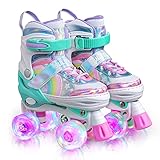
The SULIFEEL Rainbow Unicorn skate is the decorative end of the market, and it is the premium kids’ option here because of what comes with the design: a full light-up wheel set, a padded high-top boot and adjustable sizing, wrapped in rainbow unicorn graphics that are the entire reason many children want it. It is worth being clear about what “premium” means in this context. It means a higher price within the kids’ category, better finishing and a more complete feature set — not adult-level plate stiffness or bearing quality.
It suits a child who has asked for a specific look and who will skate more enthusiastically because of it, and it suits a family willing to pay a bit more for a skate that a child will actually want to put on. That motivation effect is real and worth weighing: the best skate is the one that gets used.
Key specs
- Boot: padded high-top with rainbow unicorn graphics and a soft, comfortable collar.
- Wheels: full light-up set, polyurethane in the soft indoor/outdoor class, typically 78A–85A and roughly 60 mm.
- Bearings: mid class, generally ABEC-7.
- Plate: composite double-row plate.
- Closure: lace plus strap or buckle, sized for kids’ hands.
- Sizing: adjustable across a multi-size range.
- Lighting: rotation-powered LEDs in all four wheels; no batteries.
Strengths
The obvious strength is that children want to wear it, and in a hobby where most beginners quit within a few months, that is not a trivial advantage. The full light-up wheel set is more visually complete than models that light only the rear wheels, and it is powered entirely by rolling, so there is nothing to charge.
Beyond the styling, the boot is well padded and the closure is straightforward for small hands, and the adjustable sizing keeps it usable across growth spurts. The soft wheel class means it handles driveways and sidewalks without the harshness of a rink wheel, and the ABEC-7 bearings roll smoothly for a light rider.
The main thing to plan for is wheel wear. Soft light-up wheels on abrasive asphalt will develop flat spots, and because the LED generator sits inside the hub, replacement wheels need to be the same type if you want to keep the lighting. Budget for a replacement set in the same class within a year or two of heavy outdoor use. If the skate is used mostly indoors on smooth floors, the wheels will last far longer.
Pros
- Full four-wheel light-up set with no batteries to replace.
- Strong visual appeal that keeps kids motivated to skate.
- Padded high-top boot with a comfortable collar.
- Adjustable sizing across several sizes.
- ABEC-7 class bearings roll smoothly for a light rider.
- Soft indoor/outdoor wheels handle driveways and sidewalks comfortably.
Cons
- Premium tier pricing within the kids’ category.
- Decorative focus means less emphasis on plate stiffness and support.
- Soft light-up wheels wear faster than plain wheels on rough surfaces.
- Replacement wheels need to be the light-up type to preserve the effect.
- Size range is for children, not teens or adults.
How it compares
Against the Nattork checkerboard model, the SULIFEEL is the more decorative and the Nattork is the more structurally reinforced and more teen-appropriate. For a child under ten who is drawn to the unicorn design, the SULIFEEL’s motivational value is worth the premium. For a tween or teen, the Nattork’s wider size range and more restrained look make more sense. Against the Nattork Kids adjustable skate, the SULIFEEL is the styling upgrade and the Nattork is the value pick — mechanically they are close, and the decision comes down to how much the design matters to the child who will wear them.
8. Nattork Kids Roller Skates for Boys (Blue) – Best for Big Kids Ages 7-10

This is the Nattork adjustable platform sized and styled for older children — the listing describes it as blue, for big kids roughly ages seven to ten, with all light-up wheels and an indoor/outdoor build. It is the practical middle of the roundup: more structured than a toddler skate, more adjustable than a fixed youth boot, and priced below the premium kids’ options.
It suits a seven-to-ten-year-old who is skating regularly on the street, in the driveway or at a park, and who needs a boot that will take more weight and more force than the toddler-tier models are built for. It also suits a family with two children close in age, since the adjustable sizing can be shared and passed down.
Key specs
- Boot: reinforced adjustable high-top sized for older children, with a padded collar and tongue.
- Closure: buckle or strap plus laces for a secure fit at speed.
- Wheels: all light-up polyurethane in the indoor/outdoor class, typically 78A–85A and around 60–64 mm.
- Plate: composite double-row plate.
- Bearings: mid class, typically ABEC-7.
- Toe stop: adjustable bolt-on.
- Sizing: adjustable across multiple sizes; listed as suited to roughly ages 7–10.
Strengths
The key advantage over the smaller Nattork kids’ model is structure. An older child weighs more, pushes harder and falls harder, and a reinforced boot with a firm collar handles that better than a soft toddler skate. The adjustable sizing still delivers the family-friendly benefit of not having to rebuy every year, and the all-wheel lighting keeps the motivational factor that gets kids out the door.
The indoor/outdoor wheel class is well matched to how big kids skate. They are rarely on a single surface: a driveway, then a sidewalk, then a smooth court. A soft-to-medium wheel in the 78A–85A range handles all three without the harshness of a hard rink wheel on pavement. The trade-off is rolling speed on smooth floors, where a harder wheel would be faster.
Because the components are standard, this skate can grow with the rider’s ambitions. Softer or harder wheels can be fitted depending on the surface, bearings can be upgraded for smoothness, and the toe stop can be replaced when it wears down — which it will, since toe stops are a consumable on any quad skate and are meant to be replaced.
Pros
- Reinforced boot sized for older, heavier children than toddler-tier skates.
- Adjustable sizing covers multiple sizes across growth spurts.
- All-wheel light-up design with no batteries to replace.
- Indoor/outdoor wheels work on driveways, sidewalks and courts.
- Mid-range tier pricing without the decorative premium.
- Standard wheel, bearing and toe-stop sizes allow upgrades and repairs.
Cons
- Composite plate still flexes for a heavy or aggressive older child.
- Soft wheels wear faster on rough asphalt than harder compounds.
- Illuminating hubs add slight rolling resistance for a child chasing speed.
- Age-based sizing guidance is less precise than a measured foot length.
- Not stiff enough for competitive or artistic skating.
How it compares
Against the Nattork Kids girls’ adjustable model, this is the same platform aimed at a different age and style — the boys’ version has more structure for the older rider, while the girls’ version covers the younger end of the range. Against the Roller Derby Firestar, the Firestar has the better-fitting fixed boot and faster rink wheels but no adjustability; this Nattork is the better choice for a child still growing or skating outdoors. Against the SULIFEEL Rainbow Unicorn, this is the more restrained, slightly cheaper option with a comparable feature set. A child who has outgrown this size range entirely should move to the adult YYW or Roller Star 600.
How to Choose
Three specifications decide whether a pair of roller skates will feel good: how much support the boot provides, how hard the wheels are, and whether the sizing actually fits the foot. Everything else — color, lighting, brand — is secondary. The sections below walk through each one with the numbers that matter.
Boot support: height, heel counter and closure
Boot height is the first decision. A high-top boot rises above the ankle bone and supports the joint, which is why nearly every beginner skate uses one. A low-top boot gives more ankle freedom and is preferred by experienced artistic and speed skaters who want to point and flex their ankle, but it demands more ankle strength and better technique. If you are learning, buy a high-top.
Inside the boot, the heel counter is the feature that separates a good skate from an adequate one. The heel counter is the stiffened panel around the back of the heel. If it is soft, your heel lifts every time you push, and you lose both power and control. A firm heel counter plus a properly laced boot holds the heel down, and that single factor accounts for a large share of how responsive a skate feels. When you try a skate on, lace it up and press down on your toes; if your heel slides up more than a few millimeters, the boot does not fit regardless of the size label.
Closure systems matter more than beginners expect. Laces alone can be adequate, but a strap or buckle across the top of the boot lets you tighten the ankle independently of the laces, which is how you lock the heel down. The three-point system — laces plus a mid strap plus a top buckle or cam lever — is the most adjustable and is worth having. It also makes the skate easier for a child to put on alone.
The plate is the frame the wheels bolt to. Composite plates made of nylon or fiberglass-reinforced plastic are light, inexpensive and forgiving, and they are fine for beginners and children. They flex, which absorbs some of your push. Metal plates — usually aluminum — are stiffer, transfer power more directly and last longer, but they cost more and add weight. A child under about 100 pounds will not notice the difference. A 180-pound adult skating weekly will.
Wheel hardness: the single most misunderstood spec
Wheel hardness is measured on the durometer scale, written as a number followed by “A.” Lower numbers are softer. Most skate wheels fall between 74A and 101A. The number on the wheel is the spec that determines whether you feel planted or skittering, and it has nothing to do with quality — a hard wheel is not better than a soft one, it is just suited to a different surface.
| Durometer | H
|---|