What's inside
As an Amazon Associate I earn from qualifying purchases. This post may contain affiliate links at no extra cost to you.
Moving a heavy miter saw between remodel sites puts a different burden on a stand than setting one up in a home shop. You need to lift the saw and stand into a vehicle, get through doors and rough ground, then make stable cuts without spending half the morning on setup. The best choice depends on the saw’s weight, how often you move it, and whether you work alone.
As an Amazon Associate we earn from qualifying purchases at no extra cost to you.


Our Top Picks
 POWERTEC Portable Miter Saw Stand w/ Quick-release Mounting1PK49 x 16.25 x 8.25 inchesCheck on Amazon


What matters most when moving a heavy saw
Check the combined load, not just the stand’s advertised capacity. A 60-pound saw on a 40-pound stand is already a 100-pound package before you add extension supports or accessories. Capacity ratings vary by manufacturer, and they do not tell you how easy that load is to carry or how steady the stand feels on uneven flooring.
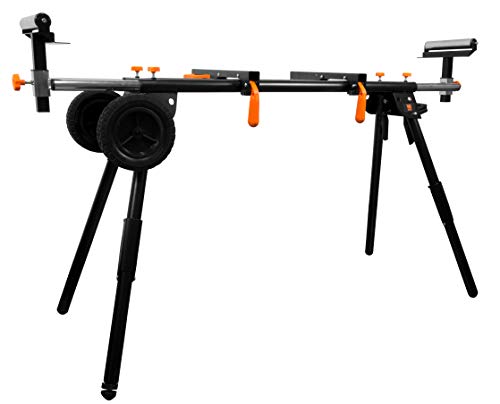
For frequent moves, prioritize wheels, a manageable folded shape, and a secure saw mount. A wheeled stand lets you roll the saw across a slab or driveway, but stairs, gravel, and narrow hallways still require lifting. A wide stance and solid legs matter once the saw is set up, especially when cutting long stock. Stand-mounted extension arms should support the work without forcing it upward or letting it sag.
Also check how the saw attaches. Universal brackets can make one stand work with different saws, but they take time to position and may not suit every base. If the saw stays mounted, confirm that the folded stand clears the saw and that the package fits your vehicle. Never assume a “portable” stand will fit through a van door with the saw attached.
Stand types compared
| Stand type | Best fit | Trade-off for heavy saws |
|---|---|---|
| Rolling, gravity-rise style | Frequent site moves and one-person setup | Convenient to roll, but bulky and still awkward over stairs or rough ground |
| Folding leg stand | Occasional moves, tight storage, or a lower budget | Usually lighter and simpler, but carrying the saw and stand together can be difficult |
| Fixed or shop-style stand | A dedicated work area | Stable and often inexpensive, but poor for hauling between sites |
A rolling gravity-rise miter saw stand is the practical starting point for a contractor who moves a heavy saw most days. The wheels reduce carrying on flat ground, and a folding mechanism can make setup faster than assembling separate legs. The trade-off is extra weight and bulk. Wheels do not turn a loaded stand into a stair-climbing cart.
Rolling stands: convenience with limits
Rolling stands make sense when the route from vehicle to cut area is mostly level. Their handles and wheels let you move the mounted saw like a cart, and many designs raise or fold with the saw attached. That can save repeated mounting and alignment work. But the whole unit may be too tall or wide for a crowded van, and a heavy saw mounted high can feel top-heavy while being moved.
Before buying, look at wheel size and placement, the folded footprint, and whether the stand can be lifted safely by one person. Small wheels can struggle in gravel, extension cords, and debris. A stand that rolls well across a shop floor may still bog down on a muddy access path. If you routinely work on rough sites, plan to carry the saw separately or use a cart designed for that terrain rather than forcing the stand over obstacles.
For long trim or framing stock, check the support span and the adjustment method. Supports that are difficult to level slow down repetitive cuts; supports that flex or sit too low can let stock tip at the cut. Avoid using stand extensions as a substitute for a helper when handling very long or heavy material.
When a simpler folding stand is enough
A folding-leg stand is a reasonable choice if you move the saw only occasionally, have help loading it, or transport the saw separately. It can cost less, weigh less, and fit into vehicles that cannot take a rolling stand. The savings are real, but so is the extra handling: you may need to carry the saw, carry the stand, set up the legs, and attach the mounting brackets at every site.
Choose this style only after checking that the legs lock positively and the stand does not rock on a flat floor. A low-cost stand can be perfectly adequate for a lighter saw and occasional use; it is a poor bargain if the saw’s weight makes every move awkward or if loose brackets add setup time. Search for a folding-leg stand with compatible mounting brackets if portability and storage matter more than rolling convenience.
Fit, loading, and safe setup
Measure the saw’s base and the stand’s mounting range before ordering. “Universal” does not guarantee a clean fit. Confirm that the brackets can reach the saw’s mounting holes, that all fasteners can be installed, and that the saw’s motor or rails will not hit the stand when the head is lowered or the saw is folded. Keep the manual’s load limit in mind, including material resting on the extensions.
For a heavy saw, get a second person to help mount it unless the manufacturer provides a safe one-person procedure. Lock the stand before fitting the saw, use the specified fasteners, and test the saw’s balance before cutting. On site, set the feet on firm ground, lock the wheels, and keep the workpiece supported at the same height as the table. If the stand rocks, shifts, or tips when you apply normal cutting pressure, stop and reposition it; do not try to fix instability by clamping the stand to an unsuitable surface.
Make the choice around your route
Buy a rolling stand if the saw stays mounted, site moves are frequent, and most of the route is smooth enough to roll. Choose a folding-leg stand if moves are infrequent, lifting help is available, and compact storage matters more than setup speed. For a permanent shop, a fixed stand may be the cheaper and steadier answer.
Before committing, compare the stand’s folded dimensions with your vehicle opening and the saw’s mounted weight with the stand’s rating. Those two checks catch the most common mismatch: a stand that supports the saw but is too cumbersome to transport, or one that travels easily but does not provide stable support for the work.