What's inside
As an Amazon Associate I earn from qualifying purchases. This post may contain affiliate links at no extra cost to you.
Our Top Picks
 POWERTEC Portable Miter Saw Stand w/ Quick-release Mounting1PK49 x 16.25 x 8.25 inchesCheck on Amazon


What matters on residential jobs
A miter saw stand for residential work has to do more than hold a saw in the shop. It needs to fit in a vehicle, move across driveways and thresholds, set up without a long wrestling match, and support trim or framing stock steadily. Those demands favor a wheeled stand with folding legs and adjustable material supports—but wheels alone do not make a stand easy to transport. Weight, folded dimensions, loading height, and how the saw attaches matter just as much.
Before buying, measure the narrowest route from your vehicle to the work area and the space available in the vehicle. A stand that rolls well on a flat garage floor may be awkward over gravel, steps, or a raised entry. Also check the saw’s mounting pattern and weight against the stand’s stated compatibility. Universal brackets are useful, but “universal” does not mean every saw bolts on without adjustment.
As an Amazon Associate we earn from qualifying purchases at no extra cost to you.


Stand types compared
| Stand type | Best fit | Typical trade-off |
|---|---|---|
| Folding gravity-rise style | Frequent moves between sites; saw can remain mounted | Bulkier and often heavier than a simple stand |
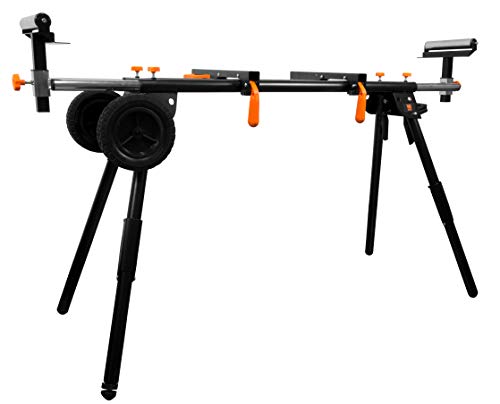
| Rolling stand with folding legs | One-person transport over reasonably smooth paths | Small wheels can bog down in gravel or mud |
| Portable stand with removable saw brackets | Shared stand, storage constraints, or multiple saws | More setup and a separate saw-and-bracket load |
| Basic folding leg stand | Infrequent moves or a tight budget | Usually must be carried; less convenient for repeated relocation |
For most crews moving between occupied homes, a rolling stand is the practical starting point. A rolling miter saw stand saves repeated lifting when the route is level and clear. If the path includes several steps, though, wheels may add bulk without eliminating the need to carry the setup.
Weight and transport
Compare the stand’s weight with the saw attached, not just the stand alone. A heavy stand may feel stable at the cut but be a poor choice if you need to lift it into a van or carry it through a house. Check the manufacturer’s listed capacity and distinguish the saw limit from the material-support limit; they are not necessarily the same rating.
Pay attention to folded length and the position of the wheels. Long rails can catch on door jambs, while a folded stand that tips easily can be annoying to load. If you work alone, look for a design that lets the saw stay mounted during folding and rolling. If you remove the saw each day, make sure the brackets lock securely and can be released without tools you’re likely to misplace.
For stairs or rough ground, a lighter folding stand can be the better buy even if it takes longer to set up. A folding miter saw stand is often enough for a homeowner or a crew that only relocates the saw occasionally. The trade-off is straightforward: you carry more and may spend extra time aligning supports, but avoid hauling an oversized wheeled frame.
Support and cutting stability
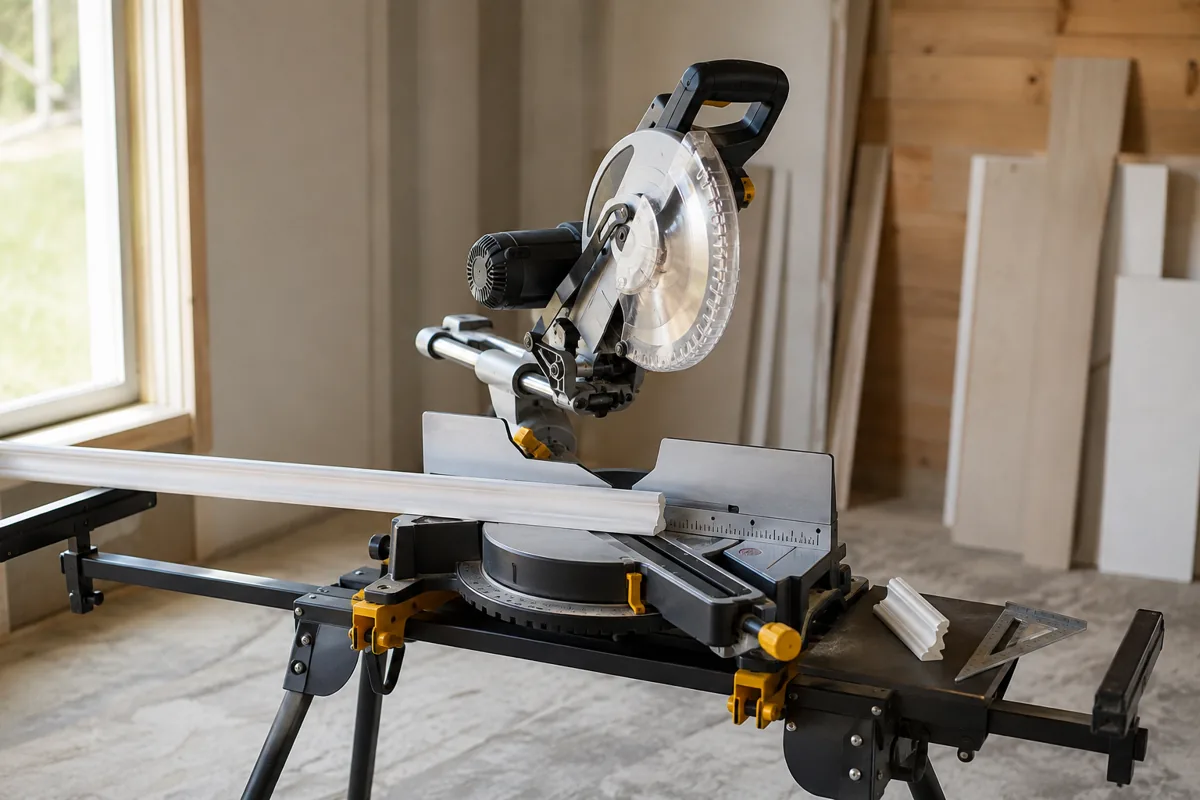
For baseboard, casing, and other long trim, adjustable end supports help keep stock level with the saw table. Check the adjustment range and how the support locks. A support that slips under a long board can change the cut angle or lift the workpiece. Rollers are handy for feeding stock through, but a flat support is often easier to control when making repeated stops or handling narrow trim.
Stand width and leg bracing affect how much the frame rocks on uneven floors. No portable stand should be treated as a bench vise: clamp the workpiece when the cut requires it, and do not lean heavily on an extended rail. Before cutting, confirm the legs are fully locked, the saw is secure, and the material supports are level with the saw bed. A stand that feels steady empty can flex when a long board is loaded at one end.
Extension capacity matters only if it suits the stock you actually cut. Longer supports help with door casing and framing lumber, but add folded length and can be vulnerable to knocks. If you mostly cut short trim pieces, paying extra for very long extensions may buy little practical value.
When a cheaper stand is enough
A basic folding stand is reasonable if the saw stays in one place most of the week, you have a helper for loading, or your vehicle has limited space. It can also make sense for occasional home projects where the stand will be moved from garage to driveway rather than between several addresses each day. The main cost is time and lifting, not necessarily cut quality.
Choose a more capable rolling stand when setup and breakdown happen repeatedly and the route is suitable for wheels. A wheeled miter saw stand with material supports is a sensible category to compare for that use. Avoid choosing by the number of accessories alone: extension arms that are awkward to lock or a stand that barely fits through a doorway can be less useful than a simpler, lighter frame.
A practical buying checklist
Before ordering, verify four things: the stand accepts your saw’s mounting layout; its rated capacity exceeds the saw and expected load; its folded dimensions fit your vehicle; and its wheels suit the surfaces you cross. If possible, check whether replacement mounting brackets are available, especially if you plan to use more than one saw.
At the first setup, test the stand unloaded and then with a long board on each side. Lock every leg and extension, check for rocking, and make a sample cut before relying on the setup for finish work. If a support arm sags, the frame shifts, or the stand cannot be rolled safely with the saw mounted, stop and adjust the setup rather than compensating by holding the material up by hand. The best stand for moving between residential sites is the one you can transport safely and set up consistently—not necessarily the heaviest or most feature-packed option.